Why are you still sending your hard-earned solar energy back to the grid for a measly 6 cents while your evening power bills continue to rise? It is a common frustration for many of us here in Townsville, especially as the regional feed-in tariff has dipped to just 6.006 cents per kWh for the 2026 financial year. Investing in solar battery storage is no longer just a luxury for the tech-savvy; it has become a practical necessity for families wanting to reclaim their energy independence and protect themselves from rising costs.
We understand that technical jargon and changing regulations can feel overwhelming. That is why we have put together this clear, local guide to help you make an informed decision for your home. You will discover exactly how these systems work, how the 2026 federal rebate can slash your upfront costs by roughly 30 per cent, and why now is the perfect time to secure a reliable backup power supply. From managing peak-rate charges to keeping the lights on during the next big North Queensland storm, we are here to ensure your home stays powered and your peace of mind remains intact.
Key Takeaways
- Learn how the 2026 Federal Rebate makes solar battery storage more affordable than ever by significantly reducing your initial investment.
- Discover why calculating your specific “night-time base load” is the secret to choosing a battery size that pays for itself as quickly as possible.
- Understand the technical journey of energy from your roof to your appliances and how the right inverter keeps your home running smoothly.
- Find out why local Townsville expertise is vital for positioning your equipment to withstand our unique tropical heat and humidity.
- Get a clear breakdown of the 2026 “solar soaker” strategy to help you retain more value from every kilowatt your panels produce.
Solar Battery Storage: Why it’s trending in Townsville
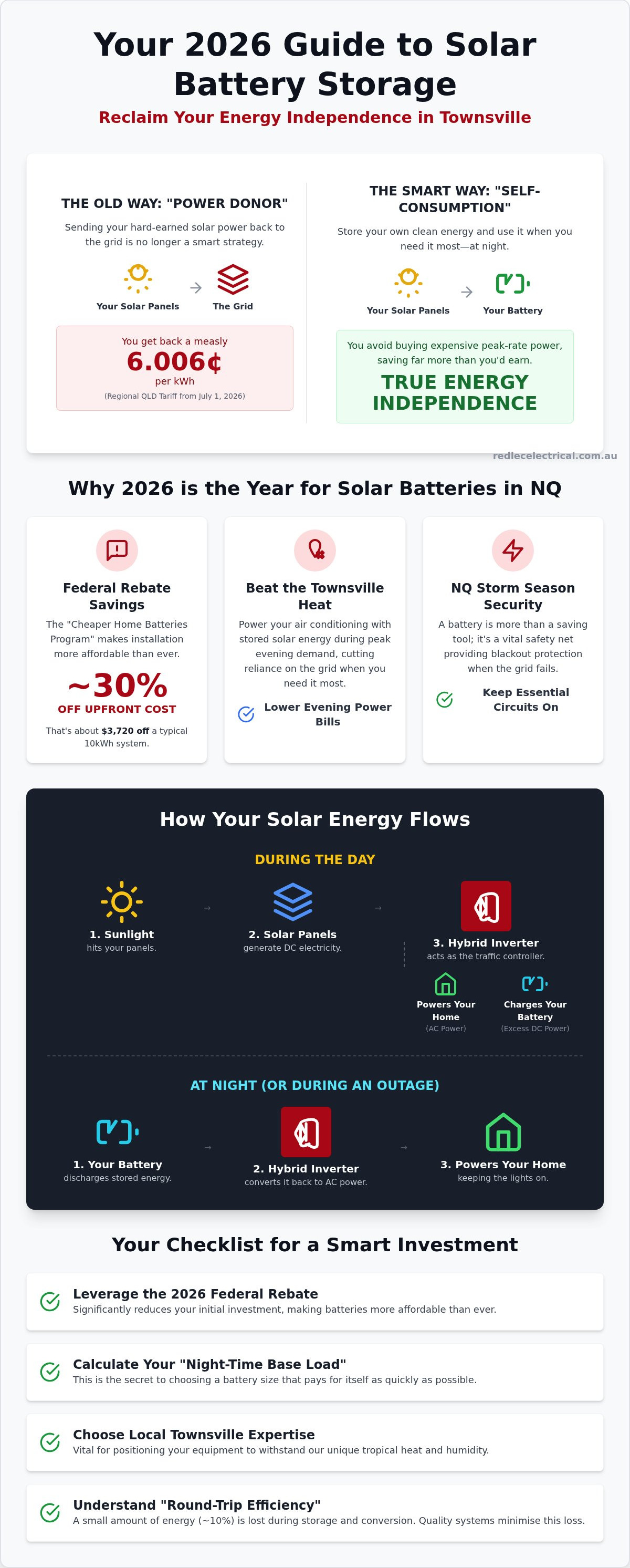
Simply put, solar battery storage is the process of capturing the excess electricity your solar panels produce during the day and saving it in a dedicated unit. Instead of letting that clean energy flow back into the grid for a small credit, you keep it for yourself. It is a way to stop being a “power donor” and start using your own generation when the sun goes down. By holding onto your power, you take control of your home’s energy cycle rather than remaining at the mercy of the grid.
2026 has become a major turning point for homeowners in North Queensland. The federal government’s “Cheaper Home Batteries Program” is now in full swing, offering a rebate that covers approximately 30 per cent of the upfront cost for eligible systems. For a typical 10kWh unit, this means a discount of about $3,720. When you combine this significant saving with the fact that battery hardware costs have stabilised, the financial argument for solar battery storage has never been stronger for the average household.
Living in Townsville presents unique energy challenges. Our tropical climate means air conditioning is often a necessity, not a choice. Most families find their highest energy demand occurs in the late afternoon and evening, precisely when solar panels stop producing. A battery bridges this gap by powering your cooling systems with stored sunshine. This shift reduces your reliance on Ergon Energy and protects your household budget from future price hikes on the national grid.
The end of low feed-in tariffs
For a long time, the standard advice was to export as much solar power as possible to earn credits. That strategy is no longer effective. From July 1, 2026, the regional Queensland solar feed-in tariff is set at just 6.006 cents per kWh. This is a sharp decline from previous years. When you consider the cost of buying that same electricity back from the grid at night, “self-consumption” is clearly the best path forward for a better return on investment.
The goal is now to store every possible kilowatt. Understanding how battery storage systems work helps you see the value in keeping your energy behind the meter. By storing your power, you avoid buying expensive peak-rate electricity. This is far more valuable than the few cents you receive for exporting it, making your solar system work harder for you.
Peace of mind during the NQ storm season
We all know the feeling of watching a summer storm roll in over the Coral Sea. Power outages are a common part of life in Townsville during the wet season. In 2026, local families are increasingly viewing batteries as more than just a savings tool; they are a vital safety net. Blackout protection is a critical safety feature for NQ homes that allows your battery to provide emergency power to essential circuits when the main grid fails. It means your fridge stays cold, your lights stay on, and your fans keep spinning during a blackout. This level of reliability provides a sense of security that a standard solar-only system simply cannot match.
How solar battery storage systems work: A beginner’s guide
Understanding how your home uses energy starts with the journey of a single photon. When sunlight hits your solar panels, it creates Direct Current (DC) electricity. In a standard setup without a battery, any power you don’t use immediately is sent to the grid. With solar battery storage, that excess energy is diverted into chemical storage cells, waiting for the moment your household needs it most. It is a simple concept that relies on sophisticated technology to keep your home running smoothly.
The inverter acts as the traffic controller for this entire process. Since your fridge, television, and air conditioner run on Alternating Current (AC), the inverter must convert the DC power from your panels or battery into a usable form. Modern “hybrid” inverters manage this two-way flow automatically. Smart monitoring software serves as the system’s brain, constantly checking your energy production against your consumption. It decides whether to charge the battery, power your appliances, or, as a last resort, draw from the grid.
It is worth noting that no energy system is 100 per cent efficient. This is known as “Round-Trip Efficiency.” A small amount of energy, usually around 10 per cent, is lost as heat during the conversion and storage process. High-quality systems installed by a professional team ensure these losses are kept to a minimum, giving you the best possible value from every kilowatt generated on your roof.
AC vs. DC coupling: Which one do you need?
There are two main ways to connect a battery to your home. DC coupling is often the best choice for brand-new solar installations because it is more efficient, requiring fewer energy conversions. However, for many Townsville high-set homes that already have solar panels, AC coupling is the preferred method. This allows us to retrofit a battery to your existing system without needing to replace your current inverter. If you are unsure which setup suits your property, our team can help with solar repairs and system assessments to find the right fit.
Battery chemistry: Why Lithium Iron Phosphate (LFP) wins in 2026
In the heat of North Queensland, the chemistry inside your battery matters. In 2026, Lithium Iron Phosphate (LFP) has become the gold standard for residential safety and longevity. Unlike older battery types, LFP is remarkably stable and has a much lower risk of overheating, which is vital during our humid summer months. These batteries also offer a superior “cycle life,” meaning they can be charged and discharged thousands of times over a 10-year period without significant degradation. This durability ensures your investment continues to perform long after the initial installation.
Calculating the ROI: Is solar battery storage worth it in 2026?
Determining if solar battery storage is a sound investment requires looking beyond the sticker price. In 2026, the financial math has shifted significantly for North Queenslanders. With Ergon Energy’s regional feed-in tariff sitting at just 6.006 cents per kWh, sending power to the grid is no longer a profitable strategy. Instead, the real value lies in “avoided cost”—the money you do not spend on expensive grid power during the night. Most Townsville households now see a payback period of roughly eight years, though this can be shorter if you join a Virtual Power Plant (VPP). VPPs allow you to share your stored power with the grid during times of extreme demand in exchange for financial credits, effectively turning your home into a mini power station that earns you money.
To protect this return on investment, regular maintenance is essential. Factoring in professional solar repairs townsville ensures your system operates at peak efficiency for its full 10 to 15-year lifespan. A small fault in an older panel or a dusty inverter can significantly hamper your battery’s ability to charge, dragging out your payback period and reducing your overall savings. Our local team focuses on keeping these systems running perfectly so you get every cent of value out of your investment.
Maximising savings with peak-rate shifting
Ergon Energy typically applies peak electricity rates during the evening when families are home and demand is highest. By using your battery to “peak-lop,” you can run your home entirely on stored energy during these hours. A well-configured 10kWh battery system can comfortably supply the 2 to 4 kilowatts of power required for lighting, cooking, and entertainment during the standard four-hour evening peak, effectively zeroing out your most expensive daily electricity charges. This strategy keeps your money in your pocket rather than handing it over to the utility provider.
The impact of the 2026 Federal Battery Rebate
The “Cheaper Home Batteries Program” has drastically lowered the barrier to entry this year. This expansion of the Small-scale Renewable Energy Scheme (SRES) provides a direct discount of approximately 30 per cent at the point of sale. To be eligible, your system must be between 5kWh and 100kWh and installed by a Clean Energy Council (CEC) accredited professional. This ensures the installation meets strict Australian safety standards and qualifies for the rebate. Before you book an installation, check our solar power systems checklist to see if your roof and existing electrical switchboard are ready for an upgrade.
Practical guidance: Choosing the right size and type
Selecting the correct capacity for your solar battery storage is a balancing act. Bigger is not always better. If you install a massive 20kWh battery but your household only consumes 7kWh during the evening, you are paying for storage capacity that will never provide a return. Conversely, a battery that is too small will leave you drawing expensive power from the grid by 9:00 pm. The goal is to find the “sweet spot” where your battery covers your evening usage with a small buffer for cloudy days.
To find this sweet spot, you must calculate your “Night-time Base Load.” This is simply the amount of electricity your home uses from the moment the sun sets until it rises again. You can estimate this by looking at your smart meter data or recording your meter readings over a few nights. Don’t forget to account for seasonal changes. Your summer base load in Townsville will be significantly higher due to air conditioning than your usage in the milder winter months.
You also need to choose between modular and all-in-one systems. All-in-one units are sleek and contain the battery and inverter in a single housing. Modular systems are like building blocks; they allow you to start with a smaller capacity and add more battery modules later if your family grows or you buy an electric vehicle. For most North Queensland properties, we recommend a shaded, well-ventilated outdoor location. While many batteries are rated for outdoor use, keeping them out of the direct afternoon sun is vital for maintaining their lifespan and efficiency. If you’re ready to find the perfect fit for your home, discuss your battery options with our expert team today.
Matching battery size to your solar array
Your solar panels and battery need to work in harmony. This is often called the “Golden Ratio.” To ensure your solar battery storage reaches 100 per cent charge most days, you typically need a solar array that is at least 1.5 to 2 times the size of your battery capacity. During the tropical wet season, shorter days and heavy cloud cover can make it difficult to reach a full charge. Having a slightly larger panel array ensures you still capture enough energy to keep the lights on when the weather turns grey. You can consult our solar battery installation guide for specific sizing charts tailored to local conditions.
Essential features for 2026
Technology has moved quickly. In 2026, we recommend looking for “blackstart” capability. This feature allows your system to reboot itself using solar power if the battery ever drains completely during a prolonged grid outage. Without it, you might be stuck waiting for the grid to return before your solar can kick back in. Most modern systems also include mobile app integration, letting you check your state of charge from your phone while you’re at work. Finally, always verify the warranty terms. A quality 10-year Australian warranty should cover both the hardware and the labour, providing the long-term security you expect from a local investment.
The Redlec approach: Solar battery storage for the Townsville climate
When it involves installing solar battery storage in North Queensland, local knowledge isn’t just a bonus; it’s a requirement. We live and work in the same relentless heat that you do, so we know exactly what a 35-degree day with 90 per cent humidity does to electrical components. Many national providers use a “one size fits all” approach that works in Melbourne or Sydney but fails under the tropical sun. We take a different path, focusing on durability and long-term performance in our specific environment.
Strategic mounting is the first priority for any Redlec installation. We never simply bolt a battery to the first available wall. We look for southern or eastern aspects to keep your unit out of the punishing afternoon sun. If a shaded spot isn’t naturally available, we discuss the best ways to provide artificial shade or housing. Keeping the battery cool is the most effective way to prevent “thermal throttling,” which is when a system slows down its charging or discharging to protect itself from overheating.
Proper ventilation and airflow are equally critical. A battery that can’t breathe is a battery that won’t last its full ten-year warranty period. We ensure every installation has the required clearance to allow heat to dissipate naturally. By choosing a local electrical company that understands these nuances, you aren’t just getting a product; you’re getting a system designed to survive a Townsville summer. We take personal pride in every job because we are part of this community, and we want your investment to deliver results for years to come.
Installation standards for the tropics
Living near the coast means dealing with salt air, which can be incredibly corrosive to standard electrical fixings. We use high-quality, corrosion-resistant hardware and sealants to ensure your mounting brackets and conduit stays secure against the elements. We also prioritise switchboard readiness. Before we even touch a battery, we check if your current setup can handle the new load. A switchboard upgrade is often the necessary first step for older Townsville high-set homes to ensure everything is safe, compliant, and ready for modern energy demands.
Matt’s personal guarantee is at the heart of everything we do. We don’t believe in aggressive sales tactics or complicated jargon. Instead, we offer the kind of professional reliability and “trusted neighbour” service you expect from a local tradie. We show up when we say we will, we clean up after ourselves, and we ensure you are completely comfortable operating your new system before we leave the site.
Your next steps toward energy independence
The path to lower power bills starts with a clear understanding of your current setup. We recommend booking a local site assessment where we can check your existing solar health and determine if your panels are producing enough excess energy to fill a battery. We also take the stress out of the financial side by handling all the complex rebate paperwork for the “Cheaper Home Batteries Program” on your behalf. You get the discount without the headache of government forms. Contact Redlec today for a no-obligation energy audit and let’s see how much you could be saving.
Secure Your Townsville Home’s Energy Future
Investing in solar battery storage is about more than just numbers; it is about taking control of your home’s comfort and security. By taking advantage of the 2026 federal rebate and shifting your usage to avoid peak-rate charges, you can finally make your panels work as hard as they should. You also gain the invaluable benefit of blackout protection, ensuring your family stays cool and connected when our unpredictable storm season hits. It’s a practical way to turn a high-demand household into a self-sufficient one.
As a Townsville-owned and operated business, we pride ourselves on being expert solar battery installation specialists who understand the local climate. We don’t just install a system and disappear; we are here for the long haul with 24/7 emergency support for NQ families. Our goal is to provide the peace of mind that comes from knowing your energy needs are in safe, local hands. We look forward to helping you navigate the technical choices to find a solution that fits your lifestyle perfectly.
Get a custom solar battery quote for your Townsville home from Matt and the Redlec team. Let’s work together to build a more independent and resilient home for your family.
Frequently Asked Questions
Is solar battery storage worth it in Townsville in 2026?
Yes, solar battery storage is a smart investment in 2026 because the regional feed-in tariff has dropped to just 6.006 cents per kWh. You save significantly more by using your own stored power at night than by selling it back to Ergon for a small credit. With the federal rebate covering nearly a third of the cost, the payback period is shorter than ever for most Townsville households.
Can I add a battery to my existing solar power system?
You can definitely add a battery to an existing solar power system. This is usually achieved through AC coupling, which allows the new battery to work perfectly with your current panels and inverter setup. It is a straightforward way to upgrade your home’s energy independence without needing to pull apart or replace your entire existing solar array, saving you both time and installation costs.
How long do solar batteries last in the North Queensland heat?
Most modern solar batteries are designed to last between 10 and 15 years, even in our intense North Queensland heat. Using Lithium Iron Phosphate (LFP) chemistry is key because it handles high temperatures much better than other battery types. We always ensure strategic mounting in shaded, well-ventilated areas to protect the unit from thermal stress and maintain its full capacity for as long as possible.
What happens to my solar battery during a power outage?
During a power outage, your battery will provide blackout protection to keep your essential appliances running if your system is configured for backup. This means your fridge stays cold and your lights stay on while the rest of the street is in the dark. It is a vital feature for peace of mind during the cyclone and storm seasons that we experience every year in Townsville.
Do I need a special inverter for solar battery storage?
You do need a specific type of inverter to manage solar battery storage effectively. This is either a hybrid inverter that handles both panels and storage or a dedicated battery inverter added to your existing setup. These smart devices control the flow of electricity to ensure your home uses the cheapest power source available at any given time, whether that is your panels, battery, or the grid.
How much does the average solar battery installation cost in 2026?
The total cost of an installation depends on the capacity of the unit you choose and whether your switchboard needs an upgrade to handle the new technology. While prices vary based on your home’s specific needs, the federal rebate now covers roughly 30 per cent of the upfront investment. This significant discount makes the transition to energy storage much more affordable for local homeowners looking to slash their bills.
Will a solar battery allow me to go completely off-grid in Townsville?
While it is technically possible to go off-grid, most Townsville families find it more practical and cost-effective to stay connected. Staying on the grid allows you to draw power during rare periods of extended tropical rain or heavy cloud cover. A battery gives you the best of both worlds: energy independence for most of the year with the security of the grid as a safety net.
What is the 2026 federal rebate for solar batteries?
The 2026 federal rebate is part of the “Cheaper Home Batteries Program,” which provides a discount of approximately 30 per cent at the point of sale. To be eligible, your battery must have a usable capacity between 5kWh and 100kWh and be installed by an accredited professional. This program has made high-quality storage much more accessible for families wanting to protect themselves from rising electricity costs.