Is your Townsville solar system actually working for you, or is it mostly just feeding the grid for a measly 6.006 cents per kilowatt-hour? With Ergon Energy feed-in tariffs sitting at record lows in 2026, watching your excess power disappear into the network for a tiny credit feels like a missed opportunity. It’s frustrating to pay full price for electricity the moment the sun sets, especially when you know your roof produced more than enough during the day to cover your evening air conditioning.
If you’re ready to stop relying on the grid, the best move is to add battery to existing solar system townsville installations. We understand the hesitation; you want to ensure your current panels are compatible and that you aren’t being sold a “one size fits all” solution that can’t handle the North Queensland heat. This guide provides the exact steps to retrofit storage to your current configuration, ensuring you can use your own power when you need it most. We’ll preview the latest federal rebates available as of May 2026, the technical reality of AC coupling, and how to navigate the process without falling for the empty promises of “solar cowboys” who don’t understand our tropical conditions.
Key Takeaways
- Maximise your financial returns by timing your installation to take advantage of the 2026 federal “Cheaper Home Batteries” rebate program.
- Learn why AC coupling is the most cost-effective way to add battery to existing solar system townsville homes without the need to replace your current solar inverter.
- Determine the right battery capacity for your household by calculating evening “peak loads,” ensuring you have enough power for air conditioning during humid NQ nights.
- Understand the essential safety requirements for a successful retrofit, including the role of professional switchboard assessments and solar health checks.
- Discover how to select battery storage technology specifically engineered to maintain performance in Townsville’s harsh tropical heat.
Why Add Battery Storage to Your Townsville Solar System Now?
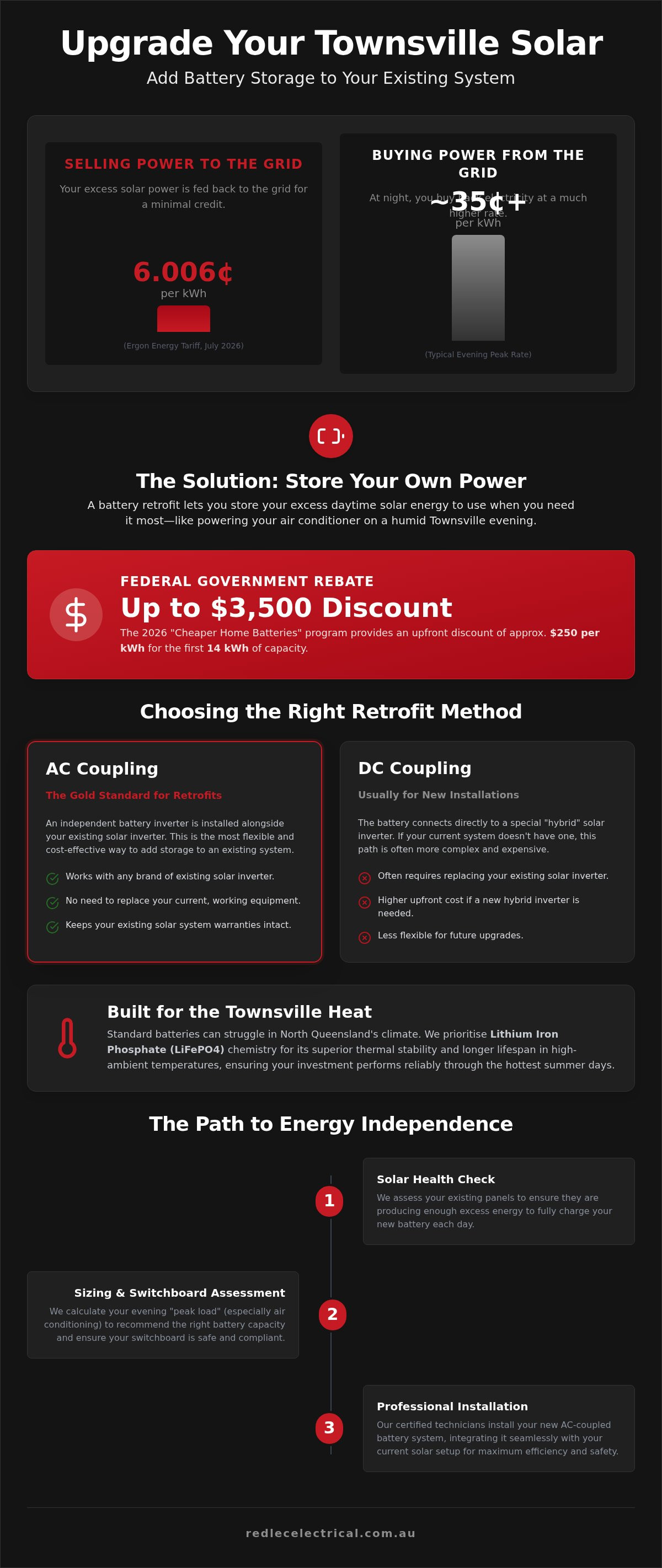
Townsville isn’t called the sunshine capital for nothing. With over 320 sunny days every year, our roofs produce a massive amount of clean energy. However, the way we use that energy has changed. As of July 2026, the Ergon Energy feed-in tariff for regional Queensland sits at just 6.006 cents per kilowatt-hour. This means you’re selling your premium solar power to the grid for a pittance, only to buy it back at a much higher rate the moment the sun goes down and the air conditioner kicks in.
The “Solar Sponge” effect is a growing challenge for the Queensland grid. During the middle of the day, there is so much solar being generated that the network struggles to soak it all up. By choosing to add battery to existing solar system townsville installations, you stop being a victim of these low export rates. Instead of sending your excess power away, you store it. This allows you to run your home on your own terms, especially during the humid summer evenings when electricity demand and prices are at their peak.
Financial incentives have also reached a tipping point in 2026. The Federal Government’s Cheaper Home Batteries Program now provides an upfront discount of approximately $250 per usable kWh for the first 14 kWh of capacity. For a standard family home, this significantly lowers the initial hurdle. Beyond the savings, there is the undeniable benefit of resilience. North Queensland storm seasons are unpredictable. Having a battery with backup capabilities means your lights stay on and your fridge stays cold when the grid goes down during a summer squall.
Beating the Heat: Battery Performance in NQ
Our tropical climate is tough on electrical components. Standard home energy storage systems designed for cooler southern states can struggle in our 35 degree days. When we install storage in Townsville, thermal management is our first priority. We focus on Lithium Iron Phosphate (LiFePO4) chemistry because it offers superior thermal stability and a longer lifespan in high-ambient temperatures compared to older lithium-ion varieties. We also ensure strategic placement, usually on a southern or eastern wall, to shield the unit from the punishing afternoon sun.
The Financial Case for Retrofitting
Retrofitting a battery is about closing the loop on your energy independence. In Townsville, our high humidity means air conditioning is often a necessity rather than a luxury, which drives up night-time “peak” consumption. A well-sized battery can often pay for itself faster now than in previous years because the gap between what Ergon pays you and what they charge you has widened. Before we install any new components, we always recommend a quick check of your current setup. Ensuring your panels are performing at their peak through professional solar repairs townsville experts can provide is the best way to guarantee your new battery gets a full charge every single day.
How to Choose Between AC and DC Coupling for Your Retrofit
When you decide to add battery to existing solar system townsville homes, you’ll quickly encounter two technical terms: AC coupling and DC coupling. Think of these as the “plumbing” of your energy system. One method connects the battery directly to your panels, while the other connects it to your home’s main electricity board. Choosing the right one depends entirely on what you already have mounted on your wall.
AC coupling is widely considered the gold standard for retrofits. It’s a flexible solution because it doesn’t care what brand or age your current solar inverter is. It works independently alongside your existing setup. On the other hand, DC coupling usually requires a “hybrid” inverter. If your current system wasn’t installed with a hybrid unit from day one, choosing this path often means replacing perfectly good equipment. Before making a decision, it’s vital to check if your existing panels are still producing enough energy to justify the storage. Older panels can lose efficiency over time, and a battery is only useful if you have enough spare “juice” to fill it every day.
The AC Coupled Solution: Simple and Effective
In an AC coupled system, we install a dedicated “battery inverter” next to your original solar unit. This is a popular choice for many Townsville residents who have a functional solar array that’s only a few years old. It’s a non-invasive way to upgrade. You keep your existing warranties intact and avoid the waste of throwing away a working inverter. While there’s a tiny loss in efficiency during the power conversion, the simplicity and lower upfront cost of the retrofit make it the logical choice for most NQ households. It’s the most straightforward way to gain independence from the grid without a total system overhaul.
Hybrid Inverters: When to Replace Your Old Gear
Sometimes, it’s better to start fresh. If your current inverter is pushing ten years old or is starting to struggle in our tropical humidity, it might be time for a system refresh. A hybrid inverter handles both your solar panels and your battery storage in one tidy unit. This DC coupled approach is more efficient because it reduces the number of times electricity is converted between types. It also simplifies your life, as you only need one app to monitor your entire home’s energy. While the cost is higher because you’re buying a new inverter, it’s often more reliable for the next decade of service. If you’re unsure about your current inverter’s health, we can help you assess your setup and provide honest advice on the best path forward.
Sizing Your Battery for the Townsville Lifestyle
Sizing your storage is more than just picking a number off a shelf. In North Queensland, our energy needs are unique. While a homeowner in Melbourne might get away with a small unit for lights and a TV, we have to account for the tropical humidity. When you look to add battery to existing solar system townsville setups, you need to distinguish between your baseload and your peak loads. Your baseload is the constant hum of your fridge and standby devices. Your peak load includes the heavy lifters, primarily your air conditioning and pool pumps.
A common mistake is assuming a 10kWh battery is a “set and forget” solution. In a humid February, where the temperature barely drops below 28 degrees at night, a single split-system air conditioner can consume 1.5kWh to 2kWh every hour. If you run that AC for eight hours, you’ve already exhausted most of a 10kWh battery before you’ve even turned on a light or boiled the kettle. This is why we often look at modular battery systems. These allow you to start with a base capacity and stack extra modules later if you find your lifestyle needs more “buffer” during the summer months.
It’s also vital to understand “usable capacity.” Most modern batteries have a high Depth of Discharge, often around 95% to 100%. However, some chemistries require you to leave a portion of the energy untouched to protect the unit’s lifespan. Always look at the usable figures rather than just the headline number. If a battery is marketed as 10kWh but only has 80% usable capacity, you only have 8kWh to play with. In the heat of a Townsville summer, that 2kWh difference is the difference between a cool night’s sleep and waking up in a sweat when the battery hits its limit at 3 am.
The Air Conditioning Factor
A split-system AC is the biggest hurdle for any Townsville battery. To make your storage stretch further, we suggest a strategy called “solar soaking.” This involves pre-cooling your home during the afternoon while your panels are drenched in sun. By dropping the house temperature to 21 degrees at 3 pm, your battery only has to maintain that temperature at night rather than fighting to bring it down from 32 degrees. This simple habit can double the effective “life” of your battery charge overnight, making a medium-sized unit perform like a much larger one.
Backup Power vs. Self-Consumption
Not all battery retrofits are created equal. Some systems are designed purely for self-consumption, meaning they save you money but turn off if the grid fails. If you want protection during a cyclone or a summer blackout, you need a “full backup” or “essential circuit” setup. This requires specific wiring to ensure your fridge, internet, and a few dedicated lights keep running when Ergon’s power goes out. Deciding this early is crucial. It changes how we configure the installation and which circuits we prioritise to keep your family comfortable during an outage.
The Retrofit Process: Steps to a Successful Installation
Retrofitting storage is a precise electrical task that goes far beyond simply mounting a box on your wall. When you decide to add battery to existing solar system townsville properties, success depends on following a structured path that respects both local regulations and our harsh environment. We don’t believe in shortcuts because a poorly planned installation isn’t just inefficient; it can be a safety risk. Our process is designed to give you peace of mind by ensuring every component is compatible and every connection is secure.
The retrofit journey typically follows these five essential stages:
- Step 1: Professional Site Audit: We start by checking the health of your existing solar panels and inverter. There’s no point adding storage if your current system isn’t producing enough surplus energy to fill it.
- Step 2: Switchboard Assessment: We look for modern safety compliance and ensure there is physical room for the new battery circuits and monitoring hardware.
- Step 3: Ergon Energy Application: We handle the technical paperwork required to get your grid connection approved, ensuring you stay compliant with regional Queensland regulations.
- Step 4: Physical Installation: Our team installs the battery and inverter. Because Townsville is in a cyclone region, we use specific mounting hardware and techniques to ensure your investment is secure during extreme weather.
- Step 5: Commissioning and App Setup: We program the system for maximum self-consumption and show you how to use the monitoring app to track your savings.
Ergon Energy Requirements in Townsville
Ergon Energy manages the regional Queensland grid with strict oversight to maintain stability. Every retrofit requires a formal “Connection Application” before work begins. This determines your export limits and ensures your battery’s grid protection settings are correctly configured. It isn’t just red tape; it’s a mandatory safety step. To ensure this goes smoothly, your installer must be a Clean Energy Council (CEC) accredited professional. This accreditation proves the person performing the work has the specific training required for Queensland’s unique grid environment.
Switchboard Upgrades and Safety
If your home is older, your electrical board might not be ready for the added load of a battery system. A switchboard upgrade is often a necessary part of the retrofit to meet the latest AS/NZS 5139 standards. These rules mandate safety features like fire-rated backing and specific clearance zones to ensure proper ventilation. We take these standards seriously because they protect your home from electrical faults and overheating. If you’re ready to secure your energy future, you can book a professional solar battery installation assessment with our local Townsville team today.
Why Townsville Homeowners Trust Redlec for Battery Retrofits
Choosing the right team to handle your energy storage is just as important as the technology itself. We’ve seen plenty of “solar cowboys” pass through North Queensland, offering cheap deals before disappearing when the tropical humidity starts to take its toll on their equipment. At Redlec, we take a different approach. As a local business led by Matt, we’ve built our reputation on being the “trusted neighbour” who shows up on time and does the job properly. We live in the same heat you do, so we know exactly what it takes for an electrical system to survive a Townsville summer.
When you decide to add battery to existing solar system townsville homes, you aren’t just buying a product; you’re starting a long-term partnership. We don’t believe in high-pressure sales or one-size-fits-all bundles that don’t actually fit your lifestyle. Instead, we provide honest, technical advice based on your specific energy usage and the condition of your current roof setup. Our goal is to ensure your investment delivers real peace of mind and genuine savings for years to come.
Expert Solar Diagnostics
We believe a battery is only as good as the solar system feeding it. That’s why our process always begins with a comprehensive health check of your existing array. We’ve found that many older systems in Townsville suffer from minor panel degradation or inverter inefficiencies that the owners weren’t even aware of. By identifying these issues early, we can perform necessary solar repairs and maintenance before the battery is connected. This ensures your panels are producing the maximum possible “juice” to keep your storage topped up, even on those partly cloudy days during the wet season.
Ongoing Local Support
Our relationship with you doesn’t end once the last screw is tightened. Being based right here in Townsville means we’re available for rapid support if you ever have questions about your system’s performance. We’ll help you get comfortable with your monitoring app so you can see exactly how much you’re saving each night. If the grid goes down or you notice something isn’t quite right, you don’t have to wait on a mainland call centre. You can just give us a call, and we’ll be there to help. Ready to secure your energy future? Get a tailored battery quote from Redlec today and take the first step toward true energy independence.
Start Your Journey Toward Energy Independence
Retrofitting storage is the most practical way to protect your home from the rising costs of peak-period electricity and the record-low feed-in tariffs of 2026. By choosing to add battery to existing solar system townsville installations, you can stop exporting your valuable power for a pittance and start using it to run your air conditioning through those humid summer nights. It’s about making your current solar setup work harder for you while gaining the resilience needed for our unique North Queensland climate.
As a local Townsville business, Redlec understands the specific technical requirements of our region. Our CEC Accredited Installers are specialists in complex retrofits and the switchboard upgrades that are often necessary to keep your home safe and compliant. We take pride in delivering quality workmanship that stands up to the punishing tropical sun and ensures your system remains a reliable asset for years to come.
If you’re ready to stop relying on the grid and start maximising your own clean energy, we’re here to help you find the right fit for your lifestyle. Request a Professional Battery Retrofit Assessment from our friendly team today. We look forward to helping you secure a more sustainable and cost-effective future for your home.
Frequently Asked Questions
Can I add a battery to any existing solar system in Townsville?
Yes, almost any system can be retrofitted with storage using a method called AC coupling. This approach allows the battery to work alongside your current solar inverter regardless of its brand or age. We perform a quick health check on your existing panels and inverter first to ensure they are still producing enough surplus energy to make the upgrade a smart financial move for your home.
How much does it cost to add a battery to an existing solar setup?
The total cost depends on the capacity you choose and the specific requirements of your home. However, the federal Cheaper Home Batteries Program currently offers an upfront discount of approximately $250 per usable kWh for the first 14 kWh of capacity as of May 2026. We provide detailed, fixed quotes after a site visit so you can see the exact investment required without any hidden surprises or “solar cowboy” guesswork.
Will a solar battery work during a power outage in Townsville?
A battery will only provide power during a blackout if it has been specifically configured with backup functionality. Standard grid-tied systems are designed to shut down during an outage to protect workers on the lines. If you want your lights, fridge, and internet to stay on during a summer storm or cyclone, we can wire essential circuits to a battery that supports full backup mode.
Does adding a battery affect my existing solar feed-in tariff with Ergon?
It depends on which tariff scheme you are currently using. If you are one of the few still on the legacy 44 cent Solar Bonus Scheme, adding a battery might change your eligibility, so it’s vital to check your specific contract first. For most residents on the 2026 regional tariff of 6.006 cents per kWh, adding storage is the most effective way to save money by using your own power instead of exporting it.
How long do solar batteries last in the North Queensland heat?
Most modern Lithium Iron Phosphate batteries are rated for about 10 years of reliable service. In our tropical climate, longevity depends heavily on proper installation and thermal management. We always mount units in well-ventilated, shaded areas to protect them from the punishing Townsville sun, which helps the internal cells stay cool and maintain their efficiency for as long as possible.
Is my switchboard ready for a solar battery installation?
Many older homes in our region require a switchboard upgrade to accommodate the new circuits and meet current Australian safety standards. When we look to add battery to existing solar system townsville properties, we check for adequate space and ensure your board has the mandatory fire-rated backing. This is a critical safety step that ensures your home’s electrical hub can handle the continuous load of a storage system.
Can I add more panels at the same time as adding a battery?
Yes, and this is often a very efficient way to upgrade your home’s energy profile. If your current solar array is small, adding a few extra panels ensures you have enough generation to charge your battery fully while still powering your daytime air conditioning. We can assess your roof space and inverter capacity to see if an expansion is the right choice for your energy goals.
What is the best battery for Townsville homes?
The best battery for our environment is one that uses Lithium Iron Phosphate (LiFePO4) chemistry due to its superior stability in high temperatures. We also look for modular systems that allow you to add more storage later if your family grows. Rather than pushing a single brand, we recommend units that have proven reliability in North Queensland and offer strong local warranty support if you ever need help.