Imagine it’s a typical 34-degree afternoon in Castle Hill, the humidity is thick enough to wear, and suddenly your lounge room goes silent. You head to the switchboard only to find your air conditioner tripping circuit breaker switches yet again, leaving you stranded in the stifling North Queensland heat. It’s an incredibly frustrating experience, especially when you’re worried about the potential cost of a major repair or a complete compressor failure during the peak of summer.
We understand that a cooling breakdown in Townsville feels like an emergency. The good news is that a tripped breaker is actually a safety feature doing its job to protect your home from electrical fires or equipment damage. This guide will help you discover exactly why your unit keeps cutting out and how to safely restore your home’s comfort. We will walk through the common culprits, from simple blocked filters to more complex electrical faults, and clarify the vital difference between a standard breaker trip and an RCD safety switch event. By the end, you’ll know if you can fix the issue yourself or if it’s time to call a professional to ensure your system survives the upcoming storm season.
Key Takeaways
- Understand that an air conditioner tripping circuit breaker is a vital safety response designed to protect your Townsville home from electrical fires and permanent equipment damage.
- Learn to distinguish between an immediate trip caused by a short circuit and a delayed trip caused by an overloaded or overheating motor.
- Discover how the unique North Queensland climate, including extreme humidity and salt air corrosion, puts extra strain on your unit’s electrical contacts.
- Identify simple maintenance steps, such as cleaning dirty air filters, that can immediately reduce the load on your system and prevent future power cuts.
- Recognise the warning signs that indicate when it is safe to reset your switchboard and when you must call a licensed electrician to avoid an expensive compressor failure.
Understanding Why Your Air Conditioner Trips the Breaker
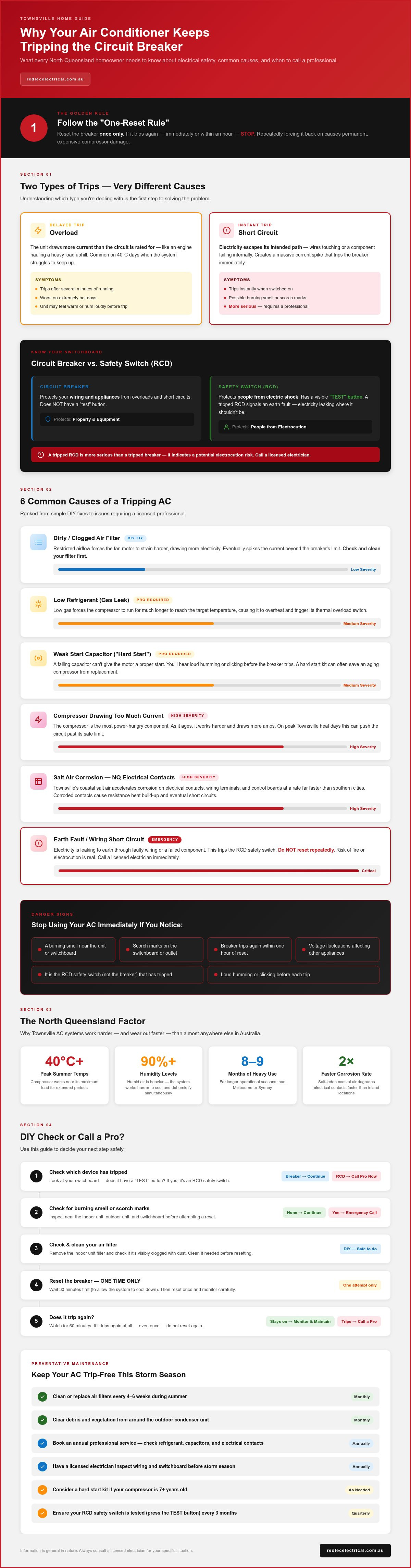
When you’re dealing with an air conditioner tripping circuit breaker, it’s easy to view that flipped switch as a nuisance. In reality, that breaker is a vital safety device designed to protect your Townsville home from electrical fires. Its primary job is to monitor the flow of electricity and cut the power instantly if it detects a dangerous surge or a sustained draw that exceeds what your home’s wiring can safely handle. In the harsh North Queensland climate, where cooling systems run for hours on end, this protection is the only thing standing between a functioning unit and a potential disaster.
There’s a significant difference between an “overload” and a “short circuit” that every homeowner should understand. An overload is like a car engine working too hard to pull a heavy trailer up a hill; the air conditioner is simply trying to draw more current than the circuit is rated for. This often happens on those sweltering 40-degree days when the system is struggling to keep up. A short circuit, however, is more serious. It occurs when electricity escapes its intended path, often because two wires are touching or a component has failed internally. This creates a sudden, massive spike in current that triggers the breaker immediately to prevent the wires from melting.
We always advise residents to follow the “one-reset rule”. If your AC trips the power, you can try to reset the breaker once. If it trips again immediately, or even an hour later, stop. Continually forcing the switch back on sends high-voltage stress through your system. This repeated “hammering” of the electrical components can cause permanent, expensive damage to your AC compressor, turning a simple repair into a full system replacement.
Circuit Breaker vs. Safety Switch (RCD)
It is important to check your switchboard to see exactly which device has tripped. A circuit breaker protects the appliances and the wiring, while a Safety Switch (RCD) is there to protect people from electric shock. If the device that tripped has a “test” button on it, it’s likely an RCD. When an RCD trips, it usually indicates an “earth fault,” meaning electricity is leaking where it shouldn’t be. Modern Queensland safety regulations are quite strict about these protections, especially for high-draw appliances like air conditioners.
The Immediate Danger of Ignoring a Trip
Ignoring a tripping breaker can lead to the wire insulation inside your walls becoming brittle or even melting due to extreme heat. Because air conditioners draw so much power, a fault in the cooling circuit can also cause “brownouts” or voltage fluctuations that damage sensitive electronics in other parts of your home. If you notice a burning smell near the unit or your switchboard, you should stop using the system and seek an emergency electrical repair to ensure your property remains safe during the storm season.
Common Mechanical and Electrical Causes
While the breaker is designed to protect your home, the root cause of an air conditioner tripping circuit breaker often lies deep within the unit’s mechanical or electrical health. In Townsville, our systems work harder than almost anywhere else in Australia, meaning wear and tear happens at an accelerated rate. One of the most common, yet overlooked, issues is a dirty air filter. When filters are clogged with dust, airflow is restricted, forcing the fan motor to strain and draw more electricity to compensate. This extra effort eventually spikes the current beyond the breaker’s limit, causing it to flip as a safety precaution.
Refrigerant levels also play a significant role. If your system is low on gas due to a small leak, the compressor must run for much longer periods to reach the desired temperature. This leads to the compressor overheating and hitting its thermal overload switch, which often results in a power trip. Keeping your system well-maintained ensures these simple mechanical strains don’t lead to a total electrical failure.
The “Hard Start” Phenomenon
There is a distinct difference between a “dead short” that trips the power instantly and a “hard start” that happens over several seconds. During a Townsville heatwave, the pressure inside your AC system is immense. An older compressor often struggles to overcome this pressure to start spinning. You might hear a loud humming sound or a persistent clicking before the breaker finally gives up. This is usually due to a weak start capacitor, which acts like a battery to give the motor a kick. If your system is struggling, installing a hard start kit can provide that necessary jolt of energy, often saving an aging compressor from the scrap heap and restoring reliable cooling.
Electrical Faults and Short Circuits
Thermal expansion is a constant factor in North Queensland. The cycle of extreme daytime heat followed by cooler nights can cause electrical terminal connections to loosen over time. These loose wires create high resistance and heat, which can trip your breaker. We also face a unique local challenge: geckos and ants. These pests love the warmth of an outdoor condenser unit and can crawl across live contacts, creating a short circuit that kills the power instantly. In older Townsville properties, brittle wire insulation is another frequent culprit. If you suspect pests or worn wiring are behind your power issues, our team can provide expert electrical services to safely diagnose and clear these hidden faults before they cause permanent damage.
Troubleshooting: Immediate vs. Delayed Tripping
The timing of a power fault is often the most revealing clue in a diagnostic puzzle. When you are faced with an air conditioner tripping circuit breaker, paying close attention to exactly when the switch flips can help you narrow down the cause before you even pick up the phone. There are three primary scenarios we typically see in Townsville homes, each pointing to a different underlying issue.
- Scenario A: The Immediate Trip (Dead Short). If the breaker flicks off the very second you turn the AC on, you likely have a “dead short.” This means electricity is flowing directly to the ground or another wire, bypassing the motor. It is often caused by a burnt-out compressor or internal wiring damage.
- Scenario B: The Delayed Trip (Overload). If the unit runs for 15 to 30 minutes before cutting out, the system is likely overheating or drawing too much current over time. This suggests the motor is working too hard, possibly due to a mechanical strain or poor airflow.
- Scenario C: The Shared Load Trip. Sometimes the AC runs fine until you turn on the kettle or the oven. This indicates that the total demand on your home’s main power supply is exceeding its capacity, rather than a fault with the air conditioner itself.
Diagnostic Steps for Homeowners
Before calling out a technician, there are a few safe visual checks you can perform. Start by inspecting your outdoor condenser unit. Ensure it isn’t buried under overgrown garden beds or blocked by stored items, as restricted airflow is a major cause of overheating. Check your internal return air grille for heavy dust buildup that might be choking the system. It is also worth considering if any other recent electrical work, such as a new smoke alarm installation, has coincided with the start of the tripping issues, as this helps us trace the circuit logic more effectively.
When the Fault is in the Switchboard
In many older Townsville properties, the problem isn’t actually the air conditioner. Circuit breakers can become “weak” or “sensitive” as they age, tripping at a lower current than they are rated for. Our extreme North Queensland heat also plays a role; if your switchboard is positioned in direct afternoon sun, the internal temperature of the enclosure can rise significantly, making the breakers more prone to nuisance tripping. If your board is outdated, investing in professional switchboard upgrades is often the most reliable way to support modern, high-efficiency cooling systems and prevent future breakdowns during storm season.
The North Queensland Factor: Climate and Your AC
Living in Townsville means accepting that our environment is exceptionally tough on electrical machinery. It isn’t just the heat that causes an air conditioner tripping circuit breaker; it’s the combination of relentless humidity, salt air, and local wildlife that creates a perfect storm for electrical faults. In North Queensland, your cooling system faces operational challenges that simply don’t exist in the southern states, making local expertise essential for keeping your home comfortable.
One of the most persistent issues we see is the “Gecko Factor.” These small reptiles are attracted to the warmth generated by your outdoor unit’s circuit board. When a gecko crawls across the live traces of a printed circuit board, it creates a bridge between high-voltage components. This instantly shorts the board, frequently sacrificial the gecko and tripping the breaker. While it’s a common local problem, the resulting damage to the electronics can be permanent if the surge isn’t caught quickly by your switchboard’s safety mechanisms.
Humidity and Condensate Issues
High humidity levels in Townsville significantly increase the physical load on your cooling system. Research indicates that a compressor in a humid tropical climate often works up to 30% harder than the same unit in a dry environment. This is because the system must work overtime to remove moisture from the air before it can effectively lower the temperature. During the wet season, this extra strain can lead to overheating. Furthermore, if your condensate drain lines become blocked by algae or dust, water can back up into the unit. This moisture often finds its way toward internal sensors or fan motors, triggering an electrical fault that cuts your power.
Corrosion and Coastal Wear
For residents in coastal suburbs like North Ward, Pallarenda, or Bushland Beach, salt air corrosion is a constant threat. Salt is highly conductive and corrosive; it settles on the electrical contactors inside your outdoor unit, leading to a condition known as “pitting.” These tiny craters on the metal surfaces increase electrical resistance, which generates excessive heat every time the compressor tries to kick in. Over time, this heat weakens the circuit breaker’s internal spring, leading to “nuisance tripping” where the power cuts out even if the unit is technically functioning. Regular application of protective coatings and professional cleaning can extend the life of these contacts, but in our coastal environment, proactive servicing is the only way to stay ahead of the rust.
If your system is showing signs of coastal wear or has been affected by local pests, it’s vital to have a professional inspection before the next big heatwave. Our team specialises in Townsville’s unique climate challenges and can provide the necessary electrical services to ensure your air conditioner remains reliable all year round.
Professional Solutions and Preventing Future Trips
Resolving the issue of an air conditioner tripping circuit breaker is often a matter of moving from reactive repairs to proactive maintenance. While it’s tempting to simply flick the switch back on and hope for the best, consistent tripping is a clear signal that your system is under duress. Investing in professional servicing is always more cost-effective than a total compressor replacement. A technician can identify a failing capacitor or a loose connection before it causes a catastrophic electrical failure, ensuring your home stays cool when the North Queensland humidity is at its peak.
Long-term reliability often starts on the day your system is first fitted. There is a direct link between the initial air conditioning installation cost and the likelihood of future electrical issues. Cheap installations sometimes cut corners with undersized wiring or inadequate circuit protection that struggles under the heavy load of a Townsville summer. By ensuring your unit is correctly sized and installed on a robust circuit from the beginning, you eliminate many of the common triggers for nuisance tripping.
Solar and AC Integration
For many Townsville residents, solar power is the key to affordable cooling. However, the high “inrush current” required to start an older AC unit can sometimes clash with your solar inverter’s capacity. Integrating solar battery storage can provide a vital buffer, supplying that initial surge of power without straining your home’s main connection. Your solar monitoring system can also act as an early warning device; if you notice unusual power spikes or “leaking” energy when the AC is running, it may be the first sign that a motor is beginning to fail internally.
The Importance of a Dedicated Circuit
A frequent cause of power failure in older homes is an air conditioner sharing a circuit with other high-draw appliances. Plugging a toaster or a kettle into the same circuit as your cooling system is a recipe for disaster. Modern Queensland safety standards require air conditioners to have their own dedicated circuit. Upgrading your switchboard to include a modern RCBO (Residual Current Breaker with Overload) for your AC provides the best of both worlds: it protects the machinery from overloads and keeps your family safe from earth faults.
Creating a “Cooling Resilience Plan” for your home involves regular filter cleans, keeping the outdoor area clear of geckos and debris, and having an annual electrical health check. Don’t wait for the next heatwave to leave you in the dark. Book a professional AC health check with Redlec today to ensure your system is ready for the upcoming storm season.
Restore Comfort and Safety to Your Home
Dealing with an air conditioner tripping circuit breaker is more than just a struggle against the North Queensland humidity; it’s a critical safety warning for your property. We have explored how everything from simple dust buildup to the local “gecko factor” can disrupt your cooling. By identifying whether your unit is facing a dead short or a heat-induced overload, you can take the right steps to prevent an expensive compressor replacement before the next storm season hits.
Your peace of mind is our priority. Whether you need an urgent switchboard upgrade or a routine health check to ensure your solar integration is working efficiently, we’re here to help. Our fully licensed and insured Townsville sparkies bring expert local knowledge of North QLD conditions to every job. We provide 24/7 emergency electrical support to ensure you’re never left sweltering in the heat.
Get your AC back online with Townsville’s trusted electrical experts at Redlec. We look forward to helping you keep your home safe, efficient, and perfectly cool all year round.
Frequently Asked Questions
Is it safe to reset my AC breaker more than once?
It is generally safe to reset the breaker once to see if it was a nuisance trip, but you should never do it a second time. If the switch flips again, it means there is an active electrical fault or a mechanical overload. Forcing electricity into a faulty system can lead to wire insulation melting or permanent damage to your compressor. It’s better to stay warm for an hour than to risk a house fire.
Why does my air con only trip the breaker when it is really hot outside?
Extreme Townsville heat forces your system to work significantly harder to move heat out of your home. When the mercury hits 35 degrees or more, the internal pressure in the compressor rises, which increases the electrical current needed to keep it running. If your circuit is already close to its limit or the motor is ageing, this extra demand on a sweltering afternoon is often the final straw that causes the breaker to trip.
Can a dirty air filter really cause a circuit breaker to trip?
Yes, a clogged filter is one of the most common reasons for an air conditioner tripping circuit breaker. When dust blocks the airflow, the fan motor has to strain much harder to pull air through the unit. This increased effort draws more amperage from your switchboard. Over time, the motor overheats and the current spikes, triggering the safety breaker to prevent the wiring from catching fire. Cleaning your filters every month can prevent this.
How do I know if my AC compressor is burnt out?
A burnt-out compressor often causes the breaker to trip the very second you turn the unit on. You might hear a loud, metallic clunk or a deep humming sound right before the power cuts out. In some cases, you may even notice a distinct acrid or “acidic” smell coming from the outdoor unit. These are signs of a major internal failure that requires a professional assessment to determine if the unit is actually salvageable.
What is the difference between a short circuit and a ground fault?
A short circuit occurs when a “hot” wire touches a neutral wire, creating a massive spike in current that trips the circuit breaker instantly. A ground fault happens when electricity escapes its intended path and touches a grounded part of the unit or the earth wire itself. In modern Queensland homes, ground faults are typically caught by your safety switch (RCD), while short circuits are managed by the standard circuit breaker in your switchboard.
How much does it cost to fix an AC that keeps tripping the breaker in Townsville?
The cost of resolving an air conditioner tripping circuit breaker depends on whether the issue is a simple fix like a blocked filter or a major electrical failure. Minor repairs such as replacing a faulty capacitor or clearing a gecko from the circuit board are relatively affordable. However, if the compressor has failed or the internal wiring has melted, the repairs will be more involved. A professional diagnostic check is the best way to get an accurate answer.
Should my air conditioner be on its own dedicated circuit?
Yes, absolutely. Under current Queensland electrical regulations, any air conditioner with a capacity over 3.5kW must be installed on its own dedicated circuit. Sharing a circuit with other high-draw appliances like kettles or vacuum cleaners will almost certainly lead to frequent power trips. A dedicated circuit ensures your cooling system has a steady, safe supply of power without being affected by whatever else is happening in the rest of your home.
Can a gecko really trip my air conditioning circuit?
Geckos are a major cause of electrical faults in Townsville. These small reptiles often crawl into the outdoor unit’s control box seeking warmth. Because their bodies are conductive, they can bridge the gap between two live terminal points on the circuit board. This creates an instant short circuit that trips the breaker and usually destroys the board. Using repellent tablets or installing gecko-proof covers can help protect your unit from these common local pests.