Cracking open a window to clear shower steam might work in cooler climates, but across North Queensland, muggy outside air often invites more moisture inside than it lets out. When summer relative humidity hovers near 80%, a reliable bathroom exhaust fan installation Townsville homeowners can depend on is not just about clearing a foggy mirror. It serves as your property’s frontline defence against timber rot, peeling ceiling paint, and relentless tropical mould.
You shouldn’t have to spend your weekends scrubbing dark spores off damp plaster while listening to an old, rattling fan that barely shifts the air. Discover how to protect your home from persistent humidity with ventilation designed specifically for our local tropical climate. In this guide, we walk you through calculating the right airflow capacity for your space, meeting electrical safety zones under Australian Standard AS/NZS 3000, and configuring external ducting to keep your bathroom dry, quiet, and healthy year-round.
Key Takeaways
- Learn why Townsville’s intense tropical humidity demands up to 20 air changes per hour to stop rapid mould colonisation and peeling paint.
- Understand how to calculate the right cubic metres per hour rating to match your bathroom’s exact dimensions and layout.
- Compare ceiling-mounted fans with remote inline exhaust systems to achieve whisper-quiet operation without sacrificing extraction power.
- Discover the critical damp-zone wiring rules under Australian Standard AS/NZS 3000 that make professional bathroom exhaust fan installation Townsville homeowners rely on essential for safety.
- Find out how compliant external ducting shields your ceiling cavity from trapped moisture and structural timber damage.
Why Bathroom Ventilation is Non-Negotiable in Townsville
North Queensland living brings sun, warmth, and intense wet-season downpours. During summer, Townsville routinely experiences relative humidity levels averaging above 75%, with daytime heat frequently crossing thirty-five degrees. When you mix that tropical baseline with hot shower steam, your bathroom becomes an incubator for fungal spores. Moisture settles on cool tiles, sinks into plasterboard, and seeps behind cabinetry within minutes.
Without sufficient mechanical airflow, this dampness triggers rapid cosmetic and functional damage. Paint bubbles along ceiling cornices, moisture swells vanity joinery until laminates peel, and grout lines blacken. True ventilation is far more than clearing glass so you can shave. By applying proven architectural ventilation principles, an efficient extraction setup captures steam at the source, preventing moisture from saturating your living space and safeguarding your family against airborne mould allergens.
The Fight Against Tropical Mould and Mildew
Standard builder-grade fans often choke when the wet season sets in. If your fan sounds like an aeroplane engine but your mirror stays fogged for half an hour after a shower, moisture is winning the battle. Lingering dampness creates a persistent musty odour and black spotting around air conditioning grilles and skirting boards. Investing in a professional bathroom exhaust fan installation Townsville specialists configure ensures your system moves enough air volume to strip humidity out before mould colonies take root, protecting your indoor air quality and preserving your property value.
Protecting Your Home’s Structural Integrity
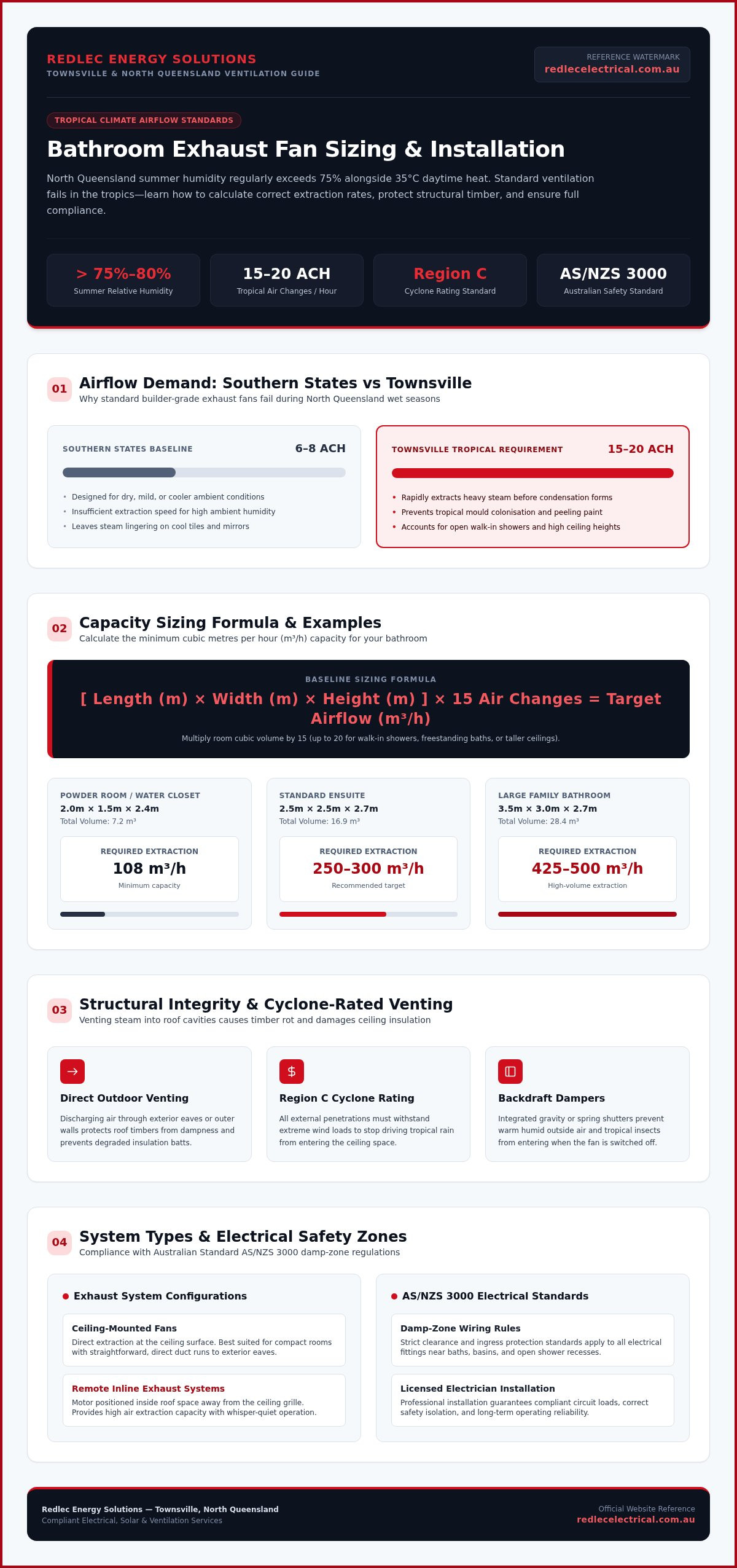
Venting steam directly into your roof cavity is a serious hazard. Trapping hot, moist air inside the ceiling damages timber framing, encourages dry rot, and degrades fibrous insulation batts until they lose thermal efficiency. Because Townsville sits in Wind Region C, our homes require a specialized approach to exhaust design:
- Direct outdoor venting: Discharging air through external eaves or exterior walls keeps roof timbers dry and compliant.
- Cyclone-rated penetrations: Any penetration must respect our region C cyclone rating to ensure driving rain cannot blow back into your ceiling space during severe storms.
- Backdraft dampers: Integrated shutters stop humid outdoor air and tropical insects from entering when the unit isn’t running.
Planning your bathroom exhaust fan installation Townsville project with dedicated external ducting ensures damp air leaves your home entirely, keeping structural timbers solid year after year.
Calculating the Right Fan Capacity for Your Bathroom
Selecting an exhaust fan based solely on appearance leaves your bathroom vulnerable to damp conditions. In southern states, standard ventilation guidelines recommend six to eight Air Changes per Hour (ACH). North Queensland demands a completely different approach. Because Townsville’s ambient air holds heavy moisture throughout the wet season, your exhaust unit must evacuate steam quickly before it clings to cooler surfaces.
Exhaust systems are rated in cubic metres per hour ($m^3/h$) or litres per second (L/s). The Australian Government’s Your Home guide on condensation reinforces the need for properly sized, dedicated mechanical extraction to prevent structural dampness. To stop mould before it starts, tropical bathrooms require a minimum of 15 to 20 air changes per hour. If you have walk-in open showers, freestanding tubs, or high ceilings, you need the upper end of that capacity to account for the larger air volume.
A Simple Sizing Guide for Homeowners
Calculating the baseline volume for your room requires simple mathematics. Multiply your bathroom’s length by its width and height to find the total cubic volume, then multiply that figure by 15 air changes:
- Powder room or water closet ($2text{ m} times 1.5text{ m} times 2.4text{ m}$): A $7.2text{ m}^3$ room needs at least $108text{ m}^3/text{h}$ of airflow.
- Standard ensuite ($2.5text{ m} times 2.5text{ m} times 2.7text{ m}$): A $16.9text{ m}^3$ space requires roughly $250text{ to }300text{ m}^3/text{h}$ of capacity.
- Large family bathroom ($3.5text{ m} times 3text{ m} times 2.7text{ m}$): A $28.4text{ m}^3$ room requires upwards of $425text{ to }500text{ m}^3/text{h}$ to prevent condensation settling on distant walls.
Undersizing a fan wastes your time and money. An inadequate motor runs continuously without ever removing enough humidity to dry the room.
Noise Levels and Sone Ratings
High extraction capacity shouldn’t sound like heavy machinery above your shower. Budget fans often rely on basic sleeve bearings, which dry out quickly in tropical heat, causing high friction and irritating rattling noises. Modern ball-bearing motors and mixed-flow impellers move large volumes of air smoothly while keeping operational sound down to whisper-quiet levels.
Ductwork layout also directly affects performance. Every sharp bend and corrugated ridge adds resistance, which cuts fan efficiency by up to 50% and increases air turbulence noise. If you want seamless performance and quiet extraction, arranging a professional bathroom exhaust fan installation Townsville property owners trust will ensure correct sizing, rigid ducting runs, and whisper-quiet operation.
Types of Bathroom Exhaust Systems for North Queensland
Every home layout presents distinct airflow challenges. Choosing the right system depends on your roof cavity space, room layout, and whether you are renovating an older high-set Queenslander or building a modern slab-on-ground home. Rather than relying on old exhaust setups that simply vent moisture directly into the roof space, modern properties benefit from purpose-built systems that expel air straight outdoors through sealed ductwork.
For ground-floor bathrooms in multi-storey dwellings or apartments where ceiling access doesn’t exist, wall-mounted exhaust fans provide a direct discharge route through external walls. For standard suburban homes, however, the choice generally comes down to integrated ceiling units or remote inline exhaust configurations.
The 3-in-1 Advantage: Light, Fan, and Heat
Multi-function 3-in-1 units combine extraction, overhead heating, and energy-efficient LED lighting into a single ceiling fixture. While Townsville is known for tropical warmth, winter mornings between June and August can feel noticeably crisp when stepping out of the shower. These units provide rapid radiant warmth alongside steady extraction.
Because heat lamps and extraction motors draw dedicated electrical current, your switchboard must be assessed to verify circuit capacity. Strict Electrical Safety Office Queensland regulations on unlicensed work mandate that wiring, mounting, and connecting these multi-switch fixtures must always be carried out by a licensed electrician. Doing the work yourself is illegal and compromises household safety around wet areas.
Inline Fans vs Standard Ceiling Units
Standard ceiling fans house the motor directly behind the grille. They work well for straightforward layouts with short, direct duct runs straight out through an adjacent eave. However, they can produce noticeable motor vibration against ceiling plasterboard.
Inline fans solve this problem by placing the extraction motor inside the roof cavity, several metres away from the bathroom ceiling. A discreet, flush-mounted intake vent sits in your ceiling, connected via smooth ducting to the remote motor, which expels air through an external wall or roof cowl. This setup offers distinct benefits:
- Higher airflow over distance: Inline motors handle long, complex ducting runs without losing static pressure.
- Whisper-quiet operation: Shifting the mechanical motor into the ceiling space eliminates annoying hums and vibrations.
- Clean aesthetic: Small, minimalist grilles blend seamlessly into contemporary ceiling designs.
Whether you select a streamlined ceiling fan or a high-capacity inline system, coordinating your bathroom exhaust fan installation Townsville project ensures the correct ducting, fan type, and switch layout for your home.
Professional Installation and Safety Standards
Water and electricity create a hazardous mix when installed incorrectly. In Queensland, hardwiring a fan, adding run-on timers, or installing combination heat units constitutes prescribed electrical work. Under the Queensland Electrical Safety Act 2002, these tasks must legally be completed by a licensed electrician. Professional work ensures your system operates reliably while strictly adhering to Australian Standard AS/NZS 3000.
Navigating Bathroom Electrical Zones
Australian Standard AS/NZS 3000 breaks bathrooms down into specific damp zones to dictate where electrical equipment can safely sit:
- Zone 0: The interior base of the shower tray or bathtub. No standard exhaust fans are permitted here.
- Zone 1: The area directly above the shower or bath up to a height of 2.25 metres from the floor. Any extraction fan or light installed in this zone must carry an Ingress Protection rating (IP rating) of at least IPX4 to prevent water splashes from penetrating the housing.
- Zone 2: Extends 0.6 metres horizontally beyond Zone 1 and up to 2.25 metres high, also requiring a minimum IPX4 splash-proof rating.
Every 240V bathroom circuit must be protected by dedicated RCD safety switches at the main switchboard. Attempting a DIY installation near water sources puts your family at risk of severe shock, invalidates property insurance, and creates immediate safety hazards.
The Importance of Proper Ducting and Venting
National Construction Code condensation management rules mandate that bathroom ventilation systems discharge directly to outdoor air rather than dumping damp exhaust into ceiling spaces. Terminating ductwork inside an enclosed attic traps moisture, degrades insulation, and rots roof trusses.
In North Queensland, exterior penetrations demand extra care. Townsville sits in Wind Region C, which means roof cowls, flashings, and external wall vents must hold an engineering-certified region C cyclone rating. These fittings incorporate spring-loaded backdraft dampers and heavy weather seals to stop cyclonic wind gusts from forcing torrential rain back down the duct. During testing, technicians can use thermal imaging cameras to inspect the ceiling run, confirming seals are airtight and operating without thermal loss.
To ensure your wet areas are safe, fully compliant, and sealed against tropical storms, schedule your bathroom exhaust fan installation Townsville service with our certified team.
Expert Bathroom Ventilation Solutions with Redlec
Managing moisture in North Queensland requires practical planning and dependable execution. At Redlec Energy Solutions, our process for bathroom exhaust fan installation Townsville wide begins with a detailed assessment of your home’s layout. We inspect ceiling cavities, calculate precise airflow requirements, and map out the shortest, most efficient ducting paths to external eaves.
We prioritise long-term reliability and energy-efficient technologies that keep power consumption down while moving maximum air. Because moisture management links directly to overall climate control, our technicians frequently coordinate ventilation setups alongside air conditioning installation Townsville households depend on to keep indoor spaces cool and dry. Every project includes thorough electrical safety testing and thermal imaging diagnostics to verify that connections remain secure and free from thermal stress.
The Redlec Difference: Local Knowledge and Quality
Living on the tropical coast means hardware faces intense heat, high humidity, and airborne salt. We install high-grade motors, sealed ducting, and non-corrosive external cowls that withstand rapid thermal cycling and severe weather.
Our team treats your property with genuine care. We use drop sheets to protect vanities, cut ceiling plaster with surgical precision, and tidy up completely before leaving. By stopping mould growth at the source, we help local families maintain healthier homes and cleaner indoor air without ongoing cleaning hassles.
Ready to Refresh Your Bathroom?
Upgrading an old, noisy ceiling sweep fan is one of the most practical property improvements you can make. When you book an on-site visit, a licensed electrician inspects your bathroom zones, reviews existing ductwork, and confirms your circuit protection is up to standard.
If your current electrical panel still relies on outdated ceramic fuses or lacks modern circuit protection, combining your ventilation project with a switchboard upgrade ensures full compliance with Australian Standard AS/NZS 3000 and complete peace of mind. Contact Redlec today to discuss your bathroom exhaust fan installation Townsville needs and take the first step toward a dry, mould-free home.
Keep Your Home Dry and Mould-Free All Year Round
Living with persistent bathroom dampness and peeling paint doesn’t have to be an accepted part of North Queensland life. When your property is equipped with the correct airflow capacity and direct external ducting, you stop steam from damaging your walls, ceilings, and roof timbers. Effective ventilation isn’t just a daily convenience; it’s a vital structural safeguard for our humid climate.
Redlec Energy Solutions brings genuine expertise in tropical humidity solutions directly to your doorstep. Every system we fit is strictly AS/NZS 3000 compliant, giving you complete peace of mind around household wet zones. Our licensed Townsville electricians take pride in neat workmanship, ensuring your fan runs quietly, efficiently, and reliably in every season.
Protect your living spaces and enjoy fresh, steam-free bathrooms every single morning. Book your Townsville bathroom ventilation assessment with Redlec today and discover how seamless professional bathroom exhaust fan installation Townsville homeowners rely on can be.
Frequently Asked Questions
Do I really need to vent my bathroom fan outside in Townsville?
Yes, venting your bathroom exhaust fan outside is essential and legally required under Australian building codes. Dumping moist air into a ceiling cavity causes severe mould, rots roof trusses, and ruins ceiling insulation. In North Queensland’s tropical humidity, trapped attic moisture cannot evaporate naturally. A professional bathroom exhaust fan installation Townsville homeowners arrange will always route ductwork to external soffits or cyclone-rated roof cowls.
How many air changes per hour does a Queensland bathroom require?
Bathrooms in tropical Queensland require between 15 and 20 air changes per hour (ACH) to effectively prevent mould colonisation. Standard southern guidelines of 6 to 8 ACH fall short against our intense humidity. High ambient moisture and hot shower steam quickly saturate plasterboard. Sizing your fan for at least 15 ACH ensures moist air is completely cleared within minutes of turning off the tap.
Can I install a bathroom exhaust fan myself if there is already a plug?
Even with an existing surface plug socket, any fixed installation or ducting work should be handled with professional care, and hardwired fans legally require a licensed electrician. Under the Queensland Electrical Safety Act 2002, DIY electrical wiring in wet zones carries strict legal penalties and risks severe shock. A licensed tradesperson guarantees your unit aligns with AS/NZS 3000 damp-zone clearances, maintains proper external seals, and connects safely to safety switches.
What is the best exhaust fan for a small bathroom with no windows?
A high-capacity inline exhaust fan equipped with an automated run-on timer is the ideal choice for a windowless bathroom. Without natural window ventilation, National Construction Code rules mandate mechanical extraction interlocked with lighting and set to run for at least 10 minutes post-use. Remote inline units generate strong airflow while keeping motor sound minimal, rapidly pulling humid air through dedicated external ductwork without vibrating small wall spaces.
Why is my bathroom fan dripping water during the humid season?
Water dripping from your exhaust fan is typically caused by hot indoor steam condensing inside an uninsulated duct or an improperly sloped pipe. When humid exhaust hits cooler duct surfaces or outside wind, moisture turns back into liquid droplets that run back down the housing. Installing smooth ductwork with a slight downward pitch, adding insulation, and fitting a gravity backdraft shutter prevents condensation and rainwater from trickling into your room.
How do I know if my current exhaust fan is powerful enough?
You can test your fan’s extraction strength using a single sheet of toilet paper placed against the grille while the unit is running. If the suction holds the paper firmly in place, the motor is generating decent intake. However, if your mirror remains fogged for more than ten minutes after showering, your fan lacks sufficient capacity. Upgrading through a dedicated bathroom exhaust fan installation Townsville service restores rapid clearance and protects your paintwork.
Does a bathroom fan need a dedicated RCD safety switch?
Yes, Australian Standard AS/NZS 3000 requires all 240V bathroom electrical circuits to be protected by an RCD safety switch. Bathrooms are high-risk damp environments where electrical appliances operate close to running water and conductive pipework. RCD safety switches monitor electrical currents and cut power within milliseconds if a leakage is detected, protecting your family from electric shocks and preventing electrical fires caused by moisture intrusion.
How often should I clean my exhaust fan to keep it efficient?
You should clean your exhaust fan grille and impellers every three to six months to maintain peak airflow performance. In tropical climates, high humidity causes airborne dust, hairspray residue, and lint to stick inside fan grilles, choking the motor. Gently pull off the fascia plate, wash it in warm soapy water, and vacuum lint from the fan blades. Keeping vents clear extends motor lifespan and ensures quiet extraction.