If your solar battery can’t handle a 40-degree Townsville afternoon with 90% humidity, it isn’t an investment; it’s a ticking clock. Most locals know the frustration of watching power bills spike during sticky summer nights, yet many hesitate to invest because they fear the tropical heat will cook a sensitive battery in just a few years. Finding the best solar battery for Queensland climate isn’t about picking the flashiest brand. It’s about choosing hardware specifically built for thermal endurance.
We understand you want the peace of mind that comes with lower bills and a reliable backup during storm season. You need a system that works as hard as you do. This 2026 guide promises to clear the confusion around battery chemistries and show you how to select a unit that survives the North Queensland sun while maximising your long-term savings. We will look at why LiFePO4 technology is now the industry standard for safety, explain how to navigate the current federal ‘Cheaper Home Batteries Program’ rebate, and provide the technical checklist every homeowner needs to ensure their system lasts well over a decade.
Key Takeaways
- Learn why Lithium Iron Phosphate (LFP) is the superior choice for Townsville homes due to its high thermal stability in extreme humidity.
- Discover how to select the best solar battery for Queensland climate by prioritising cooling systems and smart placement over raw storage capacity.
- Understand the importance of professional installation to ensure your battery is shaded and ventilated correctly to maintain its 10-year lifespan.
- Get the latest facts on 2026 federal rebates and how participating in a Virtual Power Plant can further reduce your energy costs.
- Identify whether an AC-coupled or hybrid system is the most efficient way to upgrade your current solar power system for maximum reliability.
Why the Queensland Climate is a Challenge for Solar Batteries
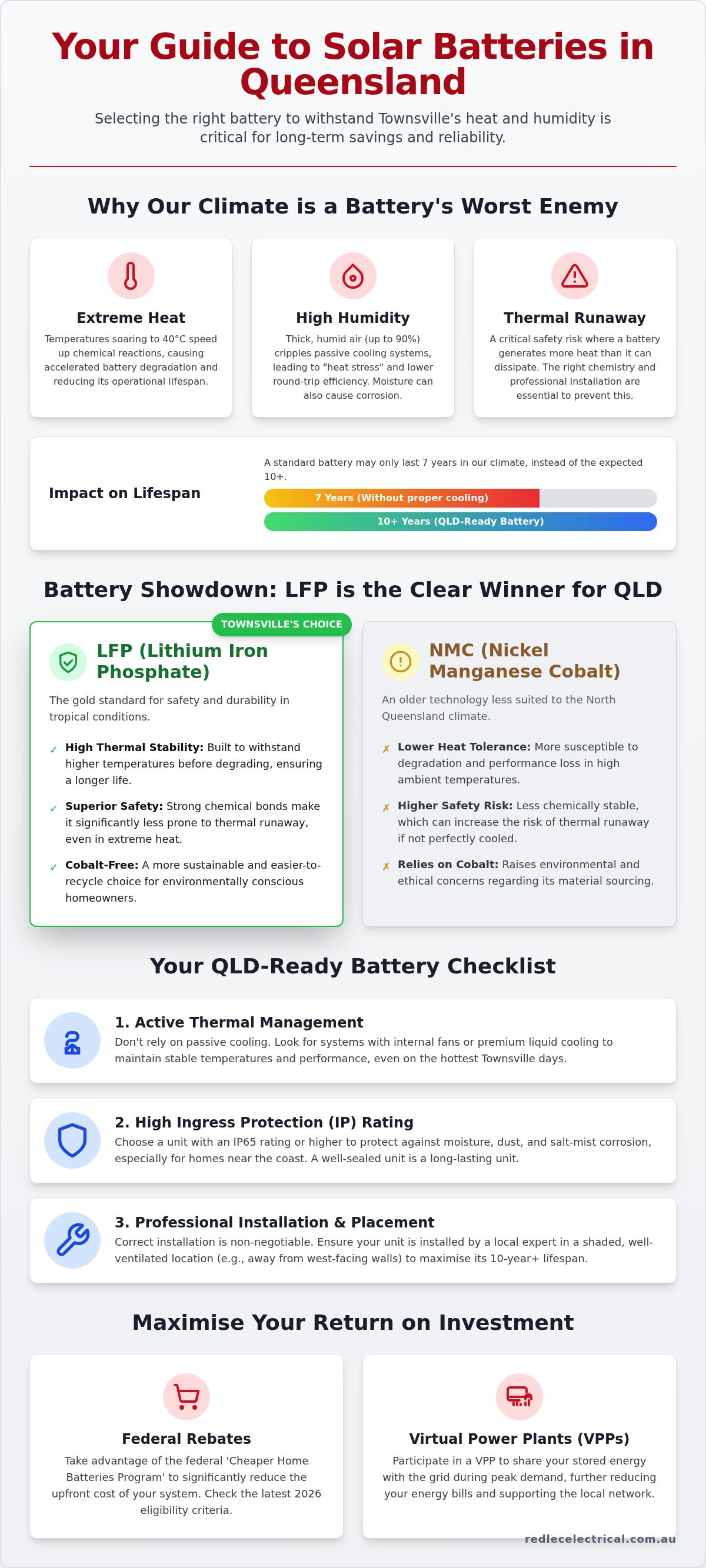
Living in Townsville means we’re used to the “sweat-on-the-brow” heat, but your solar battery feels it even more. While solar panels love the sun, the storage units are far more sensitive to our tropical environment. When it hits 40 degrees in mid-January, the chemical reactions inside a battery speed up. This leads to accelerated degradation, meaning a battery designed for 10 years might only manage seven if it isn’t cooled properly. This is why finding the best solar battery for Queensland climate requires looking past the glossy brochures and checking the thermal operating range.
Our humidity adds another layer of trouble. Many batteries use passive cooling, which relies on ambient air to pull heat away from the core. In thick, humid air, this process is much less effective. It creates “heat stress,” reducing the round-trip efficiency, which is the amount of energy you get back out compared to what you put in. If the unit can’t shed heat, it simply won’t perform as advertised.
Townsville isn’t a lab. We define a “QLD-ready” battery as one featuring active thermal management, like liquid cooling or advanced internal fans. Without these, you might find your warranty has hidden clauses that reduce coverage if the unit is installed in zones where temperatures frequently exceed 35 degrees. Always check the fine print to ensure your investment is protected in the tropics.
The Impact of High Humidity on Electrical Components
High humidity isn’t just uncomfortable; it’s a threat to electrical circuits. Moisture ingress can cause short circuits or slow corrosion in poorly sealed units. When choosing a system, look for a high Ingress Protection (IP) rating, ideally IP65 or better. For homes near the Townsville coast, salt-mist corrosion is a real risk that can eat through poorly finished casings. A local expert knows which brands use marine-grade materials to prevent this premature failure.
Thermal Runaway: Safety in the Summer Heat
Safety is our priority during the peak of summer. In extreme heat, batteries can enter a state called thermal runaway, where the heat generated inside the unit exceeds its ability to dissipate it. Modern systems use sophisticated sensors to shut down or “derate” performance before this happens. Keeping these systems in top shape through professional solar repairs and regular maintenance is essential for long-term safety. Understanding the different rechargeable battery technologies helps you see why some chemistries handle these spikes better than others.
Comparing Battery Chemistries for Tropical Conditions
Not all batteries are built the same inside. When you’re searching for the best solar battery for Queensland climate, the chemistry choice is actually more important than the brand name on the box. In the 2026 market, we primarily see two contenders: Lithium Iron Phosphate (LFP) and Nickel Manganese Cobalt (NMC). While NMC was once popular for its compact size, it simply hasn’t proven to handle the North Queensland “oven” as well as LFP does.
LFP is currently the gold standard for our tropical conditions. It’s built to withstand much higher temperatures before the chemistry begins to break down. This means you get more cycles out of the unit over its lifespan compared to NMC alternatives. While we’re seeing the emergence of solid-state and flow batteries in the 2026 Australian market, LFP remains the most reliable and accessible choice for Townsville families right now.
Why LFP Wins for Townsville Homeowners
The main reason LFP wins is safety. In an LFP battery, the chemical bonds are incredibly strong. This makes the unit significantly less prone to thermal runaway even when our ambient temperatures stay above 30 degrees through a humid night. It’s also a better choice for the planet. LFP batteries don’t rely on cobalt, making them easier to recycle at the end of their life. If you’re considering new battery storage systems, LFP provides the best balance of safety and value.
Active vs. Passive Cooling Systems
How a battery sheds heat is just as vital as what’s inside it. Passive cooling relies on heat sinks, which often struggle if the unit is mounted on a west-facing wall during a fierce QLD afternoon. Fan-forced air cooling is a common alternative, but in dusty or coastal Townsville areas, those fans can eventually pull in salt and grit. Liquid cooling is the premium solution. It uses an internal coolant to keep cells at a steady temperature regardless of the outside arvo heat. This ensures the battery doesn’t “derate” or drop its performance when your aircon is working its hardest.
Top Battery Technologies for 2026 Queensland Homes
The ideal tropical battery is a unit with an IP65 rating and LFP chemistry. This specific combination ensures the internal components are sealed against our coastal salt air while the core chemistry remains stable during a sweltering December heatwave. In the 2026 market, high-voltage hybrid systems have become the preferred choice for new builds. These integrated solutions combine the solar and battery inverter into one sleek unit, which minimises energy loss and makes the system much easier to monitor through a single app.
For those looking to upgrade, AC-coupled batteries are the best option for retrofitting to existing Townsville solar systems. They work alongside your current setup without needing to replace your existing solar inverter. We’re also seeing a massive shift towards modular battery stacks. These allow you to start with a modest amount of storage and simply “click in” extra modules as your budget allows or your family grows. It’s a flexible way to find the best solar battery for Queensland climate without a massive upfront cost.
Smart management software is the final piece of the puzzle. Modern batteries now use AI to track local weather patterns. If the system predicts a severe storm or cyclone heading towards Townsville, it will automatically prioritise charging the battery to 100% from the grid or your panels. This ensures you have a full tank of energy before the power lines go down, providing a level of security we didn’t have a few years ago.
Retrofitting vs. New System Design
Adding a battery to your current solar power systems requires a bit of local know-how. Older systems often need switchboard upgrades to handle the new load and meet the latest AS/NZS 5139:2019 safety standards. We always recommend looking for “black-start” capability. This feature allows your solar panels to keep working and recharging the battery even during a total grid blackout, which is a lifesaver during our extended summer storm outages.
Capacity Planning: How Much Storage Do You Need?
Sizing your battery correctly is all about beating the “humidity hump.” This is the extra energy you use running air conditioning through those sticky 28-degree nights. While a 5kWh battery might cover your lights and fridge, most Townsville households now find that 10kWh to 15kWh is the “sweet spot” for true comfort. You also need to consider your solar panel output; if your panels can’t produce enough excess energy during the day to fill the battery, you won’t see the full return on your investment.
Professional Installation: Protecting Your Investment from the Elements
Buying the best solar battery for Queensland climate is only half the battle. If it’s installed in the wrong spot, even the most expensive unit will struggle to perform. In Townsville, strategic placement is everything. We strictly avoid west-facing walls because the relentless afternoon sun adds a massive thermal load. This extra heat forces the battery to work harder just to stay cool, which can lead to “derating” or a reduction in power output. Ideally, your unit should be tucked away in a shaded, well-ventilated area like a garage or the southern side of the house.
Airflow is your battery’s best friend. Without adequate clearance around the unit, heat builds up and trapped humidity can start to affect the external casing. We also have to consider our local weather extremes. In a cyclone-prone region, standard mounting brackets often aren’t enough. We ensure every installation uses cyclone-rated fixings that meet local building codes. This keeps your system secure during severe weather events, providing the peace of mind that your investment won’t become a hazard when the wind picks up.
Many older Townsville homes still have original switchboards with ceramic fuses. These aren’t built for the modern demands of a solar battery system. A professional installation usually requires a switchboard upgrade to include high-quality circuit breakers and fire-resistant backing. This isn’t just about meeting the latest safety standards; it’s about making sure your home is prepared for the next 20 years of energy technology.
The Importance of Local Expertise
Choosing a Townsville-based commercial electrical contractor means you’re working with someone who understands our local grid quirks and Ergon Energy’s specific requirements. We ensure every job complies with AS/NZS 5139, the national standard for battery safety and placement. Being local also means that if you ever need emergency electrical repairs or have a warranty question, we’re just around the corner. A local warranty is far more valuable than a promise from a national company with no boots on the ground in North Queensland.
Preparing for Storm Season
As the humidity rises and storm season approaches, your battery becomes your most valuable asset. Most modern systems allow you to configure a “Reserve” mode. When a cyclone warning is issued, you can set this reserve to 100%. This ensures you have maximum backup power if the grid fails. It’s important to understand that while a battery can run your lights, fridge, and fans, it might not run every air conditioner in the house at once. We help you prioritise your “essential circuits” so you can stay comfortable during an outage. Before the summer rains begin, a quick maintenance check of your seals and ventilation is the best way to ensure smooth operation.
If you’re ready to secure your home’s energy future, our team can help with a professional solar battery installation tailored to your property.
Maximising ROI: Rebates and Smart Energy Management
Getting the best solar battery for Queensland climate is a financial decision as much as a technical one. To see a return on your investment sooner, you need to look beyond the hardware and focus on how the system integrates with the 2026 energy market. As of May 2026, the primary incentive for Townsville homeowners is the Federal ‘Cheaper Home Batteries Program.’ This provides a point-of-sale discount of approximately $250 per usable kilowatt-hour (kWh) for the first 14kWh of capacity. For a typical 10kWh system, this can reduce your upfront costs by thousands of dollars, provided the unit is on the Clean Energy Council approved list and is Virtual Power Plant (VPP) capable.
One of the smartest ways to boost your ROI is by joining a VPP. By allowing a provider to occasionally draw small amounts of energy from your battery during grid peaks, you earn extra credits on your bill. When you combine this with Time-of-Use (ToU) tariff optimisation, the savings stack up quickly. Your battery can be programmed to charge during the day from your panels and discharge during the expensive 4 pm to 9 pm peak, effectively “peak-shaving” your power bill to near zero. While we focus on energy, we never neglect total home protection. A professional smoke alarm installation and a full electrical safety audit are essential additions when we upgrade your home’s energy infrastructure.
Understanding the ‘Sun Tax’ and Battery Benefits
We’re seeing a shift in how the Queensland grid handles solar. With lower feed-in tariffs and new export limits, sending your excess power back to the grid is no longer the best financial move. Storing that energy for use at night is much more attractive. Most modern systems now come with smart apps that let you track your savings and self-consumption in real-time. This data is also vital if you’re planning to add an electric vehicle (EV) charger in the future, as it helps you understand how much “spare” solar you have to fuel your car for free.
The Redlec Energy Solutions Difference
At Redlec, Matt takes a personal interest in every design. We don’t believe in one-size-fits-all kits because we know that a battery in Castle Hill faces different conditions than one in Bushland Beach. Our team focuses on high-quality hardware that won’t quit when the Townsville humidity hits its peak. We value long-term relationships and take pride in being the steady hand you can rely on for honest advice and prompt service. If you’re ready to take control of your power bills, contact Redlec today for a Townsville-ready solar battery assessment and get a customised quote from a local expert who truly understands the North Queensland tropics.
Secure Your Energy Future in the Tropics
Choosing the best solar battery for Queensland climate is about more than just storage capacity; it’s a long-term commitment to your home’s comfort and safety. By prioritising Lithium Iron Phosphate (LFP) chemistry and ensuring your system is installed with proper ventilation and shading, you can avoid the common pitfalls of heat-induced failure. Remember that local expertise is the real difference between a system that survives one summer and one that lasts a decade.
As Townsville’s trusted local solar experts, Redlec Energy Solutions is here to help you navigate the 2026 rebate landscape and design a system built specifically for the humidity. Whether you need specialists in tropical-grade solar repairs or 24/7 emergency electrical support, our team ensures your power stays on when you need it most. We take pride in being a steady hand for our neighbours, providing reliable results and honest advice without unnecessary fanfare.
Get a QLD-Ready Battery Quote from Redlec Energy Solutions and take control of your energy future before the next storm season arrives.
Frequently Asked Questions
What is the best solar battery chemistry for the Queensland heat?
Lithium Iron Phosphate (LFP) is the best solar battery for Queensland climate because of its superior thermal stability. Unlike other chemistries, LFP doesn’t suffer from the same risk of thermal runaway when ambient temperatures spike during a Townsville summer. It’s built to handle daily cycling in our 30-degree nights without losing capacity as quickly as older technologies. This makes it the most reliable choice for families who want their investment to last through a decade of tropical weather.
Can I install a solar battery outside in Townsville?
You can install a battery outdoors, but it must be protected from direct sunlight and heavy rain. In North Queensland, we look for a minimum IP65 rating to ensure the unit is sealed against dust and moisture. Strategic placement is vital; we always recommend the southern side of your home or a shaded carport. Proper airflow is also required to prevent the unit from overheating during a humid afternoon, which can cause the system to shut down prematurely.
How long does a solar battery last in a tropical climate?
Most high-quality batteries are rated for 10 years, but the extreme heat in Townsville can accelerate chemical wear if the system isn’t managed correctly. Choosing a unit with active cooling and a high temperature tolerance is the key to reaching that 10-year milestone. Regular maintenance and professional solar repairs also play a big role in longevity. If a battery is poorly positioned or lacks ventilation, you might see its performance drop significantly after just five or six years of use.
Will a solar battery keep my air conditioner running during a power outage?
A battery can run an air conditioner, but it depends on the unit’s power draw and your battery’s discharge capacity. Most Townsville households prioritise “essential circuits” like the fridge, lights, and fans during a storm-related outage. Running a large split-system aircon will drain a standard 10kWh battery very quickly. If backup cooling is a priority, we recommend a larger modular system and ensuring your aircon is a modern, energy-efficient inverter model to reduce the initial power surge.
Are there any Queensland government rebates for solar batteries in 2026?
The previous state-level “Battery Booster” rebate is now closed to new applications. However, the Federal ‘Cheaper Home Batteries Program’ is the primary incentive available in 2026, offering a point-of-sale discount based on your battery’s usable capacity. As of May 2026, this rebate is valued at approximately $250 per kWh for the first 14kWh. To qualify, your system must be installed by a CEC-accredited professional and be Virtual Power Plant (VPP) capable to ensure maximum support for the local grid.
Does high humidity affect the lifespan of my solar battery system?
High humidity doesn’t directly damage the internal cells of a well-sealed battery, but it does make cooling much harder. Humid air is less effective at pulling heat away from passive cooling fins. This can lead to the battery “derating” its power output to stay within safe temperature limits. For coastal Townsville properties, humidity also carries salt-mist, which can corrode external terminals and casings if the unit isn’t specifically designed for marine environments with high-quality IP-rated enclosures.
How much does it cost to install a solar battery in Townsville?
The total investment for a battery system varies based on the storage capacity you need and the complexity of your current electrical setup. Factors like whether you need a switchboard upgrade or if you’re retrofitting to an older inverter will influence the final amount. While federal rebates provide a significant point-of-sale discount in 2026, we always recommend a site assessment to determine the most cost-effective size for your home’s specific evening energy usage patterns and tropical cooling needs.
Is it worth retrofitting a battery to an older solar system?
Retrofitting is definitely worth considering, especially with the current low feed-in tariffs in Queensland. An AC-coupled battery allows you to store your excess solar energy instead of sending it to the grid for a small credit. This is often the most logical path for Townsville homes with older, functional solar panels. It allows you to use your own clean energy during the expensive evening peak, providing a much better financial return than selling power back to your electricity retailer.