Could a single overlooked sensor or a misunderstood update in the National Construction Code be the biggest hidden risk to your business right now? We know that staying on top of commercial smoke alarm requirements Australia mandates can feel like chasing a moving target, especially when you are trying to balance federal standards with specific state laws. It is a lot to manage while also running a company; the fear of liability in the event of a fire is a weight no business owner should have to carry.
This guide is designed to give you total peace of mind by breaking down exactly what you need to do to meet the 2026 compliance standards. We will clarify the vital differences between the AS 1670.1:2024 and AS 3786:2023 standards, while providing a straightforward checklist to ensure your system is up to scratch. Whether you are managing a shopfront in the city or maintaining complex systems in the tropical humidity of Townsville, you will find the clear, local expertise you need to keep your premises safe and your insurance valid.
Key Takeaways
- Understand how the 2026 National Construction Code updates and your specific building classification dictate your legal fire safety obligations.
- Navigate the complex commercial smoke alarm requirements Australia enforces by distinguishing between AS 1670.1 fire detection systems and AS 3786 self-contained alarms.
- Learn why photoelectric technology is the mandatory commercial standard and how interconnected systems provide the earliest possible warning for your staff.
- Stay compliant and protect your business from liability by following the mandatory AS 1851 testing and maintenance schedules.
- Discover the process for securing essential Form 15 and Form 16 compliance certificates from a qualified Townsville commercial electrician.
Australian Commercial Fire Safety Legislation: The 2026 Landscape
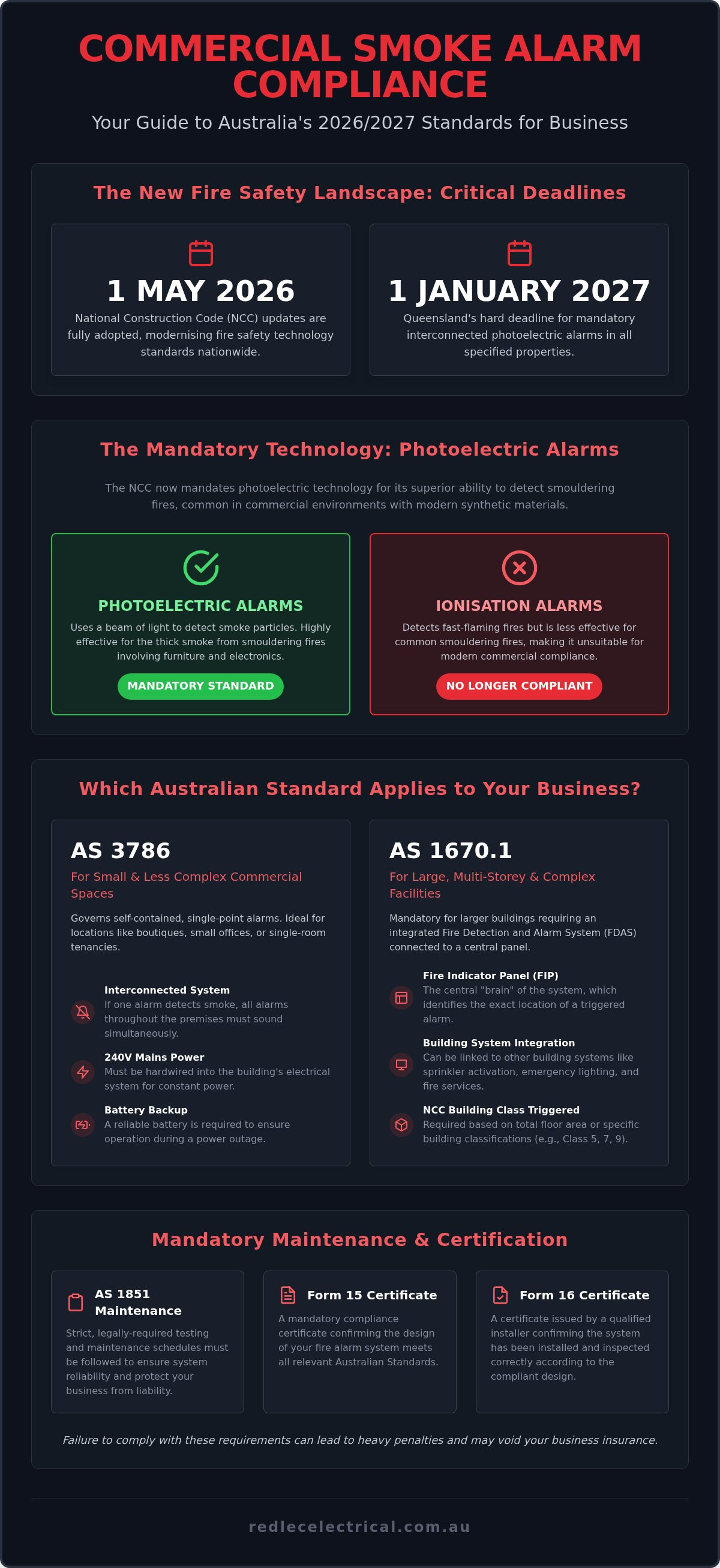
The legal framework for fire safety in Australia is undergoing its most significant change in a decade. As of 1 May 2026, the National Construction Code (NCC) has introduced updated standards that redefine how we protect commercial assets. These changes aren’t just about ticking boxes. They’re designed to save lives by modernising the technology we rely on. For business owners, understanding the commercial smoke alarm requirements Australia mandates is the first step toward ensuring both safety and legal compliance.
The National Construction Code (NCC) and Building Classes
The NCC uses building classifications to determine exactly what fire detection systems you need. It’s a precise system. For instance, a Class 5 office building has different needs compared to a Class 7 warehouse or a Class 6 retail shop. The NCC 2022, fully adopted in 2026, categorises buildings from Class 2 through to Class 9. Each classification dictates whether you need a simple interconnected alarm system or a comprehensive fire detection and alarm system (FDAS). The latest updates to the Building Code of Australia (BCA) focus on increasing the speed of detection and ensuring alarms are audible in every occupied space. A major part of this shift involves the different Smoke Detector Types available, with a clear preference for photoelectric sensors. These sensors are far more effective at detecting smouldering fires, which are common in office environments filled with furniture and electronics.
QLD Specific Requirements for Business Owners
In Queensland, the landscape is even more specific. The state is currently in the final stages of a massive rollout of interconnected photoelectric alarms, with a hard deadline of 1 January 2027. While this often focuses on residential spaces, it significantly impacts commercial landlords and tenants in Class 2 to 4 buildings. If you’re a business owner, you need to know where the line of responsibility sits. Generally, the landlord must ensure the building meets the commercial smoke alarm requirements Australia and QLD law dictate, while tenants are often responsible for maintaining the system’s operational status. The shift toward mandatory photoelectric technology is now non-negotiable for new builds and major renovations. Unlike older ionisation alarms, photoelectric sensors use light to detect smoke particles. This makes them much faster at spotting the thick, black smoke produced by modern synthetic materials. Failing to comply can lead to heavy penalties under the Queensland Fire and Emergency Services Act, not to mention the risk of voiding your insurance. It’s a lot to keep track of, but staying informed is your best defence.
Technical Standards: AS 1670.1 vs. AS 3786 Explained
The technical side of fire safety often feels like a maze of codes and numbers. To stay compliant, you must know exactly which Australian Standard applies to your property. While AS 3786 covers individual units, AS 1670.1 governs complex, interconnected systems. Choosing the wrong one isn’t just a technical error; it’s a legal risk that can compromise your insurance and staff safety. The commercial smoke alarm requirements Australia mandates are very specific about which hardware belongs in which environment.
AS 3786: Single-Point Alarms for Small Commercial Spaces
This standard is the go-to for smaller, less complex environments. Think of a local boutique, a small accounting firm, or a single-room tenancy. These alarms are self-contained units that detect smoke and sound an alert from the same device. Under the regulations coming into full effect for 2026, these must be 240V mains-powered and include a reliable battery backup. It’s about ensuring the system works even if the power goes out during a storm.
A critical rule for these smaller spaces is interconnection. It’s no longer enough to have a lone alarm in the hallway. If an alarm detects smoke in a back storage room, every interconnected unit in the building must sound simultaneously. This provides the earliest possible warning for occupants who might be in a different part of the building, giving them those vital extra seconds to exit.
AS 1670.1: Integrated Fire Detection Systems
Once your business grows or moves into a larger multi-storey facility, the rules shift toward AS 1670.1. This standard is mandatory for buildings that require a Fire Indicator Panel (FIP). An FIP acts as the “brain” of your fire safety system, showing exactly where a detector has been triggered. Triggers for moving to this system typically involve the total floor area or the specific building classification under the National Construction Code.
These integrated systems do more than just sound a siren. They link with other essential services. For example, they can automatically shut down air conditioning to prevent smoke from spreading through vents and activate emergency lighting to show the way out. Many of these systems also feature a Direct Brigade Alarm (DBA). This link ensures that fire services are notified immediately, reducing response times significantly.
Properly categorising your system as Type A or Type B is vital during any commercial fit-out. Regardless of the system size, you must follow the strict maintenance cycles defined in Australian Standard AS 1851 to stay legal. If you are starting a new project or upgrading an old site, our team can provide the commercial electrical expertise needed to keep your property compliant and your people safe.
Choosing the Right Commercial Smoke Detection System
Selecting the right hardware for your business is about more than just finding a unit that makes a loud noise. It’s about matching technology to your specific environment to ensure the system actually works when it matters most. To stay on the right side of the law, your choices must align with the National Construction Code (NCC) and the latest 2026 safety mandates. Making an informed decision now saves you from costly retrofits later and ensures you meet the commercial smoke alarm requirements Australia expects from responsible business owners.
Photoelectric Technology: The 2026 Gold Standard
Photoelectric sensors have become the industry benchmark for a simple reason: they’re better at detecting the types of fires most common in modern workplaces. Unlike older ionisation units that struggle with smouldering fires, photoelectric sensors use a light source to detect visible smoke particles. This allows them to spot a fire in its early stages, often long before open flames appear.
One of the biggest headaches for Townsville business owners is the “nuisance alarm” triggered by steam, dust, or fumes. Photoelectric technology is far more stable in these conditions, meaning fewer unnecessary evacuations and less downtime for your team. Under current regulations, photoelectric alarms are now the compulsory choice for all Class 2 to 4 buildings in Australia.
System Architecture: Wired vs. Wireless
When you are planning a renovation or a new fit-out, the way your alarms communicate is a major factor. Both options have their place in a professional fire safety strategy:
- Hardwired Systems: These are the gold standard for permanent commercial structures. They offer unmatched reliability because they don’t rely on radio signals. While the initial installation involves more labour for cabling, the long-term stability is superior.
- Wireless Interconnection: This is an excellent solution for heritage buildings or temporary retail spaces where running new wires through solid walls isn’t practical. Installation is fast and causes minimal disruption to your daily operations.
If you opt for wireless, keep in mind that these systems still require strict battery management. To maintain compliance with commercial smoke alarm requirements Australia, you must ensure that wireless units are checked as part of your regular maintenance cycle. It’s also vital to consider the environment. In some settings, like commercial kitchens or workshops, a standard smoke detector isn’t enough. In these areas, thermal detectors are often required. They trigger based on temperature rises rather than smoke, preventing false alarms from cooking fumes or sawdust while still providing a steady hand of protection. Evaluating the total cost of ownership means looking beyond the purchase price; it’s about the longevity of the units and the ease of performing mandatory testing.
Mandatory Maintenance and Testing Schedules (AS 1851)
Installing a high quality fire system is only half the battle. To remain compliant, you must ensure it actually functions when needed. This is where AS 1851-2012 comes in. This Australian Standard governs the routine service of fire protection systems and equipment, providing a clear map for maintenance. Adhering to these schedules is a core part of the commercial smoke alarm requirements Australia mandates for every business. It’s not just about safety; it’s about protecting your liability and ensuring your insurance remains valid.
The AS 1851 Testing Cycle
Maintenance follows a strict hierarchy. While your staff can perform basic monthly functional checks, such as a simple “press to test” to ensure the siren sounds, the more technical work must be handled by a qualified professional. Every six months and annually, your system needs a deeper dive. Annual testing involves sensitivity checks to ensure the sensor reacts within the legal limits defined by Australian Standards. If a sensor becomes too “lazy” or overly sensitive, it must be replaced immediately.
Record keeping is the most critical part of this process. Every test must be documented in a logbook kept on-site. This data feeds into your Annual Fire Safety Statement (AFSS) or, in Queensland, your Form 16 occupancy certificate. Without these records, you cannot prove your building is safe, which can lead to significant fines from local councils or fire authorities.
Townsville Maintenance: Managing Humidity and Dust
Our local environment in North Queensland is tough on electronics. High humidity can cause internal components to corrode, while salt air and fine dust can build up inside the sensor chamber. This often leads to “false positives,” where the alarm sounds for no apparent reason, disrupting your business operations. In Townsville, we also face the unique challenge of tropical insects. Geckos and small spiders often find the warmth of a smoke detector’s housing an ideal home, which can easily trigger a false alarm.
Regular professional cleaning and calibration are the only ways to prevent these issues. While you can find basic tips on how to test smoke alarm units at home, commercial systems require a much higher level of scrutiny and specialised equipment. If you want to ensure your business stays compliant without the headache of constant false alarms, our team at Redlec Energy Solutions can manage your mandatory testing schedule with professional integrity.
Professional Commercial Installation in Townsville
Local expertise matters when you are dealing with the harsh conditions of North Queensland. A Townsville commercial electrician doesn’t just understand the wiring; they understand how our relentless heat and humidity stress a fire safety system. When we install these systems, we provide the essential Form 15 and Form 16 compliance certificates required under Queensland law. These documents are your official proof that the design and installation meet every strict standard. Keeping up with the commercial smoke alarm requirements Australia enforces is much easier when you have a local partner who takes personal pride in their craft.
Our approach at Redlec Energy Solutions is built on professional integrity. We don’t just “fit and forget.” We look at your smoke alarms as one piece of a larger safety puzzle. This often involves integrating them with our other commercial electrical services, such as switchboard upgrades or LED emergency lighting. This holistic strategy ensures that if a fire does occur, your building reacts as a single, coordinated safety net. It’s about creating a smooth operation where every component works in harmony to protect your assets.
Why Certification Matters for Insurance
Your insurance policy is only as good as your compliance documentation. In the event of a fire, an insurer’s first question will be whether the system was installed by a licensed professional and maintained according to AS 1851. DIY or unlicensed work is a massive risk in commercial settings. It doesn’t just put lives at stake; it can lead to the immediate rejection of an insurance claim, leaving you personally liable for damages. This is a burden no business owner should have to face.
Professional certification provides a clear paper trail that satisfies both insurers and council fire audits. Having a current Form 16 on file shows you’ve done your due diligence. It gives you the peace of mind that your business is protected from both fire risks and financial ruin. We handle the technical details so you can focus on running your business with confidence.
Ready to Secure Your Business?
Managing a business is demanding, so we aim to make compliance as simple as possible. Redlec Energy Solutions offers comprehensive maintenance packages tailored to the specific needs of Townsville businesses. We show up when promised and deliver exactly what is needed without unnecessary fanfare. Whether you need a full system overhaul or a simple compliance check, we act as a steady hand for your property maintenance.
Don’t leave your fire safety to chance or outdated sensors. If you’re unsure if your current setup meets the latest commercial smoke alarm requirements Australia mandates for 2026, we can help. Contact our team today to organise a professional fire safety audit and ensure your business remains a safe, compliant environment for everyone.
Secure Your Business and Protect Your People
Meeting the 2026 commercial smoke alarm requirements Australia mandates doesn’t have to be a stressful process. By choosing the right photoelectric hardware, adhering to the building classifications in the NCC, and sticking to your AS 1851 maintenance schedule, you’re doing more than just ticking a box. You’re building a safer environment for your staff and securing your business against future liability. It’s about ensuring your insurance stays valid and your property remains a safe place to work every single day.
As licensed QLD electrical contractors and Townsville local experts, we understand the unique challenges our tropical climate poses to fire safety systems. Whether you need a full installation or a routine compliance check, we provide the steady hand and professional certification you need for total peace of mind. Our team even offers 24/7 emergency support to ensure your operations stay smooth around the clock. We take personal pride in every job we do for our local community and value the long term relationships we build with our clients.
Ensure your business is compliant with a Redlec fire safety audit today. It’s a simple step that guarantees long-term security for everything you’ve built. We’re here to help you navigate these changes with honest advice and reliable results.
Frequently Asked Questions
Is it a legal requirement to have smoke alarms in a commercial building in Australia?
Yes, it is a strict legal requirement under the National Construction Code (NCC) and state-specific legislation. Every commercial building in Australia must have a compliant fire detection system that matches its specific building classification. The commercial smoke alarm requirements Australia mandates are designed to ensure the safety of all occupants. Failing to meet these standards puts lives at risk and leaves your business legally vulnerable to prosecution and insurance rejection.
How often do commercial smoke alarms need to be tested under AS 1851?
Commercial systems require a structured testing cycle that includes monthly, six-monthly, and annual inspections. Monthly functional tests can often be performed by a designated staff member to ensure the sirens are audible. However, the more technical six-monthly and annual sensitivity tests must be carried out by a qualified professional. These technical checks ensure the sensors react correctly to smoke and that all backup batteries remain fully operational for emergencies.
What is the difference between a smoke alarm and a smoke detector in commercial use?
A smoke alarm is a self-contained unit that both detects smoke and sounds an alert from the same device, which is common in smaller offices. A smoke detector is a sensor that sends a signal to a central Fire Indicator Panel (FIP), which then triggers separate sirens or bells throughout the building. Detectors are typically part of the more complex AS 1670.1 systems found in larger Townsville commercial facilities and warehouses.
Can I install my own smoke alarms in my business premises?
No, you cannot legally install hardwired smoke alarms yourself in any commercial setting. All mains-powered fire safety equipment must be installed and certified by a licensed electrician to meet Australian Standards. In Townsville, using a professional ensures you receive the necessary Form 16 certification. This documentation is vital for your business insurance policy and provides proof to local authorities that your installation is safe and compliant with current laws.
What happens if my business is found to be non-compliant with fire safety laws?
Non-compliance can lead to severe consequences, including heavy fines from local councils or fire authorities. In the event of a fire, your insurance provider may reject your claim entirely if they discover your system was not properly maintained or installed. This could leave you personally liable for property damage and legal costs. Staying on top of commercial smoke alarm requirements Australia enforces is the only way to protect your business from financial ruin.
Do commercial smoke alarms in Queensland need to be interconnected?
Yes, Queensland legislation requires smoke alarms to be interconnected in many commercial settings to ensure maximum safety. This means that if one alarm triggers in a back storage room, every alarm in the building sounds simultaneously. For businesses in Townsville, this interconnectedness is a vital part of the 2026 compliance landscape. It provides the earliest possible warning for staff and customers, giving them those extra seconds needed to evacuate the building safely.
How long do commercial smoke alarms last before they need replacing?
Most commercial smoke alarms have a maximum lifespan of 10 years from their date of manufacture. After this decade, the internal sensors become less reliable and are far more prone to failure or false triggers. In our humid Townsville climate, sensors can sometimes degrade even faster due to corrosion or dust build-up. It is a legal requirement to replace these units before they expire to maintain your building’s mandatory fire safety certification.
Which building classes require a Fire Indicator Panel (FIP)?
A Fire Indicator Panel (FIP) is generally required for larger buildings classified as Class 3 through to Class 9 under the NCC. This requirement usually kicks in when a building exceeds a specific floor area or height, or if it provides sleeping accommodation like a hotel. The FIP acts as the central brain of the system, allowing fire services to quickly identify the exact location of a fire within a large or complex property.