Is your business paying a “Tropical AC Tax” every time the Townsville sun hits its peak? You’ve likely noticed those quarterly Ergon bills climbing higher, especially when the humidity kicks in and the air con has to work overtime. It’s a common frustration for local business owners who want to grow but feel held back by soaring overheads. This 2026 guide shows you how high-performance commercial solar power systems can turn that harsh North Queensland sun into a competitive advantage, slashing your costs while securing your energy independence.
We understand that investing in solar involves more than just picking panels; it’s about peace of mind. You need to know that your system will stand firm through a Region C cyclone and that the financial numbers actually stack up for your bottom line. We’ll walk you through the recent SRES expansion that now covers systems up to 1MW, explain the current feed-in tariffs, and show you how to maximise your ROI. By the end of this guide, you’ll have a clear, step-by-step plan to take control of your power and protect your business for the long term.
Key Takeaways
- Offset the “Tropical AC Tax” by aligning your solar production with the peak daytime cooling demands of the North Queensland summer.
- Navigate the 2026 SRES expansion which allows commercial solar power systems up to 1MW to access significant upfront discounts.
- Ensure your investment survives the local climate by meeting the specific engineering and mounting standards required for Cyclone Region C.
- Learn how to use your business’s interval data to determine whether a 30kW, 100kW, or megawatt-scale system offers the best ROI.
- Protect your property by identifying the essential credentials and local experience a commercial contractor must possess to avoid “Solar Cowboys.”
Reducing Business Overheads with Commercial Solar in Townsville
For many Townsville business owners, the monthly electricity bill feels like an unavoidable tax on doing business in the tropics. We call this the “Tropical AC Tax.” Because our local climate demands heavy air conditioning usage throughout the day, energy costs often spike exactly when your business is most active. However, this challenge presents a unique opportunity. High-performance commercial solar power systems turn that intense North Queensland sun into a strategic financial asset rather than a burden.
Unlike standard residential setups designed to cover basic household needs, a rooftop solar power system for a commercial property is engineered for scale and durability. While a homeowner might look for a 6.6kW system, Townsville businesses typically start at 30kW and move upwards to 100kW or more. This scale allows you to generate massive amounts of energy during peak business hours, effectively shielding your bottom line from the volatility of Ergon Energy’s grid prices and peak-rate charges.
The Financial Case for Solar in North Queensland
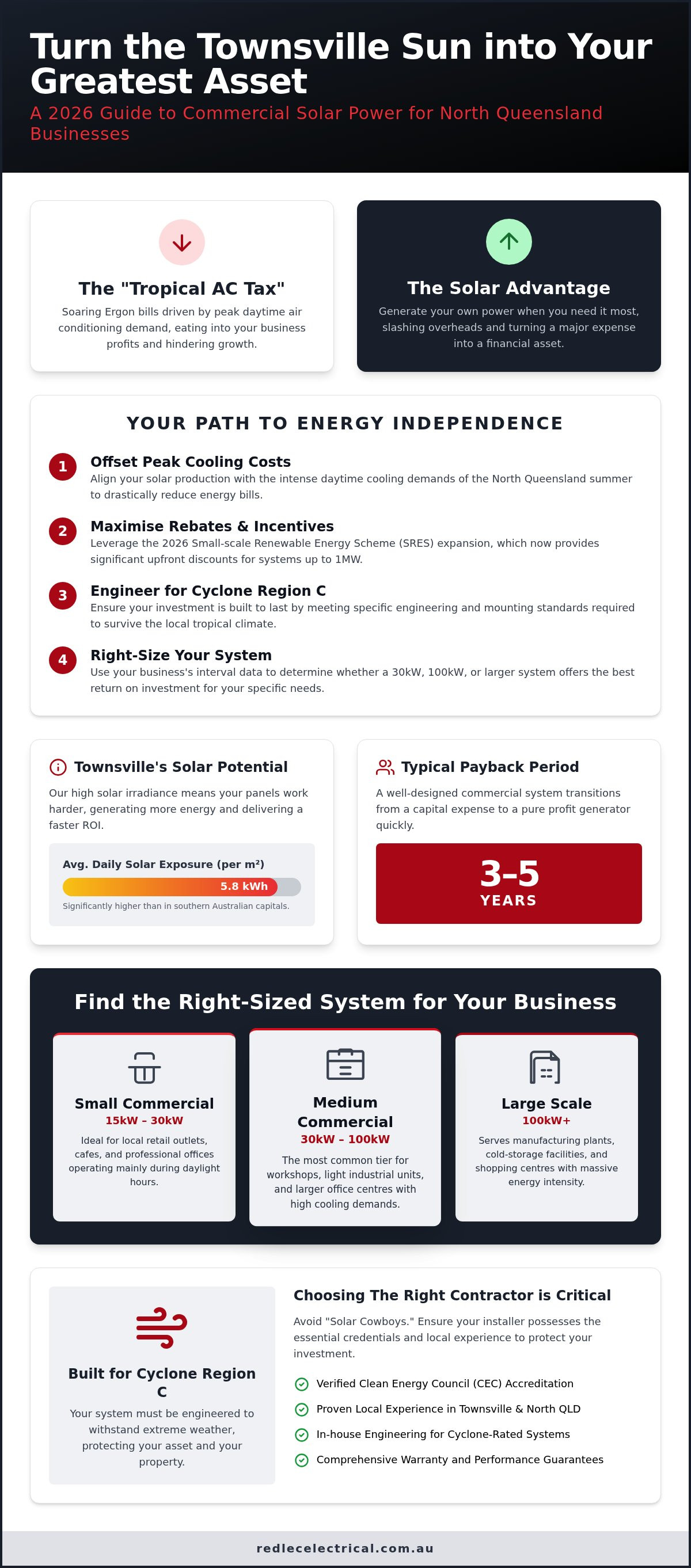
Townsville is one of the best locations in Australia for solar generation, receiving an average of 5.8 kWh of solar exposure per square metre every day. This high level of irradiance means your panels work harder and produce more energy than they would in southern capitals. By generating your own power during the day, you offset the most expensive electricity rates, which usually coincide with your heaviest cooling demands. In the Townsville market, Solar ROI represents the transition from a capital expense to a pure profit generator, with most local businesses seeing a full return on investment within a conservative 3 to 5-year payback period.
Beyond Electricity Bills: Brand and Value
The benefits of commercial solar power systems extend beyond the balance sheet. In 2026, sustainability credentials have become a core requirement for many government and corporate tender responses. Demonstrating a commitment to renewable energy can give your business a competitive edge when bidding for new contracts. Additionally, if you own your commercial freehold, a high-quality solar installation adds tangible value to the property. It makes the site more attractive to future tenants or buyers who are looking for low-overhead operational environments. Reducing your carbon footprint isn’t just about being a good neighbour; it’s about future-proofing your business against evolving corporate standards and environmental expectations.
Sizing Your System: From 30kW to 100kW+ Solutions
Determining the right scale for commercial solar power systems is not a matter of guesswork. It requires a methodical look at your business’s interval data. This data provides a 24-hour snapshot of your energy consumption, showing exactly when your machinery, lighting, and air conditioning units are drawing the most power. By matching your generation capacity to these usage peaks, we ensure you don’t over-invest in unnecessary hardware or under-size a system that leaves you vulnerable to high grid prices.
The 30kW threshold is a significant milestone for many mid-sized Townsville businesses. At this level, the system is large enough to offset substantial operational costs while often fitting within standard grid connection requirements. Since the Australian Government expanded the Small-scale Renewable Energy Scheme in October 2026 to include systems up to 1MW, the upfront financial incentives for larger installations have improved. We always recommend designing with future growth in mind. This means installing a switchboard and mounting infrastructure that can easily accommodate additional panels as your business expands.
Understanding Commercial System Tiers
- Small Commercial (15kW–30kW): These setups are ideal for local retail outlets, cafes, and professional offices that operate primarily during daylight hours.
- Medium Commercial (30kW–100kW): This is the most common tier for Townsville workshops, light industrial units, and larger office centres with high cooling demands.
- Large Scale (100kW+): These systems serve manufacturing plants, large cold-storage facilities, and shopping centres with massive roof spaces and high energy intensity.
Integrating Battery Storage for 24/7 Reliability
While panels do the heavy lifting during the day, Battery Energy Storage Systems (BESS) are becoming a vital tool for managing peak demand charges. These charges are often calculated based on your highest point of energy use during a billing period. A battery can discharge during these spikes to keep your grid draw low, effectively “shaving” the peak off your bill. Furthermore, a battery acts as a critical backup, providing an uninterrupted power supply for essential servers and security infrastructure during grid instability.
If you want to understand the fundamentals of this technology, you can read our detailed breakdown of Solar Battery Storage: Is it the Right Choice for Your Townsville Home in 2026? to see how storage fits into the modern energy landscape. We can help you analyse your current interval data to determine if adding storage to your commercial system will provide the best long-term ROI for your specific site.
Navigating Rebates, STCs, and Tax Incentives in 2026
Understanding the financial incentives for commercial solar power systems is the key to unlocking a faster return on your investment. In late 2026, the landscape has improved significantly for larger Townsville businesses. The most impactful change is the expansion of the Small-scale Renewable Energy Scheme. As of 1 October 2026, the eligibility for rooftop solar systems increased from 100kW to 1MW. This shift is a game-changer for our local industrial sector. For example, a 250kW system can now receive an estimated discount of around $68,000, which reduces upfront costs by approximately 20%.
For systems that exceed the new 1MW threshold, Large-scale Generation Certificates (LGCs) remain the standard. Unlike the upfront discount of STCs, LGCs are created based on the actual electricity your system generates and are sold or traded over time. Beyond these certificates, Australian businesses can still take advantage of accelerated asset depreciation. This allows you to write off the value of your solar assets more quickly, providing a welcome boost to your cash flow during the first few years of operation. While the regional feed-in tariff for the 2026-2027 financial year has moved to 6.006 cents per kWh, the real profit lies in avoiding the high cost of buying power from the grid.
Maximising the STC Benefit
STCs act as a direct reduction in the price you pay for your system. It’s a simple mechanism where the value of the certificates is usually applied as a point-of-sale discount by your installer. You should be aware of the federal phase-out schedule; the number of certificates you receive reduces every year on 1 January until the programme ends in 2030. Securing your installation in 2026 ensures you capture a higher rebate value than if you wait. We always recommend working with a New Energy Tech Consumer Code (NETCC) approved retailer to ensure your system meets all eligibility requirements for these incentives.
Financing Your Solar Investment
Many Townsville businesses choose to preserve their capital by using specialised financing. Green loans are a popular choice, offering lower interest rates for energy-efficient upgrades that reduce carbon footprints. Alternatively, a Solar Power Purchase Agreement (PPA) allows you to install a system with no upfront cost; you simply pay for the solar energy produced at a rate lower than the grid. When weighing up these options, consider the “Cost of Delay.” Every month your roof remains empty is another month of paying full price for peak-rate electricity. Applications for systems under the expanded 1MW scheme are expected to open in mid to late November 2026, making now the perfect time to organise your feasibility study.
Engineering for the Tropics: Cyclone Ratings and Durability
Townsville business owners know that our weather is different. When installing commercial solar power systems in North Queensland, you aren’t just looking for efficiency; you’re looking for survival. Townsville is classified as Wind Region C under Australian Standard AS/NZS 1170.2. This means every component of your system, from the panels to the smallest mounting bracket, must be engineered to withstand cyclone-force winds. A “standard” installation that works in Melbourne could easily become a liability here during a severe weather event.
Durability starts with the mounting systems. We use high-grade rail hardware and specific fixing methods that ensure the system stays anchored to your roof purlins. It’s also vital to consider the corrosive effects of our coastal air. Salt spray can degrade inferior components in just a few years, leading to system failure or safety risks. By choosing hardware with high salt-mist corrosion resistance, you protect your long-term ROI and ensure the system remains a reliable asset for decades. Regular maintenance and prompt solar repairs after major storms are essential to keeping these systems in top condition.
Hardware Selection for Harsh Environments
Selecting the right hardware is the first step in Maximising Your Solar Investment in Townsville. We prioritise Tier 1 panels that carry specific certifications for salt-mist and ammonia resistance. However, the inverter is often the most vulnerable part of the system. In our tropical heat, inverters can struggle with overheating, which leads to “thermal derating” where the system intentionally slows down to cool itself. We focus on strategic placement in shaded areas and ensure proper ventilation so your inverter operates at peak performance even when the mercury hits 35 degrees.
The Redlec Installation Standard
A reliable system is only as good as the infrastructure supporting it. Many older commercial buildings in Townsville require switchboard upgrades to safely handle the continuous high-current input from a large solar array. Our background in Professional Commercial Electrical Services in Townsville: A Complete Business Guide allows us to assess your entire electrical network before the first panel is even lifted onto the roof. We ensure your switchboard and cabling are up to the task, preventing future faults or fire risks.
Maintenance is the final piece of the durability puzzle. After a major weather event or a heavy wet season, a professional inspection can identify small issues, like loose fixings or debris buildup, before they become expensive problems. If you want to ensure your property is truly “Townsville-ready,” we can help you audit your current electrical infrastructure to prepare for a high-performance solar installation.
Choosing the Right Commercial Solar Contractor in Townsville
Investing in commercial solar power systems is a significant decision that impacts your business’s overheads for the next twenty years. Unfortunately, the industry is often plagued by “Solar Cowboys”—large, interstate companies that fly into Townsville, install systems using cut-price sub-contractors, and then vanish when you need support. For a local business, this lack of accountability is a major risk. If a component fails during a peak summer period or after a storm, you need a partner who can be on-site within hours, not weeks.
When evaluating potential contractors, always start by reviewing their capability statements and past commercial projects. A residential solar company might not have the experience required to handle complex commercial electrical networks or the specific engineering demands of a large-scale roof. A full-service provider that combines solar expertise with a background in commercial electrical contracting offers a distinct advantage. They don’t just look at the panels; they understand your switchboards, your cooling systems, and your long-term energy needs. This holistic approach ensures that your system is integrated seamlessly into your existing infrastructure without causing future faults.
Questions to Ask Your Potential Installer
Before signing any contracts, it’s vital to vet your installer to ensure they have a genuine commitment to the Townsville region. We recommend asking these three specific questions:
- Are you a local Townsville business with a physical presence? You want to know where their office is located so you can reach them if issues arise.
- Do you use in-house A-Grade electricians or sub-contractors? In-house teams generally offer higher levels of accountability and consistency in workmanship.
- What is your process for handling warranty claims in North QLD? Ensure they have a clear, local pathway for repairs that doesn’t involve waiting for parts to be shipped from overseas or down south.
The Redlec Difference: Local Reliability
At Redlec Energy Solutions, Matt and the team take personal pride in being more than just installers; we’re your partners in energy independence. We’ve built our reputation on a “Trusted Neighbour” service model, which means we prioritise long-term relationships over quick transactions. Because we also provide 24/7 emergency electrical support and specialised solar repairs, you have the peace of mind that comes from knowing expert help is always just a phone call away. We show up when promised and deliver exactly what your business needs to thrive in our unique climate.
Ready to see how much your business could save? Contact Redlec Energy Solutions for a Commercial Solar Feasibility Report and let’s build a reliable energy future for your property together.
Secure Your Business’s Energy Future Today
The 2026 landscape for commercial solar power systems presents a unique opportunity for Townsville business owners to lock in substantial savings. By taking advantage of the expanded 1MW rebate threshold and aligning your generation with daytime cooling demands, you can effectively eliminate the “Tropical AC Tax.” Success in North Queensland requires more than just panels; it demands specialised Cyclone Region C engineering and a system built to withstand our unique coastal environment.
Choosing a partner who offers full-service electrical and solar contracting ensures that your infrastructure is safe, efficient, and ready for the future. As Townsville-based local experts, Redlec Energy Solutions provides the professional reliability and ongoing support your business deserves. We take pride in being a steady hand for our local community, ensuring your transition to renewable energy is smooth and rewarding.
Ready to see the real-world ROI for your property? Get a Professional Commercial Solar Quote from Redlec Energy Solutions and take the first step toward energy independence. We look forward to helping your business thrive under the North Queensland sun.
Frequently Asked Questions
How much can a 30kW solar system save my business in Townsville?
A 30kW system typically saves a Townsville business several thousand dollars annually by offsetting peak-rate electricity charges during daylight hours. While exact figures depend on your interval data, most local commercial solar power systems achieve a full return on investment within 3 to 4 years. By generating your own power, you reduce reliance on the Ergon grid and protect your bottom line from future price hikes.
Are solar panels cyclone-rated for North Queensland?
Yes, every component we install is specifically rated for Wind Region C, which covers the Townsville area. This engineering standard ensures your panels and mounting hardware can withstand the extreme wind loads associated with North Queensland cyclones. We follow the AS/NZS 1170.2 standards strictly. This local expertise prevents your investment from becoming a liability when severe weather hits our coast and ensures long-term durability for your property.
What is the difference between STCs and LGCs for commercial solar?
The primary difference lies in how the financial incentive is delivered based on the system’s size. Small-scale Technology Certificates (STCs) provide an upfront discount for systems up to 1MW as of October 2026. In contrast, Large-scale Generation Certificates (LGCs) apply to systems over 1MW and are created based on actual power generation over time. Most Townsville businesses find STCs provide the most immediate boost to their cash flow by reducing the initial capital outlay.
Does my business need a switchboard upgrade for a commercial solar installation?
Many commercial properties require switchboard upgrades to handle the continuous high-current input that solar arrays generate. Older infrastructure wasn’t designed for the bidirectional energy flow of modern commercial solar power systems. As full-service electrical contractors, we assess your existing boards during the feasibility stage. If an upgrade is needed, we integrate it into the installation process to ensure your site remains safe and compliant with current Australian standards while preventing future electrical faults.
What maintenance is required for a commercial solar power system?
Regular maintenance involves professional inspections of the mounting hardware, electrical connections, and inverter performance. In our tropical climate, we also recommend periodic cleaning to remove salt spray and dust buildup which can reduce efficiency. Redlec provides comprehensive solar repairs and maintenance schedules. These proactive checks help identify small issues, like loose fixings or thermal derating, before they lead to expensive downtime or system failure. It’s about keeping your operational environment running smoothly year-round.
Can I add a battery to my existing commercial solar system later?
You can certainly add battery storage to an existing system at any time using AC-coupling technology. This is a common strategy for businesses that want to test their solar generation first before investing in a Battery Energy Storage System (BESS). Adding a battery later allows you to store excess daytime energy for use during early morning or evening shifts, further reducing your reliance on the grid during expensive peak periods and providing essential backup power during grid instability.
How long does a commercial solar installation typically take in Townsville?
A standard 30kW installation usually takes between 3 to 5 days on-site, while larger 100kW+ projects can take several weeks to complete. This timeline doesn’t include the initial engineering design and the Ergon Energy connection approval process, which can add a few weeks to the lead time. We manage the entire schedule from start to finish, ensuring the physical installation causes minimal disruption to your daily business operations while keeping you informed at every step.
Is there a limit to how much solar I can install on my business roof?
Your installation limit is generally determined by two factors: your available roof space and Ergon Energy’s grid connection constraints. While the 2026 rebate expansion supports systems up to 1MW, the physical layout of your building and the capacity of the local transformer will dictate the final size. We conduct a thorough site audit to calculate the maximum capacity your roof can safely support while meeting all local network requirements and ensuring optimal energy generation for your site.