If you’re searching for “flickering lights in house what to do”, start by noticing when the flicker happens and which lights are affected. A single light that flashes now and then may have a different cause from several rooms dimming or flashing together.
It’s understandable to wonder whether the issue is harmless or needs attention. In Townsville, heat, humidity and salt mist can affect outdoor electrical components, while flickering inside your home can have several possible causes. You don’t need to diagnose the problem yourself, and you shouldn’t attempt electrical repairs.
This guide explains how to read common flicker patterns, what you can safely observe, and which details can help an electrician assess the issue. You’ll also learn when to arrange a professional electrical assessment with a local Townsville team. If the flickering continues or affects multiple areas, having it assessed can help you understand what’s happening and what to do next.
Key Takeaways
- Compare whether the flicker is limited to one fitting, affects a room or appears across several rooms. The pattern helps describe the issue but doesn’t confirm the cause.
- A flickering light may relate to its globe, dimmer or lighting equipment, while flickering across several areas can have other electrical causes.
- If you’re wondering flickering lights in house what to do, note when the flickering happens and which lights are affected. Don’t inspect wiring or switchboard components.
- Arrange an electrical assessment if the flickering persists or affects multiple areas of your home.
- Redlec Energy provides electrical services in Townsville and surrounding areas, with an assessment suited to the issue you describe.
Flickering Lights in Your House: What the Pattern Can Tell You
A light that pulses, dims or briefly goes out can feel unsettling, especially when you don’t know whether it’s isolated or happening throughout your home. Start with observation, not diagnosis. The location, timing and spread of the flicker are useful clues, but they don’t prove its cause.
If you’re working out flickering lights in house what to do, note what you can see during normal use. You don’t need to open a fitting, touch wiring or inspect electrical equipment. A clear description of the pattern gives an electrician a useful starting point for an assessment.
Is it one light, one room or the whole house?
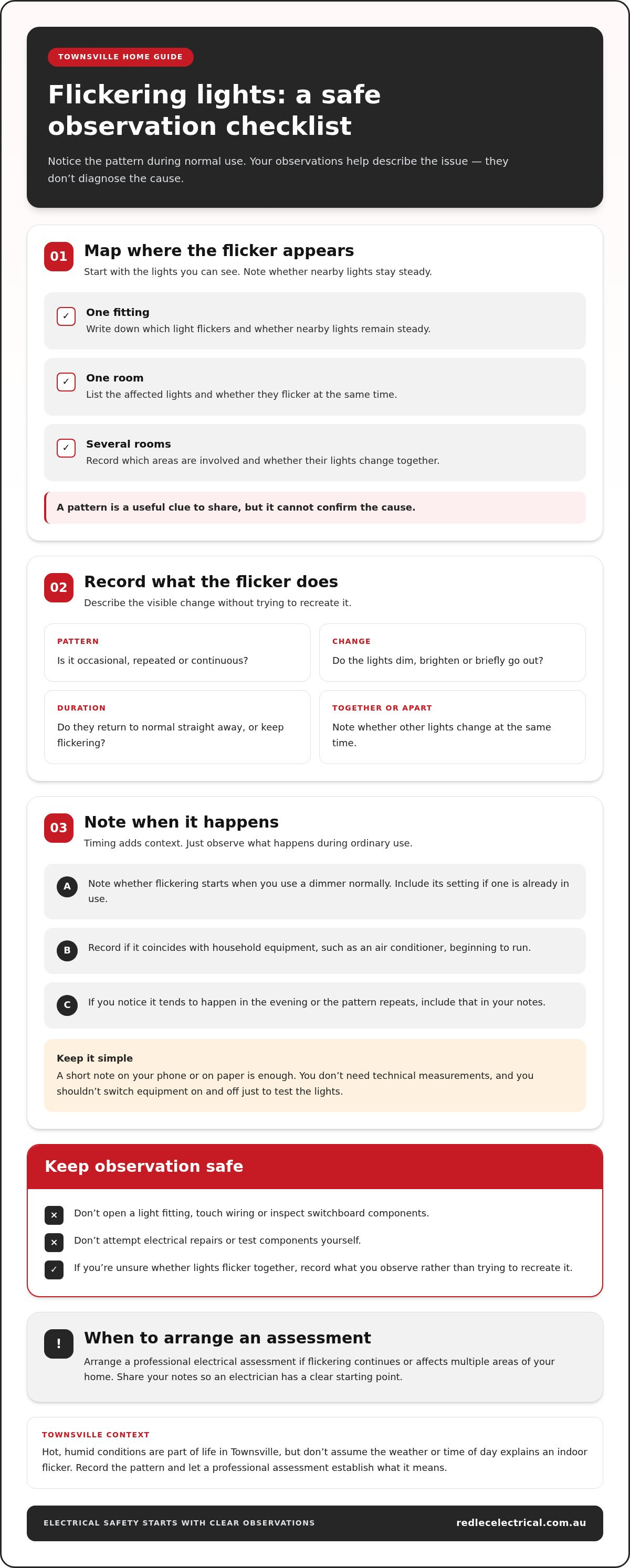
First, identify which lights flicker. Is it one fitting, several lights in the same room, or lights in different parts of the home? Note whether the flicker is occasional, repeated or continuous, and whether the lights dim, brighten or briefly go out. If you’re unsure whether two lights flicker at the same time, record what you observe rather than trying to recreate it.
One affected light is a different pattern from several rooms flickering together, but neither tells you the cause by itself. Use this simple record:
- One fitting: Note the exact light and whether nearby lights remain steady.
- One room: List which lights are affected and whether they flicker together.
- Several rooms: Record which areas are involved and whether the changes happen at the same time.
Patterns help describe the issue, but they can’t confirm whether the source is a globe, lighting equipment or a wider electrical concern. The Flicker (light) overview describes different forms of flicker, which is one reason a simple note of what you see is more useful than guessing at a fault.
When does the flickering happen?
Timing can add useful context. Note whether flickering starts when you use a dimmer or when household equipment, such as an air conditioner, begins running. Don’t switch equipment on and off just to test the lights. Record what happens during ordinary use, including whether the pattern seems to repeat or tends to occur in the evening.
Also note whether the light returns to normal straight away, continues to flicker or changes in brightness. Include the dimmer setting if one is already in use, and whether other lights change at the same time. A short note on your phone or on paper is enough; you don’t need technical measurements.
Townsville homes experience hot, humid conditions, but don’t assume the weather or time of day explains an indoor flicker. Record the pattern and let a professional assessment establish what it means. This gives you a clear account to share if the issue persists or spreads.
Common Causes of Flickering Lights: From LED Globes to Electrical Connections
Flickering can start with a single globe or relate to equipment serving several lights. A light-source issue may affect one fitting, while flickering across multiple areas can have other possible electrical causes. These are possibilities, not diagnoses. The pattern helps describe what’s happening, but an electrician needs to assess the cause.
Consider what type of light is affected and whether the flicker changes during normal use. A single fitting that flickers at a particular dimmer setting suggests different possibilities from lights in separate rooms changing together. Neither pattern proves what has gone wrong.
LED globes, drivers and dimmer compatibility
An LED globe and dimmer need to work together. If they’re incompatible, the globe may flicker, particularly when you adjust the brightness. An ageing or faulty globe could also be involved. Some LED lights have a driver, the component that regulates power to the light. If it isn’t working as it should, flickering may result. These are possible explanations, not a confirmed fault.
You can observe whether the flicker changes as you use the dimmer normally, then record the setting and what you noticed. Don’t take the fitting apart or try to test its components. If the light continues to flicker, note whether the symptom is limited to that fitting or appears elsewhere.
Wiring, circuit and switchboard possibilities
If several lights flicker, an electrician may consider factors beyond an individual globe. Possible explanations include an electrical connection, changes in voltage, demand on a circuit or an issue involving the switchboard. Note whether lights in more than one room change at once, or whether the flicker coincides with household equipment starting. Those details can help guide an assessment, but they don’t establish the cause.
A licensed electrician can assess the electrical system and relevant components to identify what may be contributing to the flickering. Keep your observations external: describe which lights are affected and what was happening at the time, rather than opening fittings or examining switchboard components yourself.
Townsville homes rely on lighting through hot, humid North Queensland conditions, but the climate alone doesn’t explain an indoor flicker. Record whether the issue is isolated or widespread and whether it keeps returning. If flickering affects multiple areas or continues, Redlec’s electrical services in Townsville can provide an assessment and explain the next steps.
One Flickering Light or Several? How to Read the Difference
Whether one light flickers or several change together is useful information, but it isn’t a diagnosis. A single fitting may draw attention to the globe, dimmer or light fitting. Flickering across a room or several rooms can have other possible explanations that need professional assessment. A globe isn’t always the answer, so note the pattern before deciding what to do.
Use this comparison to describe what you see. The possible explanations are clues only, not confirmation of a wiring, circuit or switchboard fault.
| Pattern you observe | Possible explanations | Suitable next step |
|---|---|---|
| One fitting flickers while nearby lights remain steady | The globe, dimmer compatibility or the light fitting may be involved. | Note whether it happens at a particular dimmer setting and whether it continues. |
| Several lights in one room flicker together | The shared pattern may relate to lighting equipment or another electrical factor. Symptoms alone can’t identify which. | Record which lights change together and whether other rooms stay steady. |
| Lights in several rooms flicker at the same time | A wider electrical issue may need to be considered, but the pattern doesn’t prove a wiring, circuit or switchboard fault. | Arrange an electrical assessment if it persists, is widespread or you’re unsure what’s happening. |
What a single fitting may suggest
If only one light flickers, notice whether other nearby lights remain steady at the same time. A globe, dimmer or fitting could be involved, but replacing a globe won’t necessarily address every cause. If the light is dimmed, record whether the symptom changes with the setting during normal use. Don’t open or alter the fitting; leave electrical checks to an electrician.
What several flickering lights may suggest
Lights changing together, especially across different rooms, give an electrician useful information about how widespread the symptom is. Record the rooms and fittings affected, whether they flicker simultaneously, and whether the issue is persistent or intermittent. Don’t use the pattern to decide that a circuit or switchboard is faulty. Arrange a professional assessment if the flickering is widespread, continues or remains unclear.
For a clearer account, note what stays steady as well as what flickers. For example, you could report that lights in the living room and hallway dip together while bedroom lights remain unchanged. This doesn’t identify a cause, but it helps distinguish a limited symptom from one affecting more of your Townsville home. An electrician can assess the relevant parts of the electrical system and explain the findings.
What to Do About Flickering Lights in a Townsville Home
If a light starts flickering, you don’t need to work out the fault yourself. A calm, clear record of what you notice can help an electrician understand the issue. Keep your observations simple and external: don’t open fittings or inspect wiring or switchboard components.
Follow these steps to move from noticing the flicker to deciding whether to arrange an assessment:
- Observe: Notice which lights flicker and whether they dim, brighten or briefly go out.
- Record: Write down when it happens, how long it lasts and whether the pattern repeats.
- Compare the pattern: Note whether it affects one fitting, one room or several areas, and whether dimming or household equipment use coincides with it.
- Arrange an assessment if needed: If flickering persists, is widespread or has no clear pattern, have a licensed electrician assess it.
You can make a quick note on your phone after an episode rather than trying to reproduce it. For example, record that the hallway light flickered when you adjusted its dimmer, or that lights in two rooms changed together while the air conditioner was running. These details describe what happened; they don’t establish the cause.
Record the details before arranging help
Note the location of each affected fitting and whether nearby lights stayed steady. Record the time, duration and whether the flicker was occasional, repeated or continuous. Add any relevant activity, such as adjusting a dimmer or starting household equipment. A brief, factual description is enough; you don’t need to take measurements or test electrical components.
When arranging electrical help, share which lights flicker, when it happens, how long it lasts, whether it repeats and what else is running. This gives the electrician a useful starting point without asking you to diagnose the problem.
Know when to arrange a professional assessment
Arrange an assessment if the flicker continues, affects several rooms or remains unexplained. A licensed electrician can assess relevant electrical components and consider whether the issue relates to a fitting or a wider part of the electrical system. If the assessment identifies a switchboard concern, the electrician can explain the findings and whether further attention is needed.
Townsville’s hot, humid North Queensland climate is part of local home life, but it doesn’t prove why an indoor light is flickering. Focus on the pattern you can observe and leave technical checks to a professional. If you’re still unsure what to do about flickering lights in your house, a clear record and an electrical assessment are sensible next steps.
For persistent or widespread flickering, arrange an electrical assessment in Townsville with Redlec Energy. Share what you’ve noticed and Redlec’s electrical team can assess the issue.
How Redlec Energy Helps with Flickering Lights in Townsville
Persistent or widespread flickering can be hard to assess from symptoms alone. Redlec Energy Solutions provides electrical services for homes in Townsville and surrounding areas, including assessment of flickering lights. Share the pattern you’ve observed so the electrician can assess the relevant lighting and electrical components without assuming a cause in advance.
What to expect from a local electrical assessment
Your notes about which lights flicker, when it happens and whether it affects one fitting or several areas give the electrician a useful starting point. The relevant lighting and electrical system can then be assessed to understand what may be contributing to the symptom. The assessment focuses on what you’ve noticed rather than relying on a guess based on the pattern alone.
You can ask for a clear explanation of the findings and possible next steps. Flickering can have more than one possible cause, so don’t assume a particular globe, connection or switchboard component needs attention before it has been assessed. The aim is to understand the issue and discuss suitable next steps.
As NQ locals, the Redlec Energy Solutions team works with homes in the Townsville area. Customer feedback describes the service as professional, prompt and courteous, with neat workmanship. These qualities matter when you’re dealing with an unexplained electrical symptom and want the issue approached carefully and explained clearly.
Arrange electrical help in Townsville
Consider arranging an assessment if flickering continues, affects several rooms or remains unexplained. Share what you’ve recorded, including which lights are involved, whether they change together and what was happening at the time. You don’t need to identify the fault; a straightforward account of the symptoms is helpful.
If you’re unsure what to do about flickering lights in your house, start by discussing the pattern with a local professional. Redlec Energy Solutions assesses flickering lights in homes across Townsville and surrounding areas, focusing on your home and the details you provide.
Talk to Redlec Energy Solutions about flickering lights to discuss what you’ve noticed and arrange professional electrical help.
Take the Next Step Towards Steady Lighting
You don’t need to identify the fault before asking for help. If you’re still wondering what to do about flickering lights in your house, describing what you’ve noticed is enough to start a useful conversation. An electrician can assess the issue and explain the next steps clearly.
If the flickering changes, keep track of what’s different and share that information when you speak with Redlec Energy. A shift from one light flickering to several, for example, is useful context for an assessment, not something you need to interpret on your own. Focus on understanding what’s happening in your home rather than guessing at a cause.
Redlec Energy provides electrical services in Townsville, with customer feedback describing its service as professional, prompt and courteous. If the flickering persists, affects several areas or leaves you unsure, you can take the next step without having a diagnosis ready.
Talk to Redlec Energy about flickering lights and describe what you’ve noticed. A clear conversation can help you move towards a professional assessment with greater confidence.
Frequently Asked Questions
Why do my lights flicker when the air conditioner starts?
A light may briefly dim as an air conditioner starts because the appliance draws power as it begins running. If the flicker is pronounced, lasts beyond startup or affects lights in different rooms, don’t assume it’s a normal response. Note which lights change and whether it happens each time the air conditioner starts. If it keeps happening, an electrician can assess the electrical system and determine whether anything needs attention.
Can a dimmer switch make LED lights flicker?
Yes, an LED globe may flicker if it doesn’t work well with the dimmer, particularly at certain brightness settings. The light’s driver, which regulates power to an LED, may also contribute if it’s ageing or faulty. Notice whether the flicker changes as you adjust the dimmer during normal use. If it continues across different settings or the cause isn’t clear, have the fitting assessed rather than taking it apart.
Why do my lights flicker at the same time each evening?
A repeating evening pattern can coincide with household equipment being used, but the timing alone can’t identify the cause. Note whether the flicker affects one light or several, and what appliances are running when it occurs. If it happens at a similar time without an obvious connection, record the pattern over several occasions. Don’t assume it’s a network signal or a fault. An electrician can consider your observations as part of an assessment.
Can a loose light globe cause flickering?
Yes, a globe that isn’t seated properly can cause intermittent flickering, though other issues can produce the same symptom. If one light is affected, note whether the flicker changes or stops during ordinary use, and whether other lights stay steady. Don’t reach into or dismantle a fitting to investigate. If the flickering continues, or you’re uncertain about the fitting, arrange an assessment rather than assuming a globe replacement will resolve it.
Why do lights flicker when the washing machine is running?
The washing machine’s motor can change its power demand as it starts or moves through parts of a cycle, and lights may appear to dip at the same time. Note whether it happens at startup, during a change in the cycle or throughout operation, and whether other appliances are running. A brief coincidence doesn’t confirm a fault. If the flicker is strong, recurring or affects several rooms, arrange an electrical assessment. For broader property maintenance involving major household appliances and utility installations, experienced service providers such as Synergy Trades Group can assist with comprehensive trade and plumbing solutions.
Can flickering lights be caused by ripple control in Australia?
Ripple control signals are used by some Australian electricity networks to manage certain electrical loads, and in some circumstances a signal may be associated with lighting flicker. That doesn’t mean a regular evening flicker in Townsville is caused by ripple control. The equipment and exact pattern matter. Record when the flicker occurs and which lights are affected, then have a professional assess persistent or widespread symptoms rather than relying on the timing alone.
Should I arrange an electrician if only one light is flickering?
Arrange an assessment if the single light keeps flickering, the symptom is unexplained or you’re uncomfortable with what you’ve noticed. A one-fitting pattern can involve the globe, dimmer or fitting, but it doesn’t prove which part is responsible. If you’re deciding what to do about flickering lights in your house, note whether nearby lights remain steady and when the flicker occurs, then share those details with an electrician in Townsville.