When you hear a faint crackling or smell something like burnt plastic near your meter box, your first thought is likely: is my old switchboard a fire hazard? It’s a stressful question that many Townsville homeowners face, especially when the mercury hits thirty-five degrees and every air conditioner in the house is working overtime. Your switchboard is the brain of your home, but if it’s still using technology from the last century, it simply isn’t built for the electrical demands of a modern North Queensland lifestyle.
We understand the fear of electrical fires during the night and the confusion that comes with changing safety standards. You deserve a home that feels secure and a clear way to tell if your equipment is actually dangerous. In this guide, you’ll learn how to identify critical warning signs in your electrical board and why modern upgrades are essential for your safety.
We’ll provide clear criteria to judge your own switchboard, explain the vital role of RCD safety switches, and show how our local climate impacts your wiring. This guide gives you the facts you need to protect your property and find a reliable local expert to handle the switchboard upgrade process.
Key Takeaways
- Learn how to determine if your old switchboard is a fire hazard by checking for outdated ceramic fuses and a lack of modern protection.
- Discover the immediate warning signs of electrical failure, including unusual buzzing sounds and visible scorch marks on your meter box components.
- Understand how Townsville’s humidity and thermal cycling accelerate the degradation of older electrical connections, increasing the risk of faults.
- Find out why modern Australian Standard AS/NZS 3000 requires life-saving RCD safety switches that cut power in milliseconds.
- Get a clear overview of the switchboard upgrade process to ensure your home is ready for heavy tropical loads and potential solar battery storage.
Is My Old Switchboard a Fire Hazard? The Reality for Ageing Homes
National data indicates that electrical faults are responsible for roughly 25% to 40% of residential structure fires. For many homeowners in our region, asking is my old switchboard a fire hazard is the first step toward preventing a disaster. If your home was built before 1990, the answer to is my old switchboard a fire hazard is often a resounding yes. You can usually identify these outdated systems by looking for two main things:
- Ceramic fuses: These look like small porcelain blocks that you must pull out to replace a wire manually.
- Lack of RCD safety switches: If your board doesn’t have switches with ‘test’ buttons, your circuits aren’t protected against earth leakage.
Think about how much power we use today compared to forty years ago. A typical 1970s home had a fridge, a TV, and some lights. Today, a Townsville household runs high-capacity split-system air conditioners, pool pumps, and induction cooktops. This massive increase in demand puts immense pressure on old components. When these systems struggle, they generate heat. Without modern circuit breakers, that heat can build up until it ignites surrounding materials.
A dangerous practice we often see is over-fusing. This occurs when someone replaces a blown fuse with a wire that’s too thick. While this stops the fuse from blowing, it forces the house wiring to carry more current than it was designed for. The wires inside your walls can literally cook themselves while the fuse remains intact. This is a recipe for a hidden fire that starts long before you see smoke.
The Hidden Danger of Ceramic Fuses
Ceramic fuses are simple devices that work by melting a bridge of wire when too much current flows. This process can create sparks and molten metal inside the enclosure. Modern electrical distribution boards use circuit breakers that trip instantly and safely. Unlike these modern units, old fuses provide zero protection against earth leakage. This means they won’t trip if you touch a live wire, leaving you at risk of a fatal electric shock.
Asbestos Backing Boards: A Silent Risk
Many older Townsville homes have switchboards mounted on dark, bituminous panels. These panels, often branded as Zelemite, Lebah, or Ausbestos, frequently contain asbestos. Disturbing these boards during a repair or a DIY attempt is incredibly dangerous. Breaking or drilling into them releases hazardous fibres into your living space. A licensed electrician will identify these ageing panels and ensure they’re managed safely during the switchboard upgrade process without putting your family at risk.
Red Flags: How to Spot a Failing Electrical Panel
Identifying whether your home is at risk doesn’t always require advanced technical tools; sometimes, your senses provide the most reliable clues. If you’re wondering, is my old switchboard a fire hazard, start by paying close attention to the area around your meter box. While some dangers remain hidden behind the panel, many critical faults announce themselves through sounds, smells, and visual changes that you can spot during a quick walk-around.
- Buzzing or crackling: If you hear a faint sizzling sound coming from behind the board cover, it’s often a sign of arcing. This happens when electricity jumps across loose or corroded connections, creating intense heat.
- Scorch marks and discolouration: Check the fuse holders and the backing board for any brown or black staining. This is a clear indicator that components are reaching temperatures high enough to char the material.
- The ‘fishy’ smell: A distinct, chemical odour that smells like fish or burnt plastic is a major warning. This scent is produced when the plastic insulation on your wiring begins to overheat and break down.
- Frequent tripping: Take note of how often you’re replacing fuse wire or resetting circuit breakers. If this happens under normal load, your system is struggling to cope with your household’s energy needs.
Visual Warning Signs You Can Check Today
You don’t need to be an expert to see the physical toll of time on an ageing system. Look for any visible wires near the board that show melted or brittle insulation; if the copper is exposed, the risk of a short circuit is extreme. You can also carefully check if the exterior of the board feels warm to the touch, though you should never attempt to open the panel yourself. If you still see ‘screw-in’ fuses rather than modern toggle switches, your home is likely operating on decades-old technology. According to the Queensland Electrical Safety Office safety switch guidelines, these older boards often lack the life-saving RCD protection required in modern Townsville homes.
Performance Issues in Your Home
Sometimes the red flags appear in your living room rather than at the switchboard. Flickering lights when the fridge or air conditioner kicks in are a sign that your board can’t manage the sudden surge in power. Similarly, if your power points feel hot or show signs of melting, the circuit is likely overloaded. While upgrading your board is the primary solution, ensuring your family’s safety also involves secondary layers. We recommend following our guide on how to test smoke alarms to ensure you have an early warning system in place. If you notice any of these symptoms, a professional audit of your electrical services is the safest next step.
The Townsville Factor: Why Our Climate Tests Old Switchboards
Townsville’s tropical lifestyle is hard to beat, but our environment is incredibly tough on electrical systems. If you are questioning is my old switchboard a fire hazard, you need to consider how North Queensland’s unique weather conditions accelerate wear and tear. Unlike homes in cooler, drier southern states, Townsville properties face a constant battle against moisture, extreme heat, and seasonal storms. These factors don’t just cause minor glitches; they actively degrade the safety components designed to protect your family.
One of the most significant issues we see is thermal cycling. During a typical summer day, temperatures inside an outdoor meter box can soar. As the copper wires and brass terminals heat up, they expand. When the sun goes down and the air cools, they contract. This repeated movement, day after day, eventually loosens the screw terminals. Loose connections are dangerous because they create high-resistance points that generate extreme heat and electrical arcing, which is a major reason why an ageing board becomes a liability.
Humidity and Corrosion: A Dangerous Mix
The air in Townsville is often thick with humidity, especially during the build-up and wet season. When moisture settles on the copper connections inside your meter box, it triggers oxidation. This corrosion creates high-resistance joints that act like a bottleneck for electricity. Instead of flowing smoothly, the current struggles to pass through the crusty buildup, generating intense heat in the process. For those living in coastal suburbs like Pallarenda or North Ward, salt air makes this process even faster. This hidden heat is often what answers the question: is my old switchboard a fire hazard? It can reach ignition temperatures long before a traditional fuse ever reacts.
High-Demand Cooling and Electrical Load
You deserve a home that stays comfortable even when the mercury hits thirty-five degrees. However, running three or four split-system air conditioners for hours on end puts a continuous, heavy load on your switchboard. Most older boards were designed for a time when a single fridge and a few lights were the only requirements. Modern energy-efficient technologies still require a stable supply, and a 40-year-old circuit simply wasn’t built for this sustained pressure. To ensure your home meets the latest safety requirements, we follow the AS/NZS 3000 Wiring Rules during every switchboard upgrade process. This ensures your system can handle modern cooling loads while providing the fault protection necessary to prevent a fire during a tropical storm or power surge.
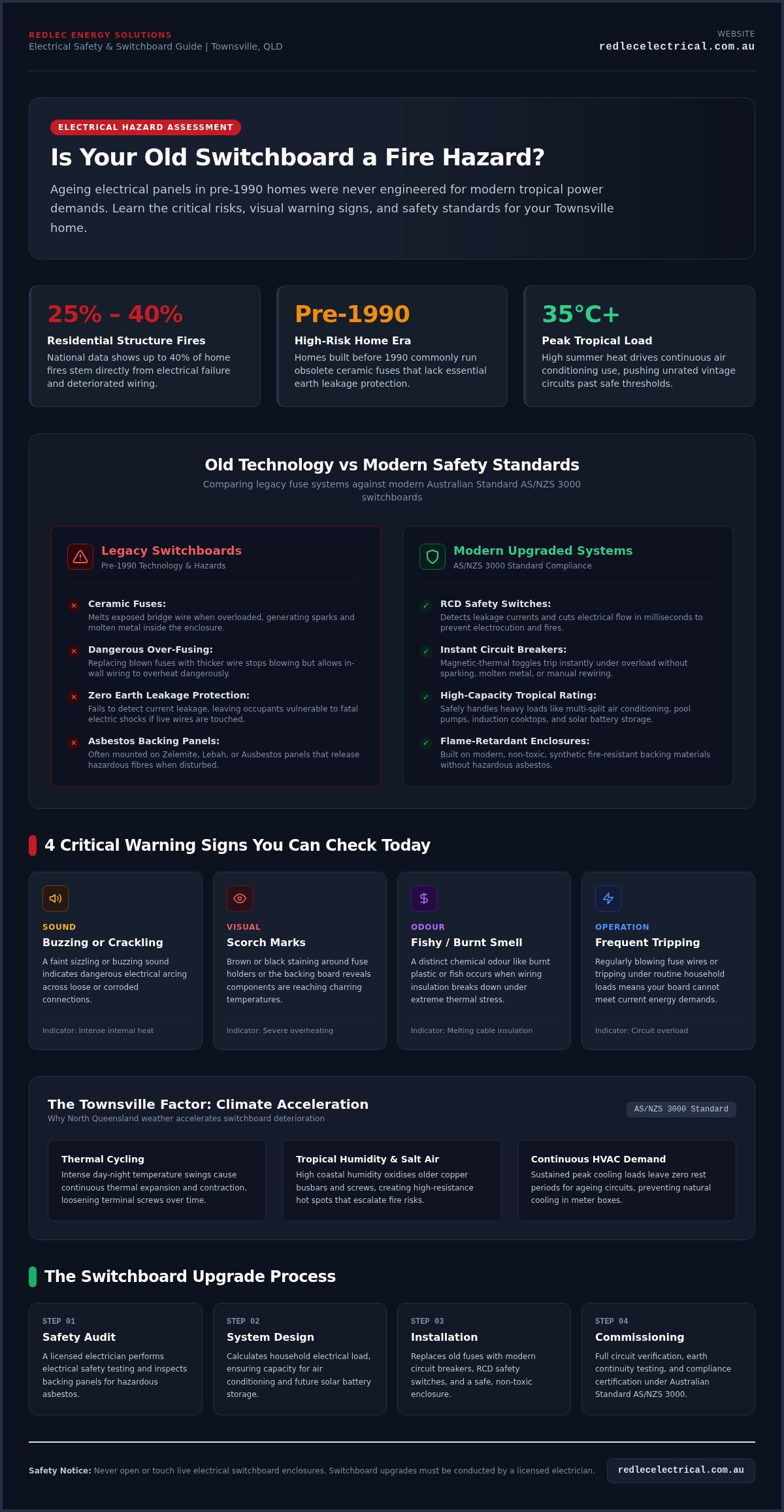
Modern Safety Standards vs. Old Technology
If you’re asking is my old switchboard a fire hazard, you need to look at how much safety technology has evolved. Current Australian Standard AS/NZS 3000:2018, which includes the critical Amendment 3 released in May 2023, sets a high bar for domestic electrical safety. Older boards with ceramic fuses rely on technology that is decades out of date. While a fuse might eventually blow during a massive short circuit, it offers no protection against the small, persistent leaks of electricity that cause fatal shocks or slow-burning fires. Modern standards mandate the use of RCD safety switches on all final sub-circuits, ensuring that every light, power point, and air conditioner in your home is monitored for faults.
Unlike old fuses, modern circuit breakers and surge protectors are designed to safeguard your property and your wallet. A surge protector acts as a shield against the sudden voltage spikes common during Townsville’s storm season, preventing your expensive appliances from being fried. Modern switchgear also detects overloads instantly, cutting power before wires have a chance to overheat. This proactive approach is the biggest difference between an outdated board and a compliant one. It’s about moving from a system that reacts to a fire to one that prevents it from ever starting.
The Role of RCD Safety Switches
RCD safety switches are life-saving devices that constantly monitor the flow of electricity and disconnect power in milliseconds if they detect a leakage current. In older Townsville homes, it was common to have just one RCD protecting the entire house. This is no longer considered best practice because a single fault can plunge your whole property into darkness. Modern installations use individual protection for each circuit. This means if your toaster has a fault, only the kitchen power trips, while your lights and fridge stay on. This setup provides both superior safety and better reliability for your daily life.
Thermal Imaging: Seeing the Invisible Risk
One of the most effective tools we use during the switchboard upgrade process is thermal imaging. This non-invasive diagnostic technique allows us to see ‘hot spots’ that are invisible to the naked eye. Research indicates that over 80% of switchboard fire events generate detectable heat anomalies weeks or even months before ignition occurs. By identifying loose connections or overloaded busbars early, we can fix the issue before it turns into an emergency. This technology is a core part of a professional safety audit, giving you peace of mind that your board isn’t hiding a dangerous secret. If you’re concerned about your home’s safety, you can book a professional switchboard inspection to catch these risks early.
Planning Your Switchboard Upgrade Process
If you have spent time wondering is my old switchboard a fire hazard, the most important step you can take is to move from worry to action. A professional switchboard upgrade process is a methodical series of steps designed to replace outdated technology with a system that can handle the heavy electrical loads of a North Queensland summer. It isn’t just a simple swap; it is a complete modernisation of your home’s energy hub to ensure long-term reliability and safety.
The journey begins with a thorough electrical safety audit. A licensed electrician will examine your existing wiring, check for signs of thermal damage, and identify any hazardous materials like asbestos backing boards. If your board contains asbestos panels, such as Zelemite or Lebah, we follow strict safety regulations to decommission and remove them without risking your family’s health. Once the old site is cleared, we install a modern enclosure featuring a robust busbar system and DIN-rail mounted circuit breakers.
The final phase involves testing and commissioning. Every new circuit is tested to ensure the RCD safety switches trip within the required millisecond timeframe. We don’t just walk away once the lights are on; we verify that every connection is tight and that the entire installation complies with the latest Australian Standards. This process gives you a clear result and the peace of mind that your home is no longer at risk from an ageing electrical panel.
Future-Proofing Your Home
When you decide to upgrade, it is the perfect time to think about your future energy needs. Consider whether you plan to add solar battery storage to your property soon. A well-designed board will have the spare capacity to integrate these systems seamlessly. We also recommend ensuring your new panel can handle high-draw appliances like EV chargers or large workshop tools. For larger Townsville properties, upgrading to three-phase power can provide a more balanced and efficient supply, especially if you run multiple large split-system air conditioners simultaneously.
Choosing a Reliable Local Expert
Your safety depends on the quality of the installation, so finding a reputable electrical company in Townsville is essential. You need a partner who understands the local climate challenges, such as salt air corrosion and extreme humidity. Always check that your electrician is fully licensed and that they provide a Queensland Electrical Safety Certificate upon completion. This document is your guarantee that the work meets all regulatory requirements and that the question of is my old switchboard a fire hazard has been permanently resolved.
Secure Your Home Against Electrical Risks
Your home’s electrical system should provide comfort, not worry. By understanding the signs of a failing panel and the unique impact of our tropical climate, you can move from asking is my old switchboard a fire hazard to taking proactive steps for your family’s protection. Modernising your meter box with RCD safety switches and circuit breakers ensures your property meets current standards while handling the heavy loads of a North Queensland summer.
At Redlec Energy Solutions, we pride ourselves on being your reliable local experts. Our team consists of Licensed North Queensland Electricians who deliver AS/NZS 3000 Compliant Workmanship on every project. We also provide 24/7 Emergency Support for Townsville residents, ensuring you’re never left in the dark when it matters most. It’s a simple change that makes a massive difference to your long-term safety and energy efficiency.
Don’t wait for a flicker or a fishy smell to become an emergency. Book your electrical safety audit with Redlec Energy Solutions today to confirm your home is secure. Taking action now provides the peace of mind you deserve, knowing your property is prepared for whatever the weather brings.
Frequently Asked Questions
Can an old switchboard cause a fire even if nothing is turned on?
Yes, a fire can start even under minimal load if there are loose connections or degraded insulation. In Townsville, thermal cycling causes components to expand and contract, which gradually loosens screw terminals. These loose joints create high-resistance points that generate intense heat without tripping a traditional fuse. This hidden heat can eventually ignite the backing board or nearby dust, answering the question: is my old switchboard a fire hazard?
How much time does a typical switchboard upgrade take?
A standard residential switchboard upgrade process typically takes between four and eight hours to complete. During this time, your power will be disconnected to ensure the safety of our licensed electricians. We coordinate with the local supply authority if a meter move or service fuse replacement is required. We aim to have your power back on by the late afternoon so your home stays comfortable for the evening.
Is it legal for me to replace my own ceramic fuses?
It’s legal for a homeowner to replace the wire in a rewireable ceramic fuse, but it’s often a band-aid solution that ignores a bigger problem. If you constantly find yourself rewiring fuses, your system is likely overloaded or faulty. You should never attempt to modify the board or replace components yourself. In Queensland, all electrical work must be performed by a licensed professional to ensure it meets the AS/NZS 3000 safety standards.
What is the difference between a circuit breaker and an RCD?
A circuit breaker is designed to protect your home’s wiring from overheating and catching fire by cutting power during an overload. In contrast, RCD safety switches are life-saving devices that protect people from electric shock by detecting tiny leakages of current. Modern boards use combination units called RCBOs, which perform both roles. This ensures your property is protected from fires while your family is safe from potential electrocution.
Does my home insurance cover me if I have an old switchboard?
Every insurance policy is different, but having an outdated or non-compliant electrical system can complicate your claims. Some insurers may refuse to pay out for fire damage if they determine the cause was a poorly maintained or dangerous old switchboard. Upgrading to a modern system with RCD safety switches provides documented proof that you’ve taken reasonable steps to maintain a safe property, which is often a requirement in your policy.
How often should I have my electrical board professionally inspected?
We recommend a professional safety audit every two to five years for most Townsville homes. However, if your property is more than thirty years old or you live near the coast, more frequent checks are wise. Salt air and high humidity can accelerate corrosion on copper busbars and terminals. If you notice flickering lights or a warm meter box, you should book an inspection immediately to determine is my old switchboard a fire hazard.
Will a switchboard upgrade help stop my lights from flickering?
Yes, upgrading your switchboard often resolves flickering lights caused by loose connections or overloaded circuits. When your board is old, it struggles to distribute power evenly when high-draw appliances like air conditioners kick in. A modern upgrade includes a new busbar system and dedicated circuits that provide a stable, reliable flow of electricity. This eliminates the voltage drops that cause your lights to dim or pulse during the peak of a tropical summer.
What happens if my switchboard contains asbestos?
If your ageing board is mounted on a panel containing asbestos, it must be handled according to strict safety regulations. Our team is trained to identify and decommission these materials safely during the switchboard upgrade process. We don’t drill into or disturb the asbestos; instead, we remove the entire panel using controlled methods to prevent fibres from entering your home. We then install a modern, non-hazardous enclosure that meets all current Australian safety standards.