What does it take to keep a rental electrically safe? It starts with understanding what the law requires and acting promptly when a fault is reported, rather than assuming you need a routine inspection certificate. For Townsville landlords, landlord electrical safety obligations QLD can feel confusing, especially when electrical maintenance and smoke alarm rules are often discussed together.
You’re right to want a clear distinction between legal duties and sensible preventative checks. Queensland landlords must keep rental properties safe and in good repair, and specific requirements also apply to safety switches and smoke alarms. Smoke alarm obligations are separate, so meeting them doesn’t replace checking the condition of the property’s electrical fittings.
This guide explains the key responsibilities to consider, what to record and how to respond when a tenant reports an electrical problem. It also provides practical checks to help you spot concerns early. Townsville’s heat and humidity can place extra strain on electrical equipment, making it worthwhile to pay attention to its condition, but they don’t create a separate climate-related legal rule. When an issue needs assessment or electrical work, a licensed electrician can help you address it safely.
Key Takeaways
- Separate landlord electrical safety obligations QLD from practical maintenance checks.
- Know what to look for on visible wiring, switches and the switchboard, and understand why RCD safety switches matter.
- Respond appropriately when a tenant reports a fault, and distinguish smoke alarm responsibilities from electrical maintenance.
- Use a repeatable checklist to review records, note concerns and document follow-up for your Townsville rental.
- Recognise when a concern needs assessment or electrical work by a licensed electrician.
What electrical safety obligations apply to Queensland landlords?
As a Queensland landlord, you’re responsible for providing a rental that meets the applicable safety and repair requirements and maintaining it during the tenancy. The Residential Tenancies and Rooming Accommodation Act 2008 and Queensland’s minimum housing standards are key references. For electrical fittings, the standards require them to be in good repair and not pose a risk of injury through normal use.
It helps to distinguish three things. A legal obligation is a requirement set by legislation or regulation. A safety recommendation is a sensible preventative step, but it isn’t automatically a legally required inspection schedule. An electrician’s finding is the result of a professional assessment of the particular installation. A concern may warrant assessment, but it doesn’t by itself prove that a defect exists.
Queensland duty summary
- Keep electrical fixtures and fittings in good repair: Queensland’s minimum housing standards require them not to pose a risk of injury through normal use.
- Provide required safety switches: WorkSafe Queensland’s rental-property guidance sets out safety switch requirements, including coverage for general-purpose power point circuits.
- Respond to dangerous electrical faults: The Residential Tenancies Authority (RTA) identifies a dangerous electrical fault as an emergency repair.
These points summarise key duties, not every rule that may apply to an individual property. Refer to current RTA guidance and the relevant Queensland legislation for your circumstances.
What does Queensland law require a landlord to maintain?
In practical terms, you need to ensure the property’s electrical fixtures and fittings meet the applicable repair and safety standard. This is an ongoing maintenance responsibility, not a stated requirement to obtain an electrical safety certificate at a set interval. The Electrical Safety Act 2002 and Electrical Safety Regulation 2026 also form part of Queensland’s electrical safety framework. For an unusual installation or tenancy, seek legal guidance about how the requirements apply rather than treating a general checklist as a ruling. General principles are explained in Electrical Safety Principles.
Which electrical issues should prompt action?
Take a tenant’s report seriously, even if you don’t yet know what has caused the problem. Warning signs include:
- Cracked, scorched or visibly damaged switches, sockets or fittings
- Exposed wiring or loose electrical components
- A burning smell near a fitting or switchboard
- A circuit breaker or safety switch that trips repeatedly
Tell the tenant to keep clear of damaged equipment and not attempt electrical repairs. Arrange prompt assessment by a licensed electrician. A dangerous fault may need to be handled as an emergency repair under the tenancy rules.
A reported electrical fault is a reason to investigate, not proof of a confirmed defect. Keep a record of the report, the assessment and any work completed. This guide provides general information, not legal advice. Queensland requirements can change, so refer to current official guidance when making decisions about your property.
Electrical safety checklist: switches, wiring and the switchboard
Start with what you can safely see and what tenants have reported. A visual check doesn’t replace an electrician’s assessment, and it isn’t a claim that Queensland law requires inspections at a set interval. For the legal position, the Residential Tenancies Authority’s (RTA) Queensland Electrical Safety Laws for Landlords guidance is a useful reference. Keep legal requirements separate from preventative maintenance and an electrician’s findings.
Use this checklist during property reviews or when a maintenance report comes in:
- Switches and sockets: Look for cracks, scorch marks, loose fittings or signs of heat damage. Don’t remove covers to inspect them.
- Visible wiring: Note exposed, damaged or sagging cables, and keep people away from the affected area.
- Switchboard: From a safe distance, look for visible damage, unusual smells or signs of overheating. Never open the switchboard enclosure.
- Reported faults: Record what the tenant noticed, when it happened and whether it has happened again.
- Safety records: Keep available records of electrical work, safety testing and electrician findings with the property documents.
- Follow-up: Record what action was taken and whether further assessment or repair was recommended.
How should landlords think about RCD safety switches?
An RCD safety switch detects leakage current and disconnects power to help protect people from electric shock. Its protective purpose is distinct from the legal requirement to install required safety switches. Queensland guidance specifies safety switches for general-purpose power point circuits in rental properties. Refer to current RTA information for details that apply to your property and tenancy. If you’re unsure what’s fitted or whether it’s operating correctly, arrange an assessment by a licensed electrician rather than relying on appearance alone.
When should wiring or a switchboard be assessed?
Arrange an assessment if you see damage, receive a report of a burning smell or exposed wiring, or learn that a circuit keeps tripping. A change in electrical use, such as adding equipment that places more demand on an older installation, can also be a sensible reason to discuss the switchboard’s condition with a licensed electrician. In Townsville, note visible concerns after storms or exposure to damp conditions, but treat these as practical prompts, not extra legal standards.
Tenants should report concerns, not open, internally test or modify electrical equipment. Electrical safety testing can help assess an installation when there’s a reason to investigate. Don’t present it as a legally required recurring check unless current official guidance says so. Redlec Energy Solutions provides electrical safety testing to help assess concerns at your rental property.
Landlord or tenant: who handles electrical faults and smoke alarms?
A tenant’s report is the starting point for action, not a request for them to diagnose wiring or repair a fitting. For landlord electrical safety obligations QLD, the practical division is straightforward: you arrange appropriate maintenance and electrical assessment, while tenants report problems and avoid working on electrical equipment. The Residential Tenancies Authority (RTA) classifies a dangerous electrical fault as an emergency repair. The appropriate response depends on the reported issue and its assessed condition.
| Situation | Landlord action | Tenant action | Appropriate next step |
|---|---|---|---|
| Electrical fault reported | Acknowledge the report, record the details and arrange assessment or repair as appropriate. | Describe what happened and where; don’t open fittings or attempt electrical repairs. | Have a licensed electrician assess concerns that require electrical work. Follow the emergency-repair process if the fault is dangerous. |
| Smoke alarm maintenance | Meet the landlord’s applicable installation and pre-tenancy testing and cleaning responsibilities. | Carry out the required in-tenancy smoke alarm testing and cleaning, and report faults. | Manage smoke alarm compliance separately from general electrical maintenance. |
What should happen after a tenant reports an electrical fault?
Acknowledge the report and gather clear details: the affected room or fitting, what the tenant observed, when it happened and whether it has happened again. Keep the tenant’s description separate from any technical conclusion. Don’t ask them to remove a cover, inspect wiring or test equipment beyond ordinary safe use. Arrange an appropriate assessment, then record the report, action taken and any electrician’s findings.
If the reported issue may be dangerous, treat it as an emergency-repair matter under Queensland tenancy guidance rather than assuming it can wait for routine maintenance. Avoid promising a specific response time unless a current legal requirement or the circumstances establish one. The RTA’s electrical safety guidance explains landlord and tenant responsibilities. Use that guidance to help determine the correct process, and arrange professional assessment when needed.
How are smoke alarm duties different from electrical maintenance?
Smoke alarm requirements sit alongside electrical safety and repair responsibilities. Meeting one doesn’t replace the other. Queensland’s smoke alarm rules set separate expectations for compliant alarms, while tenants have an in-tenancy role in testing and cleaning them. Keep alarm records separate from electrical fault and repair records so you can follow up on each responsibility. For practical steps, refer to the existing guide on how to test smoke alarms rather than treating alarm checks as a substitute for electrical maintenance.
In short, tenants report concerns and carry out their specified smoke alarm tasks; you organise the appropriate response to electrical faults and maintain the property’s required safety. Clear communication and written records help keep each responsibility on track.
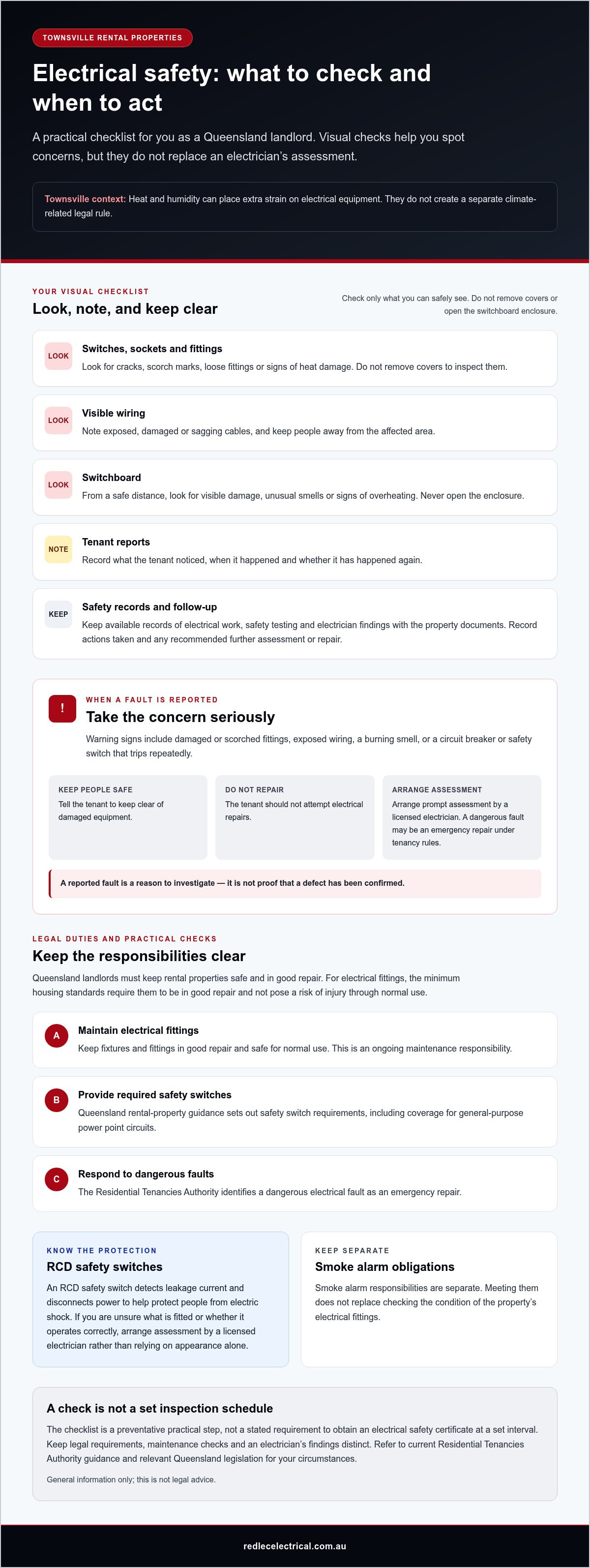
A practical rental electrical safety checklist for Townsville properties
A repeatable process helps you follow up on electrical concerns without treating every maintenance check as a legal inspection. For a Townsville rental, use this sequence when reviewing property records or responding to a report. It supports your landlord electrical safety obligations QLD while keeping legal requirements distinct from sensible preventative checks.
- Review existing records. Gather available documents for electrical work, safety testing, reported faults and previous electrician assessments. Note recommendations that still need follow-up.
- Record what you can observe safely. Note visible damage or signs of moisture near electrical fittings, along with concerns tenants have reported. Don’t remove covers, open the switchboard or touch damaged equipment.
- Arrange an assessment where needed. If a concern suggests a possible electrical fault, arrange assessment by a licensed electrician. Electrical safety testing can also be a practical maintenance step, but don’t assume a particular repeat interval is a legal requirement.
- Document the outcome. Add the assessment findings, completed work and recommended next action to the property record. Track unresolved items until you have a clear outcome.
What should you record after an electrical concern?
Keep records simple and useful. Include the date the concern was reported, who reported it, the location and a plain-language description of what happened. Add the action taken, the assessment date and relevant electrician documentation, such as findings or repair details. If further work is recommended, note who will follow it up and whether it has been completed. A consistent file helps you and your property manager see what remains outstanding, although no particular format guarantees compliance.
For example, if a tenant reports repeated power interruptions in one room, record their description rather than labelling the cause yourself. Add the electrician’s findings after the installation has been assessed. This gives you a clear timeline without confusing an initial report with a confirmed defect.
How can Townsville conditions shape practical checks?
Townsville’s humidity and storm exposure are practical reasons to look out for visible changes around a property. During routine reviews, note signs such as water ingress near electrical fittings or damage that appears after a storm. These observations are prompts to seek assessment, not additional legal standards. Leave electrical inspection and repairs to a licensed electrician, and keep tenants away from damaged equipment until it has been assessed.
If you manage commercial premises as well as rentals, arrange electrical support that suits the property’s use and electrical needs. For residential rental concerns in Townsville, Redlec provides electrical safety testing and assessment by a licensed electrician. Keep the resulting documentation with the property records to make future follow-up easier to organise.
Arrange reliable electrical safety support for your Queensland rental
For a rental in Townsville, keep three things distinct: verified legal obligations, sensible checks that help you spot concerns, and professional electrical work. A checklist can help you notice and record issues, but it can’t establish the condition of wiring or a switchboard. An electrician’s assessment is not automatically a legal certificate either. Let current Queensland requirements guide your landlord electrical safety obligations QLD, and arrange appropriate professional assessment for property-specific electrical concerns.
What can an electrical safety assessment help clarify?
An assessment can help establish whether a reported symptom points to an electrical concern, whether repairs are needed or whether further investigation is recommended. The scope depends on what is happening at the property. For example, repeated tripping may warrant investigation. You can also discuss uncertainty about the condition of a switchboard or the presence and operation of RCD safety switches with a licensed electrician. Treat the findings as technical advice about the installation, not as legal certification unless a specific requirement applies and the relevant documentation says so.
This distinction makes follow-up clearer. Your observations and a tenant’s report provide useful starting information; the electrician’s findings help determine the next practical step. Keep recommendations with your property records and track any work that remains outstanding.
How can you prepare before arranging electrical work?
Clear details can help Redlec understand the concern and provide relevant electrical support for your Townsville rental. Gather what you already have, without asking a tenant to investigate or handle electrical equipment. Share:
- The tenant’s report: Include when the issue began, where it occurs and what was noticed.
- Visible evidence: If it’s safe to do so, provide photographs of visible damage taken from a safe distance. Don’t remove covers or approach exposed wiring.
- Relevant records: Bring together documents for previous electrical work, testing records and earlier electrician findings.
- Urgent warning signs: Clearly flag reports of burning smells, exposed wiring, visible damage or repeated tripping.
In North Queensland, mention any visible changes noticed after wet weather, as humidity and storm exposure can be useful context. That information helps describe the concern, but it doesn’t replace a professional assessment or create a separate legal standard. Leave diagnosis and electrical repairs to a licensed electrician.
Redlec provides electrical safety testing and licensed electrician support to assess rental property concerns and clarify practical next steps. If you’re managing a Townsville rental and need help with an electrical fault, switchboard concern or safety testing, contact Redlec about rental electrical safety. Share the report and relevant records to give the assessment a clear starting point.
Set a clear next step for your rental
Decide who receives tenant reports and where follow-up records will be kept. This simple handover can help you act when a concern arises instead of searching through messages or property files. Keep current Queensland guidance accessible, and seek advice if you’re unsure how a specific requirement applies to your property.
Your approach to landlord electrical safety obligations QLD doesn’t need to rely on guesswork. Make the next step clear for tenants and property managers, and arrange professional support when an issue needs technical assessment or electrical work. A clear report and relevant records give your electrician a useful starting point.
If you’re ready to address a concern or plan electrical safety support for your Townsville rental, arrange reliable electrical safety support for your Townsville rental.
Frequently Asked Questions
Are landlords legally required to arrange regular electrical safety inspections in Queensland?
No. Queensland doesn’t require landlords to obtain a routine electrical safety inspection certificate at a set interval. You still need to maintain the property’s electrical fixtures and fittings in safe repair and meet specific requirements for safety devices. You can arrange electrical safety testing as a preventative measure or when a concern arises, but don’t present a chosen testing schedule as a legal rule. Refer to current Residential Tenancies Authority guidance for your circumstances.
Does a Queensland rental property need an RCD safety switch?
Yes. Queensland requirements call for safety switches on general-purpose power point circuits in rental properties. These devices reduce electric shock risk by detecting leakage current and cutting power. If you’re unsure whether the property has the required coverage, don’t rely on a visual check or assume one switch protects every circuit. Have the switchboard assessed by a licensed electrician and refer to current Queensland guidance for rules that apply to your property.
Can a tenant carry out electrical repairs in a rental property?
No. A tenant shouldn’t open a fitting, handle exposed wiring or attempt repairs to fixed electrical equipment. Their practical role is to report the issue clearly, including which room is affected and what happened. You can then arrange appropriate assessment and repair. For example, a tenant who notices a damaged socket should keep clear of it and notify you or the property manager rather than removing its cover.
Who is responsible for arranging repairs after a tenant reports an electrical fault?
You, as the landlord, are responsible for arranging appropriate maintenance or repair, either directly or through your nominated repairer. Record what the tenant has reported and whether the problem appears dangerous. Under Queensland tenancy guidance, a dangerous electrical fault is an emergency repair, so follow the applicable emergency-repair process rather than treating it as an ordinary maintenance request. If the seriousness of the fault is unclear, arrange assessment by a licensed electrician.
Are smoke alarm requirements part of a landlord’s electrical safety obligations in Queensland?
Smoke alarms have separate legal requirements that sit alongside, rather than replace, electrical maintenance duties. Queensland’s rental rules require compliant alarms for applicable properties, including interconnected photoelectric alarms under the requirements that apply to new or renewed tenancies. Tenants also have an in-tenancy role in testing and cleaning alarms. Keep alarm tasks and records separate from electrical fault reports so one type of maintenance isn’t mistaken for the other.
What should a Townsville landlord do if a property has exposed wiring or a burning smell?
Treat exposed wiring or a burning smell as a serious warning. Tell the tenant to keep people away from the affected area and not touch or investigate the wiring or fitting. Ask them to report its location and what they noticed, then arrange prompt assessment by a licensed electrician. If the fault may be dangerous, use Queensland’s emergency-repair process. Record the report and the steps taken, including any electrician’s findings and follow-up.