Could a well-presented home still have ageing wiring or electrical faults? In Townsville, heat, humidity and cyclone conditions can put extra strain on electrical systems. A pre-purchase electrical inspection Townsville buyers arrange can bring electrical concerns into focus alongside a general building and pest report.
Before you commit to a property, a focused electrical assessment can help you understand the condition of the wiring, switchboard, outlets and other electrical components. It can also help distinguish an observed concern from an issue that needs testing or further assessment. An electrical inspection complements a building and pest inspection, but does not replace it.
This checklist covers what an inspection may assess, what to consider in North Queensland homes and how to use the findings when weighing up a purchase. Redlec Energy Solutions provides electrical safety testing in Townsville. Our licensed electrical expertise can help you understand electrical concerns and practical next steps.
Key Takeaways
- A pre-purchase electrical inspection Townsville buyers arrange can clarify electrical concerns before you decide how to proceed.
- Discuss the switchboard, circuit protection and RCD safety switches, and confirm what the assessment will cover.
- Sort report findings into safety concerns, repair needs and items requiring further assessment.
- Prepare by arranging access, sharing relevant property details and noting visible concerns or known electrical work.
- Redlec’s electrical safety testing and local electrical expertise can help you understand findings and practical next steps.
Why a Pre-Purchase Electrical Inspection Matters for Townsville Buyers
A pre-purchase electrical inspection is a focused assessment of a property’s electrical system by an electrician. It can help you understand the condition of electrical components and identify safety concerns that may affect your decision to proceed, seek clarification or arrange further assessment. This gives you a clearer view of one part of the home before you commit.
An electrical assessment and a building inspection have different scopes. A building report considers the property’s general condition within the scope stated by its inspector, while an electrical assessment focuses on electrical matters. The reports can complement each other, but don’t assume one covers everything addressed by the other. A pre-purchase electrical inspection Townsville buyers arrange can bring electrical questions into focus alongside other property information.
The precise checks depend on the agreed scope and what the electrician can access. A general overview of electrical safety testing explains the range of visual checks and electrical tests, but it doesn’t define what a particular property assessment includes. Before relying on a report, check which areas were assessed, what could not be accessed and whether further investigation is recommended.
Does a building inspection cover the electrical system?
Building inspections and electrical assessments address different aspects of a property, and the electrical detail in a building report can vary. Don’t assume the report fully assesses wiring and equipment, or that it excludes every electrical observation. Read its stated scope and limitations, then compare them with the electrical report. If either document raises a question outside its scope, note it before deciding how to proceed.
Why Townsville property conditions deserve attention
Townsville’s heat and humidity are useful context when an electrician assesses electrical equipment, particularly in exposed or enclosed areas. They don’t prove a fault is present. Storm exposure is also specific to each property. The home’s location and the condition of outdoor electrical equipment may be useful points to discuss, but a history of storms alone isn’t evidence of damage.
Note whether outdoor equipment is exposed to weather or whether you can see signs of damage around it, but don’t open or test electrical fittings yourself. Share your observations with the electrician so they can consider them within the agreed assessment. A licensed electrician can explain what the findings indicate, distinguish an observed concern from a confirmed fault and identify when further assessment may be needed.
Use the reports as complementary sources of information. Together, they can help you ask better questions about the property and decide what needs attention before you proceed. The key is to understand what each assessment actually covers, rather than assuming one report answers every question about the home.
What a Townsville Pre-Purchase Electrical Inspection Checklist Can Cover
A pre-purchase electrical inspection Townsville buyers arrange can cover different parts of the electrical system, depending on the agreed scope and what the electrician can access. Treat the items below as areas to discuss, not a promise that every inspection will test every component. Before the assessment, clarify what will be checked and how any limits will be recorded.
In North Queensland, a property may have electrical equipment supporting substantial air conditioning use or outdoor areas exposed to local weather. These details can help you ask focused questions, but they don’t establish that a fault exists. The electrician’s observations and any recommended testing provide the relevant evidence.
Switchboard, circuits and RCD safety switches
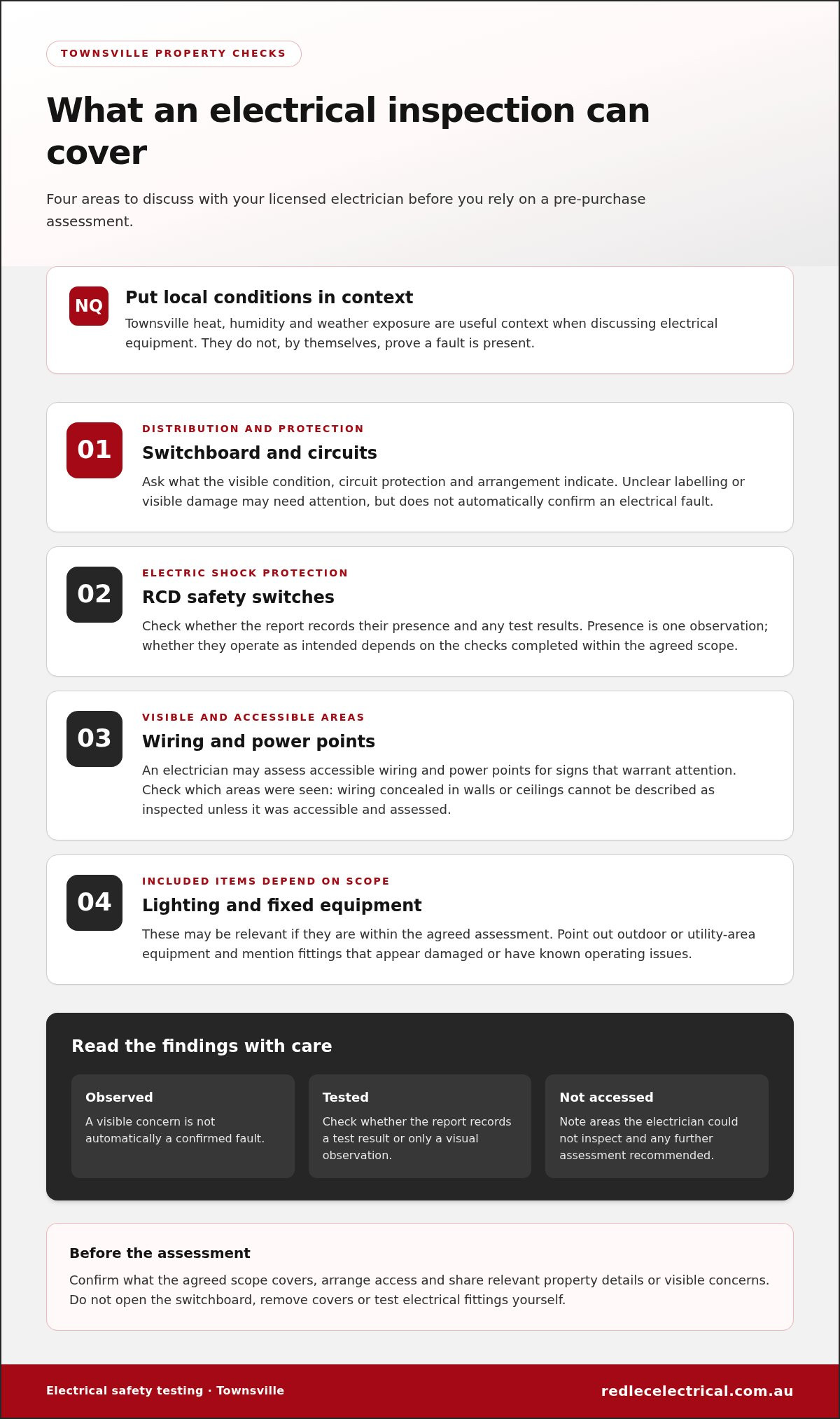
The switchboard distributes electricity to a property’s circuits and contains devices that help protect them. Its visible condition and the type and arrangement of circuit protection can help the electrician identify matters for closer assessment. RCD safety switches detect leakage current and disconnect power to reduce the risk of electric shock. Their presence is one observation. Whether they operate as intended depends on the checks completed within the agreed scope.
Check whether the report describes the switchboard’s condition, circuit protection and any RCD safety switches. Note whether it records a tested result or a visual observation. Visible damage or unclear labelling may need attention, but does not automatically confirm an electrical fault. A useful report distinguishes what the electrician observed from anything requiring testing or further assessment.
Wiring, outlets, lighting and equipment
An electrician may assess visible and accessible wiring, along with accessible power points, for signs that warrant attention. The report should make clear which areas were seen and which were not. Wiring concealed inside walls, ceilings or other structures cannot be described as inspected unless it was accessible and assessed.
Lighting and fixed electrical equipment may also be relevant if they are within the agreed scope. In a Townsville home, point out equipment in outdoor or utility areas and mention fittings that appear damaged or have known operating issues. Don’t remove covers, open the switchboard or test fittings yourself. Share your observations so the electrician can explain whether those items are included or need a separate assessment.
- Switchboard: Ask what its visible condition and protection arrangements indicate.
- RCD safety switches: Check whether the report records their presence and any test results within scope.
- Accessible points: Note which visible wiring, power points, lights and fixed equipment were assessed.
- Access limits: Identify concealed or inaccessible areas and any recommended follow-up.
Clear scope and plain-language findings make it easier to understand what you know, what remains uncertain and what question to address next. Redlec’s electrical services in Townsville include electrical safety testing to help you make sense of electrical concerns.
How to Interpret Electrical Inspection Findings Before You Buy
A pre-purchase electrical inspection Townsville report is most useful when you can tell what the electrician observed, how it was assessed and what action is recommended. Read each finding in context. Not every note is a confirmed fault, and one concern does not automatically make the whole property unsafe. The report can inform your next steps, but it doesn’t replace independent purchase or legal advice.
A report’s scope and limitations show what its findings can, and cannot, tell you about the property’s electrical system. Check which areas were assessed, whether observations were visual or tested, and whether any parts of the property were inaccessible or excluded. This helps you separate a recorded result from an open question.
Safety concerns, repairs and further assessment
Prioritise an immediate safety concern differently from routine maintenance. Follow the report’s specific recommendation and clarify the next step promptly. A repair need describes work identified by the electrician. A recommendation for further testing means more information is needed before the issue can be confirmed. Use the report’s evidence and advice rather than assuming the worst from cautious wording.
The table below helps you organise findings. Its examples are prompts for understanding, not a diagnosis or a substitute for the electrician’s wording.
| Finding type | What it may mean | How to use it |
|---|---|---|
| Safety concern | The report identifies a condition that may need prompt attention. | Note the stated risk and recommended action; clarify any urgent steps with the electrician. |
| Repair or maintenance | The report describes work needed to address an observed issue or maintain equipment. | Record the affected item and the work recommended, then consider it alongside your purchase plans. |
| Further assessment | The available inspection didn’t confirm the cause, condition or extent of a concern. | Identify what additional check is recommended before drawing conclusions. |
A recommendation for further assessment isn’t proof that a defect exists. It marks a gap in what the inspection could establish. Similarly, a listed repair isn’t automatically an immediate hazard unless the report describes it that way. Let the electrician’s findings, not guesswork, guide your understanding.
Questions the report should help you answer
As you read each finding, ask:
- Can you identify the electrical issue and where the electrician observed it?
- Does the report explain its scope, limitations, inaccessible areas or exclusions?
- Are the recommended next steps clear enough to inform your purchase decision?
If a finding is unclear, note the exact wording and ask the electrician who prepared the report to explain it. Then consider the electrical information alongside your other property reports and independent advice. This keeps your decision grounded in what was assessed, what was found and what remains to be checked, without labelling the entire home safe or unsafe beyond the evidence.
Your Townsville Buyer Checklist: Before and After the Inspection
A little preparation can make your electrical assessment more useful. For a pre-purchase electrical inspection Townsville buyers can follow a simple sequence: arrange access, share relevant information, confirm the agreed scope, then review the findings and decide what follow-up is needed.
Prepare for the electrical inspection
Arrange access through the relevant agent or owner, and confirm how the electrician can reach the areas included in the assessment. Share any available details about renovations, electrical work or known issues. Before the visit, write down your questions so you can focus on the parts of the home that matter to you.
- Arrange access: Confirm how the electrician can enter the property and reach the areas included in the assessment.
- Share property information: Pass on available records or details about renovations, repairs and known electrical concerns.
- Review the scope: Understand which parts of the electrical system are being assessed and any access limits or exclusions.
- Read the findings: After the assessment, review the report’s observations, recommendations and limitations.
Make a short list of visible concerns to discuss, such as a fitting that appears damaged or an outlet you’ve been told doesn’t work. Include questions about the switchboard and safety switches. Don’t remove covers or test equipment yourself; leave electrical checks to the electrician. Clear notes keep the discussion specific and help prevent observations from being mistaken for confirmed faults.
Review the findings and plan your next step
Read each finding alongside the report’s scope and limitations. Separate items the electrician identifies for prompt attention from repair recommendations, future maintenance and matters needing further investigation. If the report recommends additional testing, treat that as an open question, not proof of a defect. Ask what the recommended assessment needs to establish.
Keep a simple record of each item: what the report says, where it was observed, the recommended action and any follow-up answer. If further investigation is advised, arrange it with the property’s access process in mind and share the relevant finding with the electrician. This gives the follow-up assessment a clear starting point and helps you track what has been resolved and what remains uncertain.
Electrical advice can clarify technical findings, while contract decisions are separate. If you need advice about your purchase contract or how a finding affects your position, speak with your conveyancer. Don’t make assumptions about contractual rights or deadlines based on an electrical report alone.
For practical help understanding electrical concerns, arrange electrical safety testing with Redlec.
Get Local Electrical Guidance from Redlec in Townsville
Electrical findings can raise practical questions. Is a note about the switchboard a safety concern, a repair recommendation or a reason for further assessment? Redlec Energy Solutions provides electrical services in Townsville, including electrical safety testing. Our local electrical expertise can help you understand property concerns and what an electrician’s observations mean, based on what the assessment has established.
What Redlec brings to electrical safety questions
Redlec’s electrical work is carried out by a licensed electrician, with expertise in electrical safety testing and RCD safety switches. If a report refers to circuit protection, an RCD safety switch or a switchboard concern, a clear explanation can help you understand the terminology and the recommended next step. Keep the report’s finding as your guide: an observation is not automatically a confirmed fault.
AS/NZS 3000, known as the Australian/New Zealand Wiring Rules, is a relevant standard for electrical installations. It provides context for questions about an installation, but mentioning the standard alone doesn’t establish that a particular property complies with it. Any explanation needs to relate to the work assessed, the evidence available and the report’s stated limits.
This practical approach matters across Townsville homes and commercial properties. You might be trying to understand a note about an accessible power point in a house or a switchboard observation in a small business premises. In either case, focus on specific questions: what was observed, what was tested, what remains uncertain and what action is recommended? Clear answers help you consider the electrical information alongside your other property reports.
Take a clear next step with Redlec
Before discussing a finding, have the relevant report or a clear description of the concern ready. Highlight a recommendation for further assessment, note an area the electrician couldn’t access, or list questions about RCD safety switches. This gives the conversation a practical focus and helps distinguish confirmed observations from items that still need investigation.
Redlec can explain electrical safety concerns in plain language and outline appropriate electrical next steps based on the information available. This guidance can support your understanding of the property; it doesn’t replace the inspection report, independent purchase advice or legal guidance from your conveyancer. If a report recommends further testing, use that recommendation as the starting point for discussing what needs assessment, rather than drawing conclusions before the work is done.
You don’t need to interpret technical wording alone. Discuss electrical concerns raised about your Townsville property with the Redlec team. Talk with Redlec about your property’s electrical concerns and get clear guidance on what to consider next.
Move Forward with a Clearer View
As you picture settling into a Townsville home, consider how you plan to use the space and whether future changes, such as adding appliances or updating a room, are part of your plans. This gives you a practical way to connect what you learn from a pre-purchase electrical inspection Townsville with the home you want to make your own.
Redlec Energy Solutions can help you discuss electrical safety questions about a Townsville property. Talk with Redlec about electrical safety for your Townsville property.
Take your time, ask clear questions and choose your next step with confidence.
Frequently Asked Questions
Is a pre-purchase electrical inspection the same as a building inspection?
No. They serve different purposes, so use each report for the questions it is designed to answer. If both reports refer to the same area, such as a damaged fitting or water staining near electrical equipment, keep those observations together and ask the relevant professional to explain their significance. This helps you avoid treating a building observation as a tested electrical result or overlooking a connection between findings.
Can an electrical inspection find hidden wiring problems?
It may identify clues, but an inspection can’t promise to find every concealed issue. If you’ve noticed a pattern, such as power cutting out in a particular room, record where and when it happens and share that detail with the electrician. For your pre-purchase electrical inspection Townsville, this context can focus the discussion on the concern without presenting an unverified cause as fact.
What happens if the inspection identifies an electrical safety concern?
Take the recommendation seriously, but don’t try to diagnose or repair the issue yourself. Ask the electrician to clarify which equipment or area is involved, what action they recommend and whether they have instructions about using it in the meantime. Keep that technical advice separate from your purchase decision: the electrician can explain the electrical matter, while your conveyancer can advise on contract questions.
Should I arrange an electrical inspection for an older Townsville home?
Consider the home’s history as well as its age. If you know that rooms have been added, the kitchen renovated or electrical equipment changed, those details can help frame an assessment. Age by itself doesn’t establish the condition of the installation. A report gives you property-specific information to weigh up, rather than assumptions based on when the home was built.
Does a pre-purchase electrical inspection include solar panels and batteries?
Only if those items are included in the agreed scope. If the Townsville property has solar, identify the equipment you want assessed, such as the panels, solar panel inverter or battery storage, rather than referring only to “the solar system”. That makes the intended coverage clearer. The report can then state which components were examined, helping you understand whether its observations relate to the solar equipment or the home’s other electrical systems.
How long does a pre-purchase electrical inspection take?
The time varies with the property and the agreed assessment. A home with a more involved electrical setup may need a different plan from a smaller dwelling, and access to relevant areas can affect how the visit proceeds. There’s no reliable general duration to assume. When arranging an assessment, describe the property and any particular systems or concerns, then follow the timing agreed for that job.