Could a simple oversight with your smoke alarms lead to a rejected insurance claim or a fine of over $7,700? For many Townsville homeowners, the 1 January 2027 deadline for the final phase of the qld smoke alarm legislation 2027 feels like a distant problem, but the reality of non-compliance is much closer than you think.
We know it’s frustrating to keep track of changing rules, especially when you’re trying to figure out the difference between photoelectric and ionisation alarms or how “interconnected” systems actually work in a traditional Queenslander. You want your family protected without getting bogged down in technical jargon or worrying about North Queensland’s humidity causing false triggers. This guide promises to clear up the confusion, ensuring your home meets every legal requirement before the clock runs out.
We’ll break down the exact placement rules for every bedroom and storey, list the specific hardware you need to stay legal, and explain how to get your property sorted so you can sleep soundly knowing your household is fully protected.
Key Takeaways
- Understand why the 1 January deadline is the final cutoff for the qld smoke alarm legislation 2027 and how it affects every Townsville homeowner.
- Learn why your home must switch to interconnected photoelectric alarms to ensure everyone is alerted simultaneously during a fire.
- Get clear guidance on mandatory alarm placement, including the specific requirements for every bedroom and connecting hallway.
- Discover the serious financial risks of ignoring the new standards, from heavy government fines to the potential rejection of insurance claims.
- Find out why Townsville’s humidity means you need high-quality, sealed units to prevent nuisance alarms and ensure your family’s safety.
What is the 2027 Queensland Smoke Alarm Legislation?
The qld smoke alarm legislation 2027 represents the final piece of a safety puzzle that has been over ten years in the making. While many people think of fire safety as something only landlords need to worry about, this upcoming deadline changes the game for every homeowner in Townsville. It’s the closing stage of a statewide rollout designed to ensure that no matter who owns the home or how long they’ve lived there, the occupants are protected by the most reliable technology available.
By 1 January 2027, all existing private dwellings must comply with these updated standards. This isn’t just about avoiding a fine; it’s about shifting our homes toward a system that prioritises early detection. Modern standards require alarms that talk to each other, so if a fire starts in the kitchen while you’re asleep, the alarm in your bedroom sounds immediately. This interconnected approach provides the maximum possible escape time for your family, which is the primary goal of the legislation.
The Evolution of QLD Fire Safety Laws
Queensland’s path to these new standards started back in 2017, following a tragic house fire in Slacks Creek that claimed eleven lives. The government realised that older ionisation alarms simply weren’t doing the job well enough. The rollout was broken into three clear stages. First, new builds and major renovations had to comply starting in 2017. Then, from January 2022, all rental properties and homes being sold had to meet the requirements before a new lease or settlement could occur.
The 2027 deadline is the most significant milestone because it covers everyone else. Whether you live in a high-set Queenslander, a modern townhouse, or a unit in the city centre, the law applies to you as an owner-occupier. The shift to photoelectric smoke alarm technology is mandatory across all these property types because these sensors are significantly better at “seeing” smoke from smouldering fires than the older style alarms many of us grew up with.
Why 2027 is the Non-Negotiable Deadline
It’s vital to understand that the Queensland Government hasn’t indicated any plans for further extensions. This is the final cutoff. Waiting until late 2026 to organise an upgrade is a risky move. As the deadline nears, we expect a massive surge in demand for qualified electricians across North Queensland, which could lead to long wait times and potential hardware shortages. By getting ahead of the crowd, you ensure your home is sorted without the stress of a last-minute rush.
Ultimately, the 2027 deadline marks the point where every Queensland bedroom must be protected by a compliant, interconnected alarm system. Taking action now means you can tick this off your list, knowing your home is legal, your insurance is valid, and your family is safe.
Mandatory Technical Standards: Photoelectric and Interconnected Alarms
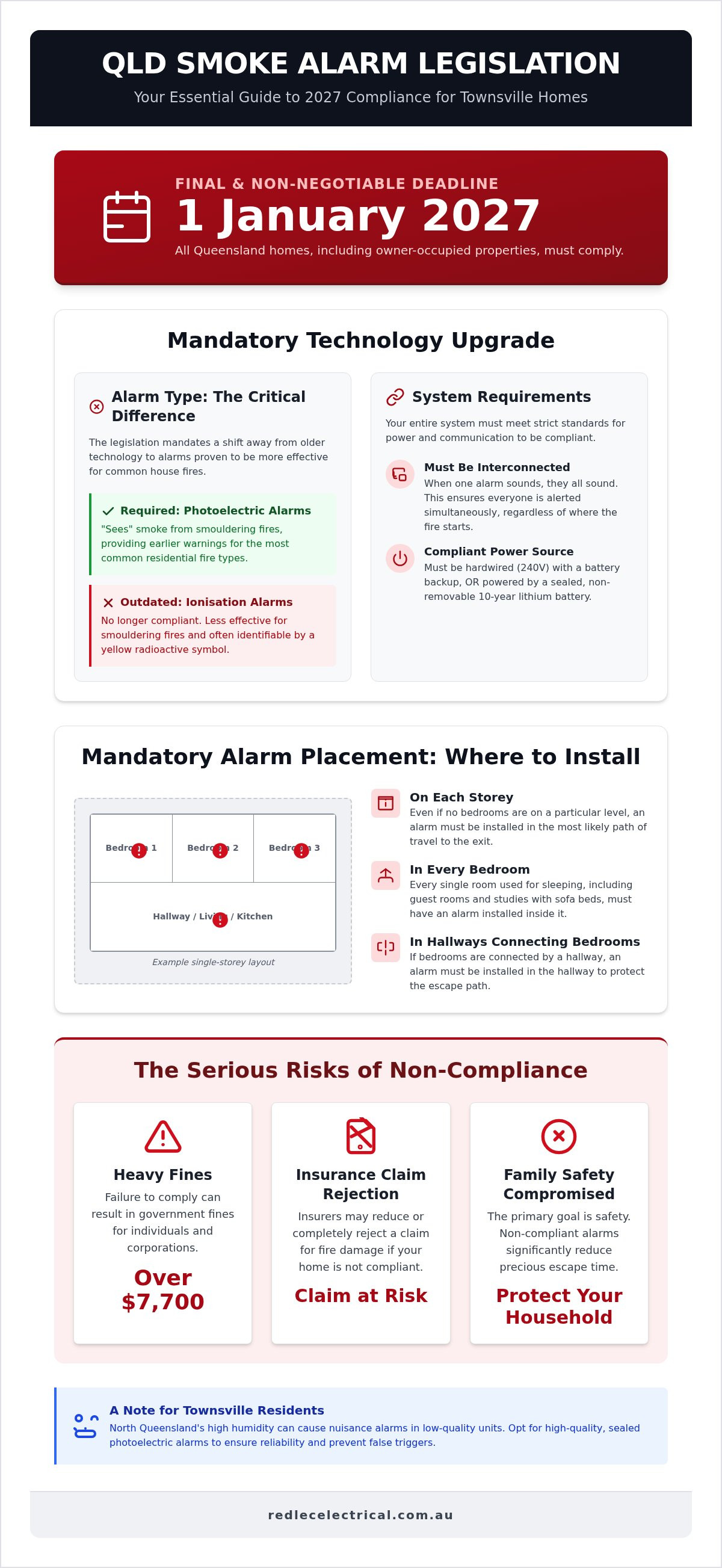
To meet the requirements of the qld smoke alarm legislation 2027, it isn’t enough to simply have a working device on the ceiling. The technical standards have become much stricter to ensure maximum reliability. Every alarm installed in your home must now comply with Australian Standard AS 3786:2014. If your current units are older models, they likely won’t meet this benchmark. The law also mandates that alarms must be interconnected. This means when one unit detects smoke, every single alarm in the house sounds simultaneously. This setup is vital for waking occupants in distant bedrooms if a fire starts in a kitchen or living area.
Power sources are another critical factor. Under the new rules, alarms must be either hardwired to your home’s 240V mains power with a backup battery or powered by a non-removable 10-year lithium battery. Traditional 9V replaceable batteries are no longer sufficient as a primary power source because they’re too easily forgotten or removed when they start chirping. These updated standards are detailed in Queensland’s official smoke alarm legislation, which aims to reduce the risk of fire-related fatalities by half through better detection technology.
Photoelectric vs Ionisation: Why the Change?
Most older homes in Townsville still have ionisation alarms installed. You can identify these by looking for a small yellow “radioactive” symbol on the unit’s casing. These alarms were designed to detect fast-flaming fires but often struggle with smouldering fires, which are the most common type in residential settings. Photoelectric sensors, on the other hand, use light-sensing technology to “see” visible smoke particles. They’re significantly faster at detecting the thick, smoky conditions produced by smouldering furniture or electrical faults. Because of this superior performance, ionisation alarms are effectively banned for all new installations under the qld smoke alarm legislation 2027.
Hardwired vs 10-Year Lithium Battery Alarms
The type of alarm you need often depends on when your house was built. If your home was constructed after 1997, it’s likely already fitted with hardwired 240V alarms. These must be replaced with new hardwired photoelectric units. For many of our classic older Townsville cottages, running new wires through tight ceiling spaces can be difficult. In these cases, 10-year non-removable lithium battery alarms are an excellent solution. These units can be interconnected wirelessly, meaning they “talk” to each other via radio frequency without needing a single new wire. If you’re feeling confused about which system fits your floor plan, having a licensed Townsville electrician perform a quick assessment can save you a lot of guesswork.
Mandatory Placement: Where Must Your Alarms Be Installed?
Where you place your alarms is just as important as the type of technology you choose. Under the qld smoke alarm legislation 2027, the old “one on each level” approach is no longer enough to keep your family safe or your property legal. The law now requires a blanket of protection that covers every sleeping area in the home. It’s about ensuring that if smoke starts in a living room or kitchen while you’re asleep, you’re alerted before the danger reaches your bedroom door.
The new standards mandate that every bedroom in the house must have a compliant smoke alarm. Additionally, hallways that connect bedrooms to the rest of the house require their own alarms. If your home doesn’t have a hallway, the alarms must be installed in the area between the bedrooms and the rest of the dwelling. You also need at least one working alarm on every storey, even if that level doesn’t contain any bedrooms. You can find more detail on these QLD Government smoke alarm requirements to see how they apply to specific building types.
Room-by-Room Placement Guide
The “every bedroom” rule is the biggest shift for many Townsville homeowners. In the past, a single alarm in a hallway might have been considered sufficient. Now, every person sleeping behind a closed door needs a dedicated sensor. When installing these, it’s vital to avoid “dead air” spaces. These are the corners of rooms where air doesn’t circulate well, which can delay the smoke reaching the sensor. We recommend keeping units at least 300mm away from corners and at least 400mm away from the tips of ceiling fan blades or air conditioning vents. This prevents air currents from blowing smoke away from the alarm during a fire.
Special Considerations for Multi-Storey and High-Set Homes
Townsville is famous for its classic high-set homes. If you’ve enclosed the downstairs area for a guest room, office, or teenager’s retreat, that space must meet the same strict standards as the upstairs level. For multi-storey houses, alarms should be placed on the ceiling of the stairway to ensure the sound carries between floors effectively. If you’re unsure about the best layout for your specific property, getting professional smoke alarm installation ensures every device is positioned for maximum safety and legal compliance. A local expert can help you navigate tricky spots, like avoiding placement too close to bathrooms where steam might cause frustrating nuisance triggers.
Non-Compliance Risks: Fines, Safety, and Insurance Concerns
Ignoring the qld smoke alarm legislation 2027 isn’t just a minor oversight; it’s a significant financial and safety risk. While the government rollout has been gradual, the final deadline is where the “grace period” ends for owner-occupiers. If your home isn’t compliant by the cutoff, you’re opening yourself up to more than just a ticking clock. There’s a heavy moral weight to consider too. Interconnected alarms provide the vital minutes needed to wake every family member, especially children who are often deep sleepers and may not hear a single alarm sounding at the other end of the house.
Property sellers face even more immediate hurdles. Compliance must be declared on the Form 24 during property settlement. If you haven’t upgraded to the new standards, it can delay your sale or result in a mandatory penalty of 0.15% of the purchase price paid back to the buyer. For a $500,000 Townsville home, that’s a $750 loss right at the finish line. It’s much simpler and cheaper to ensure the work is done correctly before the house even hits the market.
Financial Penalties and Legal Liability
Queensland fire authorities have the power to issue on-the-spot fines for non-compliance, which typically range from $685 to over $860 for various breaches. However, the maximum penalty for an individual failing to comply with the qld smoke alarm legislation 2027 is 50 penalty units, which totals $7,732 at the current 2026 value. For landlords, the legal liability is even higher. If a fire occurs in a non-compliant rental property, the owner could face massive legal claims or even criminal charges for negligence. While emergency electrician services are available if a fire causes immediate damage, preventing the tragedy in the first place is always the better path.
The “Insurance Gap” Homeowners Must Avoid
The “Insurance Gap” is perhaps the most frightening risk for Townsville families. Most Product Disclosure Statements (PDS) require the property owner to maintain the home to “legal safety standards.” If a fire occurs and your smoke alarms don’t meet the 2027 requirements, your insurer may have grounds to reduce your payout or deny the claim entirely. They look for any evidence of non-compliance to mitigate their loss. Ensuring your alarms are photoelectric and interconnected isn’t just a chore; it’s an investment in your home’s financial security. We often find that homes with outdated alarms also have ageing switchboards. A fire caused by an electrical fault in an old switchboard is a double tragedy if the smoke alarms fail to trigger.
Don’t leave your family’s safety or your financial future to chance. You can book a comprehensive smoke alarm audit today to ensure your Townsville home is fully compliant and your switchboard is up to the task.
Local Solutions: Getting Your Townsville Property Compliant
Townsville’s tropical climate presents a unique set of challenges for any electrical equipment, and smoke alarms are no exception. The intense humidity and summer heat in North Queensland can often lead to “nuisance alarms” in lower-quality units. When moisture or tiny insects get into unsealed sensors, they trigger the system, which is especially frustrating with an interconnected setup where every alarm in the house goes off at once. To meet the qld smoke alarm legislation 2027 without the headache of false triggers, you need hardware specifically designed for our local conditions.
We focus on providing sealed, high-quality photoelectric units that stand up to the local environment. By choosing the right equipment now, you avoid the cost of replacing failed units just a few years down the track. Our goal is to ensure that when your alarms sound, it’s for a genuine emergency, not just a humid afternoon in Mundingburra or North Ward. A professional installation doesn’t just tick a legal box; it builds a reliable safety net around your family that lasts for the full ten-year lifespan of the devices.
The Redlec Approach to 2027 Compliance
Matt and the team take a methodical approach to every Townsville home. We start with a full assessment of your current property layout to identify exactly where new units need to go to meet the qld smoke alarm legislation 2027. We don’t believe in a “one size fits all” solution. For some older Townsville cottages, wireless interconnection is the cleanest option, while newer homes might benefit from a fully hardwired setup. This is also an ideal time to consider a switchboard upgrade. Ensuring your hardwired alarms are connected to a modern, safe circuit with proper RCD protection is a smart move for your home’s overall electrical health.
Ongoing Maintenance and Testing
Once your new system is installed, keeping it in top shape is simple but essential. Dust and cobwebs are the main enemies of smoke sensors, so we recommend a quick vacuum around the casing every few months. Testing your alarms monthly is the best way to ensure the interconnection is still communicating correctly. For a detailed maintenance schedule, you can refer to our guide on how to test smoke alarms. If you hear a “chirping” sound in the middle of the night, it’s usually a warning that a backup battery is low or a unit has a fault. Because the units are linked, you might need to check a few different rooms to find the specific alarm that needs attention, but a quick press of the test button will usually clear the error and give you back your peace of mind.
Protect Your Townsville Home for the Years Ahead
The 1 January 2027 deadline is approaching fast. By now, you should have a clear picture of how the qld smoke alarm legislation 2027 affects your property. Upgrading to interconnected photoelectric alarms isn’t just about avoiding heavy fines; it’s about making sure your family has every possible second to escape if the unthinkable happens. Whether you live in a high-set Queenslander or a modern unit, getting your placement right and choosing hardware that handles Townsville’s humidity is the only way to stay truly compliant and keep your home insurance valid.
Don’t leave your safety to a last-minute rush as the cutoff draws closer. As a local, family-owned business, Redlec Energy Solutions is here to help you navigate these changes with ease. Our licensed Townsville electricians are interconnected photoelectric specialists who understand exactly what your home needs to be legal and safe. Book your 2027 Smoke Alarm Compliance Check with Redlec today and enjoy the peace of mind that comes with trusted local expertise. We’re ready to help you secure your home so you can focus on what matters most.
Frequently Asked Questions
What are the new smoke alarm laws in QLD for 2027?
By 1 January 2027, every Queensland home must be fitted with photoelectric, interconnected smoke alarms that comply with Australian Standard 3786:2014. This is the final stage of the qld smoke alarm legislation 2027, which mandates that alarms must be installed in every bedroom, in hallways connecting bedrooms to the rest of the dwelling, and on every storey of the house.
Do I need a licensed electrician to install my smoke alarms?
Yes, you must hire a licensed electrician to install or replace any smoke alarms that are hardwired to your home’s 240V mains power. While homeowners can technically mount standalone 10-year lithium battery units, we strongly advise professional installation to ensure every device is placed in a legally compliant location and that the wireless interconnection is signal-tested across your entire property.
Can I use battery-powered smoke alarms instead of hardwired ones?
You can use alarms powered by a non-removable 10-year lithium battery, but only if your home was not already required to have hardwired alarms under previous building codes. If your Townsville house was built or significantly renovated after 1997, the law requires you to use hardwired photoelectric alarms to remain compliant with the updated safety standards.
What happens if I don’t have interconnected smoke alarms by 2027?
Failing to comply with the new standards by the deadline leaves you liable for on-the-spot fines and a maximum penalty of 50 penalty units, which currently totals $7,732. More importantly, non-interconnected alarms significantly reduce your family’s escape time; if a fire starts in a closed laundry or lounge room, it may not wake occupants in bedrooms until the smoke is already thick and dangerous.
How many smoke alarms do I need in a standard 3-bedroom house?
A typical single-storey, three-bedroom home usually requires a minimum of four alarms to be compliant. This includes one alarm inside each of the three bedrooms and at least one in the hallway that connects those rooms to the rest of the house. If your bedrooms are spread across different areas of the home, you may need additional units to ensure every sleeping area is protected.
Does the 2027 smoke alarm legislation apply to units and townhouses?
Yes, the qld smoke alarm legislation 2027 applies to all domestic dwellings, including units, townhouses, and apartments. Even if your complex has a centralised fire system in the common areas, you are legally responsible for ensuring the alarms inside your private residence meet the new photoelectric and interconnection requirements before the January 2027 cutoff.
Why are my interconnected smoke alarms going off for no reason?
In North Queensland, nuisance alarms are frequently triggered by high humidity, dust, or small insects entering the sensor chamber. Because the system is interconnected, a single fault or dirty sensor in one room will cause every alarm in the house to sound simultaneously. Regular maintenance, such as vacuuming around the units, and installing high-quality sensors designed for tropical climates can help prevent these issues.
Will my home insurance be void if I don’t upgrade by the 2027 deadline?
It is highly likely that your insurance coverage will be affected if you fail to meet the 2027 requirements. Most insurance providers include a clause stating that the property must be maintained in accordance with all relevant safety laws. If a fire occurs and your alarms are found to be non-compliant, your insurer may have grounds to reduce your payout or deny the claim entirely.