Achieving mandatory smoke alarm compliance Townsville properties need isn’t just about checking off state regulations; it’s about installing hardware that can actually withstand North Queensland’s relentless humidity. A system that triggers screeching false alerts at two in the morning during a muggy wet season quickly becomes an exhausting nuisance rather than a dependable lifesaver.
If you feel uncertain about Queensland’s fire safety legislation, you’re certainly not alone. Many local homeowners and landlords share genuine frustration over tropical nuisance alarms, while worrying about potential non-compliance fines, legal liabilities, or discovering that non-compliant units could void their property insurance.
You’ll discover how to achieve complete compliance while protecting your home from moisture build-up, corrosion, and insect ingress. We break down the mandatory requirements under Australian Standard AS 3786:2014, help you decide between hardwired 240V systems and sealed 10-year lithium battery units, and outline how to secure an official electrical safety certificate of compliance with total confidence.
Key Takeaways
- Understand your exact legal obligations for smoke alarm compliance Townsville properties require ahead of mandatory Queensland deadlines.
- Discover why North Queensland wet season humidity triggers false alarms and how correct placement prevents middle-of-the-night sirens.
- Compare hardwired 240V installations against sealed 10-year lithium battery systems to select the most reliable setup for your home layout.
- Follow a practical five-step audit process to verify sensor expiry dates, decibel ratings, and interconnected warning systems across all storeys.
- Learn simple maintenance routines to stop dust, insects, and tropical corrosion from degrading your life-saving photoelectric alarms.
Queensland Smoke Alarm Legislation: Mandatory Rules for Townsville Properties
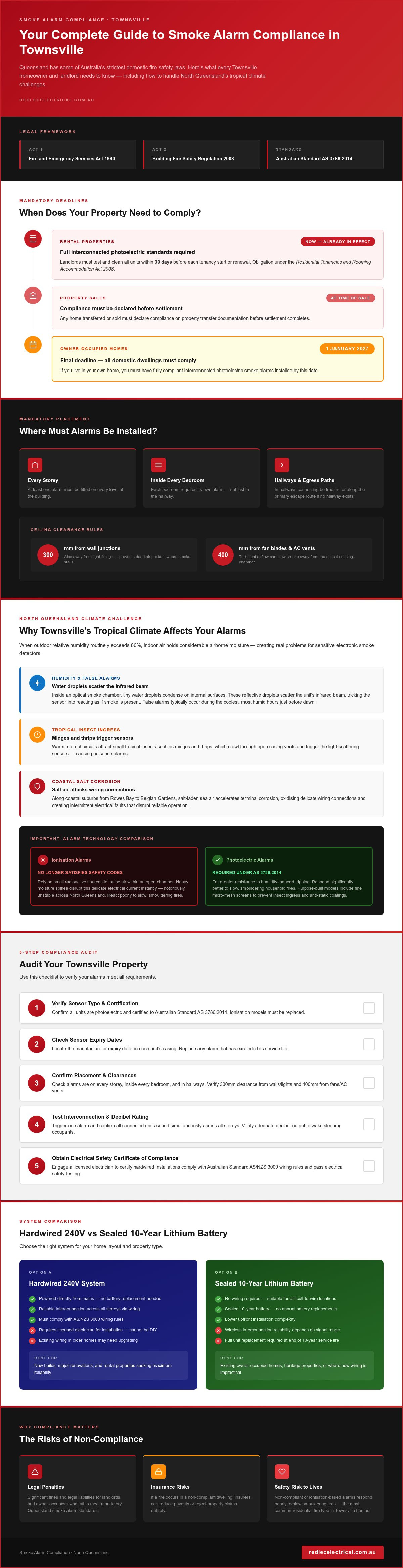
Queensland maintains some of the strictest domestic fire safety laws in the country. Under the Fire and Emergency Services Act 1990 and the Building Fire Safety Regulation 2008, every residential dwelling must transition to interconnected, photoelectric alarms. Older ionisation models no longer satisfy safety codes because they react poorly to slow, smouldering fires. Today, installing an approved photoelectric smoke detector setup certified to Australian Standard AS 3786:2014 is the baseline requirement across the state.
Ignoring these statutory standards carries significant risks beyond legal penalties. If a fire occurs in a non-compliant dwelling, insurers can reduce payouts or reject property claims entirely. Achieving proper smoke alarm compliance Townsville wide protects both lives and your financial investment.
Key Deadlines for Landlords and Owner-Occupiers
The phased rollout introduced specific cut-offs depending on your property’s occupancy status:
- Rental Properties: Landlords must ensure every leased property meets full interconnected photoelectric standards. The Residential Tenancies and Rooming Accommodation Act 2008 requires landlords to test and clean all units within thirty days prior to a tenancy start or renewal.
- Property Sales: Any home transferred or sold must declare compliance on property transfer documentation before settlement completes.
- Owner-Occupied Homes: If you live in your own home, the final deadline is 1 January 2027. All domestic dwellings must be compliant by this date.
Engaging a licensed electrician ensures your alarm configuration complies with Australian Standard AS/NZS 3000 wiring rules and passes thorough electrical safety testing.
Mandatory Location and Placement Standards
Where you mount alarms matters just as much as the technology inside them. Smoke alarm compliance Townsville requirements dictate that units must be installed:
- On every storey of the building.
- Inside every bedroom.
- In hallways connecting bedrooms to the rest of the dwelling, or along the primary egress path if no hallway exists.
To avoid dead air pockets where smoke circulation stalls, installers must mount alarms on the ceiling at least 300mm away from wall junctions and light fittings. Alarms must also sit at least 400mm away from ceiling fan blades and air conditioning vents, preventing turbulent airflow from blowing smoke away from the optical sensing chamber.
Solving the North Queensland Climate Challenge: Humidity and False Alarms
Townsville summers bring intense heat paired with persistent, heavy humidity. While these tropical conditions define lifestyle in the north, they present unique hurdles for sensitive electronic safety gear. When outdoor relative humidity routinely exceeds 80%, indoor air holds considerable airborne moisture. Inside an optical smoke chamber, tiny water droplets condense on internal surfaces. These reflective droplets scatter the unit’s infrared beam, tricking the sensor into reacting as if smoke particles were present. The result is an ear-splitting false alarm, typically occurring during the coolest, most humid hours just before dawn.
Environmental challenges do not stop with moisture. Warm internal circuits attract small tropical insects such as midges and thrips, which crawl through open casing vents and trigger the light-scattering sensors. Along coastal suburbs from Rowes Bay to Belgian Gardens, salt-laden sea air accelerates terminal corrosion, oxidising delicate wiring connections and creating intermittent electrical faults that disrupt reliable operation.
Why Ionisation Alarms Fail in Coastal Tropics
Legacy ionisation alarms rely on small radioactive sources to ionise air within an open chamber. Heavy moisture spikes disrupt this delicate electrical current instantly, making ionisation units notoriously unstable across North Queensland. Modern photoelectric hardware responds significantly better to slow, smouldering household fires while offering far greater resistance to humidity-induced tripping.
When selecting units for smoke alarm compliance Townsville properties require, look for purpose-built hardware. Leading photoelectric models incorporate fine micro-mesh screens around the optical bay to prevent insect ingress, along with specialised anti-static coatings that stop dust and water particles from sticking to the sensor lenses.
Protecting Alarms from Cyclone Season Power Surges
Between November and April, wet-season electrical storms bring severe lightning activity across the region. Voltage transients travelling through mains supply lines can easily fry unshielded circuit boards inside hardwired alarms, triggering permanent phantom faults or total component failure.
Pairing your smoke alarm setup with switchboard upgrades, including quality surge protective devices and modern RCD safety switches, shields sensitive interconnected circuits against abrupt line spikes. If your system triggers unexpectedly following severe weather, read our practical guide on how to test smoke alarms to reset and verify your hardware safely. Maintaining full alignment with official Queensland smoke alarm legislation keeps your household protected through every storm season. For tailored guidance on safeguarding your property, the team at Redlec Energy Solutions can inspect your setup and ensure your home stays quiet, safe, and fully compliant.
Hardwired vs Wireless Interconnected Systems: Choosing the Right Setup
Interconnection forms the backbone of modern residential fire safety. When an alarm detects smoke in a back bedroom, every unit across the entire house activates simultaneously, providing early notice regardless of where you are resting. Achieving full smoke alarm compliance Townsville properties require can be accomplished through two technical configurations: 240V mains-powered units or standalone sealed 10-year lithium battery systems.
Many property owners also adopt hybrid setups. These systems link existing mains-wired hallways with newly added wireless bedroom units through radio-frequency (RF) bridge bases, giving you total protection without unnecessary wall chasing.
Mains-Powered 240V Hardwired Alarms
Mains-powered setups connect straight into your home electrical circuits, supported by a secondary backup battery during sudden power failures. They represent the standard choice for new builds, substantial renovations, or homes featuring accessible roof cavities where running cable remains straightforward.
Because mains wiring handles live domestic voltages, fixed installations demand a licensed electrician working strictly to Australian Standard AS/NZS 3000 electrical rules. If an existing 240V alarm reaches expiry, the law requires the replacement unit to remain hardwired. For multi-unit residential blocks or commercial sites, engaging professional commercial electrical services ensures large-scale interconnected arrays pass all statutory certification audits.
Sealed 10-Year Lithium Battery Alarms
Townsville features exceptional architectural character, from classic high-set Queenslanders in Railway Estate and Hermit Park to homes with exposed tongue-and-groove timber ceilings. Pulling cables across solid hardwood rafters or cathedral ceilings often proves impractical and risks damaging heritage finishes.
Sealed 10-year lithium battery units resolve this challenge cleanly. These units communicate over secure RF wireless frequencies, enabling full synchronization without drilling through decorative cornices or historic timber. The permanently enclosed lithium power cells last the full ten-year service life mandated under Queensland smoke alarm legislation. Because the battery cannot be removed to silence cooking steam, these tamper-proof alarms prevent tenants or children from unintentionally disabling vital protection.
Step-by-Step Smoke Alarm Compliance Audit for Townsville Properties
A systematic audit gives you complete confidence that your safety system operates reliably under real emergency conditions. Overlooking a single non-compliant sensor or expired battery can leave your property unprotected and expose you to severe legal liability. Following a methodical inspection process ensures your property meets every standard for smoke alarm compliance Townsville authorities demand.
Begin by checking physical positions across your ceiling layout. Confirm that every alarm sits at least 300mm away from wall corners and light fixtures, and at least 400mm clear from air conditioner louvres or ceiling fan sweeps. Drafts from high-velocity ceiling fans easily push smoke plumes away from detection sensors during a fire, delaying precious warning times.
Checking Age, Sensor Technology, and Interconnection
Every domestic alarm features a manufactured date or replacement date stamped onto its baseplate or rear casing. Smoke sensors lose optical sensitivity after ten years of continuous exposure to ambient air, meaning expired alarms must be retired immediately, even if the manual test buzzer still sounds.
Take these essential steps during your physical check:
- Inspect the Rating Plate: Verify the unit displays the Australian Standard AS 3786:2014 certification mark alongside an explicit photoelectric symbol.
- Replace Legacy Units: Remove and replace any remaining ionisation models immediately with approved photoelectric alarms.
- Test the RF or Wired Interlink: Press and hold the test button on a single alarm for at least five seconds. Confirm that every linked unit throughout all bedrooms and hallways activates its 85-decibel siren in response.
Engaging a Licensed Electrician for Certification
While an owner can run preliminary functional tests, Queensland legislation requires fixed 240V wiring to be handled strictly by a qualified professional. A licensed electrician checks circuit integrity, evaluates switchboard protection, and conducts electrical safety testing to ensure your system adheres to Australian Standard AS/NZS 3000.
Once testing finishes, your contractor issues an official electrical safety certificate. This document serves as legal proof of compliance for tenancy renewals, body corporate reviews, or building insurance claims. Partnering with a dedicated smoke alarm installation townsville contractor gives you total certainty that your property meets every statutory obligation. To book your property assessment or upgrade aging sensors, schedule an electrical inspection with Redlec Energy Solutions today.
Long-Term Maintenance and Protecting Your Townsville Investment
Investing in compliant hardware is only half the equation. Sustaining the smoke alarm compliance Townsville properties require demands regular, proactive maintenance. Left unattended, ceiling dust, drifting pollen, and North Queensland humidity accumulate inside the sensing chambers. Over time, this debris degrades sensor accuracy, leading to irritating midnight false triggers or, far worse, delayed activation during a genuine fire.
For rental property managers and self-managing landlords, routine upkeep is also a legal necessity. Queensland tenancy laws mandate accurate documentation showing alarms have been tested and cleaned within 30 days before every lease renewal or new tenancy agreement. Maintaining signed maintenance logs protects you against liability disputes and gives insurance assessors undeniable proof that you have upheld your duty of care.
Routine Cleaning and Battery Care in the Tropics
Preventing nuisance alarms in our tropical climate takes just a few deliberate steps twice a year:
- Vacuum Vents Gently: Fit a soft brush attachment to your vacuum cleaner and gently run it around the perimeter slots of each alarm every six months. This lifts out settled insects, pet hair, and cobwebs before they enter the optical bay.
- Wipe Casings: Clean external plastic covers using a dry microfibre cloth to remove sticky salt air residues without introducing liquid into the electronics.
- Avoid Chemical Sprays: Never spray surface insecticides, air fresheners, or cleaning aerosols directly near alarm grilles. Chemical propellants leave oily coatings across the internal lenses, causing permanent sensor failure.
Professional Ongoing Compliance Support
While surface cleaning is straightforward, professional electrical safety testing ensures the internal electronics and wiring networks perform reliably over their ten-year design life. If your property features hardwired 240V alarms with removable backup batteries, these auxiliary cells require replacement every twelve months to keep your system operational during seasonal grid interruptions.
Scheduling an annual safety check alongside your routine switchboard audit confirms that your RCD safety switches, circuit breakers, and interconnected alarms work together seamlessly. When you need dependable maintenance, sensor upgrades, or replacement units, the team at Redlec Energy Solutions is here to help keep your Townsville property secure, quiet, and fully certified.
Protect Your Townsville Property with Confident Fire Safety
Bringing your dwelling into full alignment with Queensland legislation safeguards your household while keeping your property insurance secure. Upgrading to interconnected photoelectric units eliminates nuisance false alarms triggered by tropical humidity, providing dependable early warning when seconds count most. Whether you manage a rental portfolio or live in a classic high-set home, achieving total smoke alarm compliance Townsville properties need doesn’t have to be stressful.
Redlec Energy Solutions is ready to help you navigate every legal deadline and technical requirement. Our team of qualified licensed electricians delivers precision installations across Townsville, ensuring strict adherence to Australian Standard AS/NZS 3000 and AS 3786:2014 standards. We supply tropical-rated photoelectric alarms engineered to resist North Queensland humidity, seasonal storms, and insect intrusion. Take the uncertainty out of your safety upgrades and book your Townsville smoke alarm compliance audit with Redlec Energy Solutions today. Protecting your family and securing genuine peace of mind has never been simpler.
Frequently Asked Questions
Do owner-occupiers in Townsville need interconnected smoke alarms right now?
Owner-occupiers face a mandatory deadline of 1 January 2027 to install interconnected photoelectric alarms. Rental properties and homes sold have had to meet these strict standards since 2022. Upgrading your home ahead of the final cut-off protects your family immediately against smouldering house fires and prevents trade booking delays as the legislated deadline draws closer.
Why do smoke alarms in North Queensland go off when there is no smoke?
Extreme summer humidity and small insects cause the vast majority of false alarms across North Queensland. Heavy airborne moisture condenses inside the optical chamber, scattering infrared light beams just like smoke particles do. Tiny insects also crawl into warm sensor housings. Installing tropical-rated alarms featuring insect-proof mesh screens and anti-condensation sensors stops these nuisance midnight activations.
Can I install 10-year battery wireless smoke alarms myself without an electrician?
You can legally install standalone 10-year sealed lithium battery units yourself, provided you screw them directly to the ceiling. However, if your property already has hardwired alarms, the law requires them to remain hardwired by a licensed electrician. Having a professional oversee your smoke alarm compliance Townsville audit ensures every alarm is positioned safely outside restricted dead air pockets.
How many smoke alarms do I need in a standard high-set Townsville house?
Every home requires alarms inside every bedroom, connecting hallways, and on every occupied level. For a typical three-bedroom high-set home, you will usually need five alarms: three inside the bedrooms, one in the upper hallway, and at least one unit downstairs along the exit route. All five units must be interconnected so they sound simultaneously.
What is the penalty if my rental property does not meet Queensland regulations?
Landlords face substantial statutory fines for non-compliance under Queensland fire safety legislation. Failing to install compliant interconnected systems also prevents property managers from legally leasing the home. Even more critically, insurance providers can reduce or completely reject property damage payouts following a fire if post-incident investigators discover non-compliant fire safety equipment.
How often do photoelectric smoke alarms need to be replaced completely?
All photoelectric smoke alarms must be fully replaced every ten years from their manufacture date. Over a decade of continuous service, internal optical sensors degrade and gather microscopic dust that dulls sensitivity. Even if an expired unit still beeps when you press the test button, the aging sensor might fail to detect real smoke during an emergency.
Will ceiling fans or split-system air conditioners affect my smoke alarm performance?
Strong airflow from ceiling fans or split-system air conditioners can push smoke away from optical chambers, severely delaying life-saving warnings. Queensland regulations mandate that alarms must sit at least 400mm away from fan blades and air conditioning vents. Proper spacing maintains accurate airflow, delivering the reliable smoke alarm compliance Townsville families depend on year-round.