What if your next electricity bill arrived with a credit instead of a three-figure debt, even after a month of running the air con around the clock? For many homeowners investigating residential solar systems Townsville is no longer just about being green; it’s a necessary shield against rising tariffs and the relentless North Queensland heat. We understand the frustration of watching your hard-earned money disappear into the grid just to keep your home liveable during a humid January stretch.
This guide is here to help you regain your energy independence. We’ll show you how to master everything from the latest 2026 federal rebates to selecting cyclone-rated hardware that stays put when the weather turns nasty. You don’t have to guess which panels will survive the tropics or how to maximise your savings as feed-in tariffs change. We are going to walk through the exact steps to build a reliable system that slashes your bills and adds genuine value to your property. By the end of this article, you’ll have a clear roadmap for securing a system that handles the peak tropical heat with ease.
Key Takeaways
- Learn why Wind Region C certification is a non-negotiable requirement for mounting hardware to ensure your system survives North Queensland’s cyclone season.
- Discover how modern residential solar systems townsville function as integrated energy hubs designed to neutralise high air conditioning costs during the humid summer months.
- Navigate the 2026 STC rebate phase-out and identify which Queensland-specific battery incentives are currently available to help lower your upfront investment.
- Understand the impact of tropical humidity and salt-mist corrosion on your components and how to select hardware built for coastal longevity.
- See why partnering with a local Townsville specialist offers greater security and faster support than dealing with national, sales-driven call centres.
Why Solar Power Systems are Non-Negotiable for Townsville in 2026
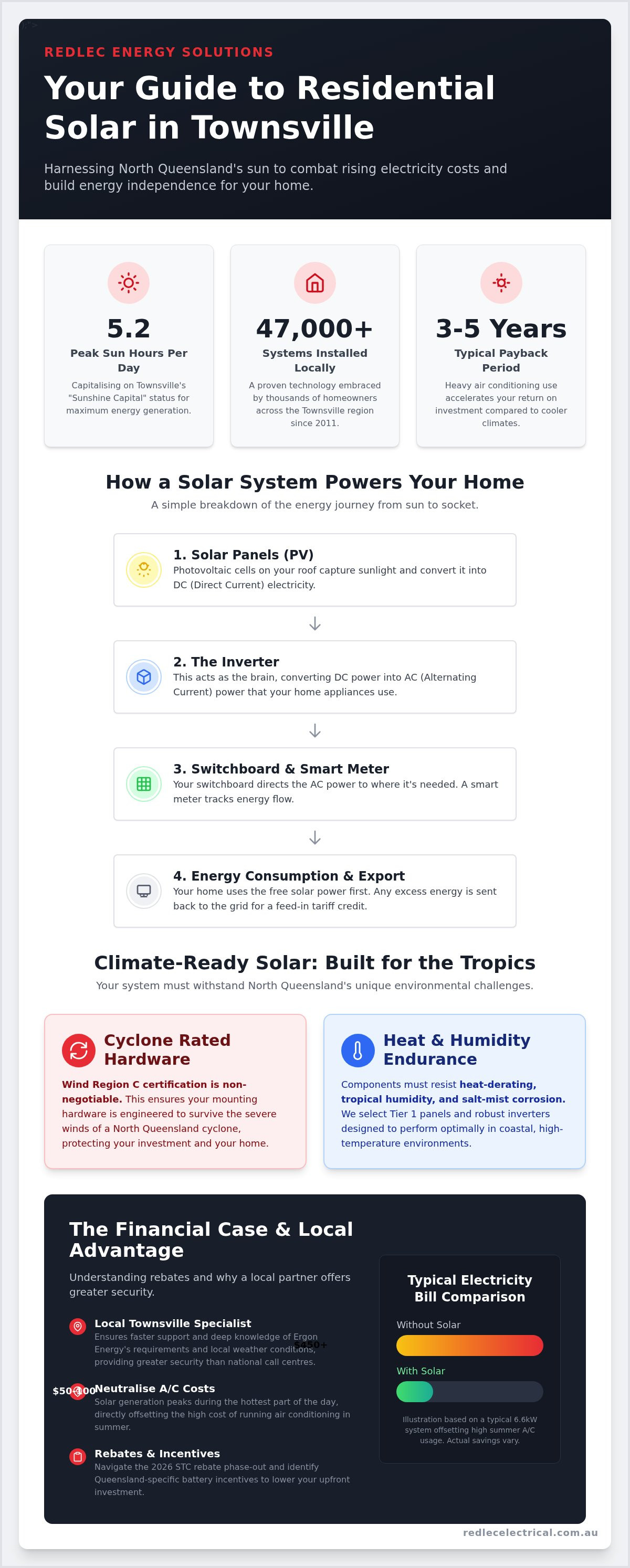
In 2026, a solar setup is no longer just a few panels on the roof; it’s a sophisticated energy hub. For those considering residential solar systems townsville offers the perfect environment to take control of rising power costs. With an average of 5.2 peak sun hours per day, our region remains one of the premier locations for Solar power in Australia. While the rest of the country deals with fluctuating energy markets, Townsville homeowners can harness the tropical sun to neutralise the 2026 electricity price hikes. Since 2011, over 47,000 systems have been installed in our region, proving that your neighbours already recognise the value of the “Sunshine Capital” advantage. Living at the gateway to the Great Barrier Reef also means our community feels a personal responsibility to reduce carbon footprints, making solar a win for both the wallet and the environment.
The Economic Case for Solar in North Queensland
In the North, we don’t just use air conditioning; we rely on it for ten months of the year. This heavy load makes the return on investment for solar far more attractive than in cooler climates. When your system generates power during the hottest part of the day, it’s directly offsetting the highest period of consumption. Local real estate trends show that homes featuring quality residential solar systems townsville buyers value as sustainable assets often see an increase in property appeal. The solar payback period for a typical 6.6kW system in North Queensland represents the three to five years it takes for your cumulative electricity bill savings to equal the initial cost of the installation.
Energy Security During the Tropical Summer
Reliability is everything when the mercury hits thirty-five degrees. By generating your own power, you reduce the strain on an ageing regional grid that often struggles during peak summer demand. This transition from being a passive consumer to an active “prosumer” means you aren’t just buying power; you’re producing it for your family’s comfort. It builds community resilience, ensuring that our local suburbs remain powered up even when the broader network faces pressure. Using a local expert ensures your system is designed for these specific conditions, providing peace of mind that your home can stay cool without the fear of the next quarterly bill. It’s about securing your family’s comfort while contributing to a more stable energy future for the whole Townsville community.
How Solar Energy Works: A Practical Guide for NQ Homeowners
Understanding how residential solar systems townsville families rely on actually function helps you make better choices for your property. It starts with photovoltaic (PV) panels capturing sunlight and converting it into Direct Current (DC) electricity. This energy flows to the inverter, which acts as the brain of the operation. The inverter transforms DC into Alternating Current (AC), the specific type of power used by your fridge, fans, and air conditioner. From there, the energy travels to your switchboard, which directs it to your appliances or sends any excess back to the Ergon Energy grid. By 2026, most local systems also include smart monitoring, allowing you to track this entire journey in real-time through a simple smartphone app.
Photovoltaic (PV) Panels vs. Inverters
While the panels get all the attention, your inverter does the heavy lifting. In Townsville, we face a specific challenge called heat-derating. When the ambient temperature hits 35 degrees, the internal components of an inverter can get significantly hotter, causing some models to throttle their output to protect themselves. This is why selecting high-quality, Tier 1 panels and a robust inverter is vital. If your roof suffers from shade from nearby trees or gables, we often recommend micro-inverters over traditional string inverters. Micro-inverters allow each panel to operate independently, so one shaded panel doesn’t drag down the performance of the whole array. Investing in hardware designed for tropical endurance ensures your system doesn’t just work on a mild day, but thrives when you need it most.
Grid Connection and Ergon Energy Requirements
Connecting to the local network involves more than just plugging things in. Ergon Energy has strict rules regarding export limits to prevent voltage rise issues in Townsville suburbs. A modern Smart Meter is required to track exactly how much power you consume versus how much you contribute to the grid. Often, the first step in this process is ensuring your home is ready for the extra load through professional switchboard upgrades. An outdated board can be a bottleneck or even a safety risk when handling the high currents generated by a large solar array. If you are unsure if your current setup is up to the task, you can always ask a local expert to take a look at your existing electrical infrastructure before you commit to a full installation.
Climate-Ready Solar: Beating the Townsville Heat and Cyclones
Living in North Queensland means our residential solar systems townsville families invest in must be tougher than those found in the southern states. Our environment presents three major challenges: extreme heat, high humidity, and the seasonal threat of tropical cyclones. While modern panels are durable, the way they are installed determines whether they will last twenty years or fail after the first major storm. Ensuring your system is climate-ready isn’t just about efficiency; it’s about protecting your home and your investment from the unique pressures of the tropics.
Cyclone-Rated Mounting and Racking
Townsville is classified as Wind Region C, a designation that dictates strict engineering standards for anything attached to your roof. Under Australian Standard AS/NZS 1170.2, your mounting gear must be certified to withstand the immense uplift forces generated during a cyclone. If an installer uses “standard” racking designed for Brisbane or Sydney, your panels could act like sails, potentially ripping the mounting points right out of your battens. This doesn’t just destroy your solar array; it compromises your roof’s structural integrity and can void your home insurance. We always look for heavy-duty, anodised aluminium racking with extra fixing points to ensure that when the wind picks up, your system stays exactly where it belongs.
Salt-Mist and Humidity Protection
If you live near The Strand, Pallarenda, or Bushland Beach, salt-mist corrosion is a constant silent threat. The salt in the air can quickly eat through inferior metals and perish seals in electrical housings. For coastal homes, we prioritise components made from corrosion-resistant materials like 316 stainless steel and high-grade alloys. You should also pay close attention to the Ingress Protection (IP) ratings of your equipment. An IP65 rating signifies that an inverter is “dust tight” and protected against water jets from any angle, making it essential for surviving the torrential downpours of a North Queensland monsoon. Choosing hardware with these specific protections prevents premature failure and ensures your system continues to produce power in our high-humidity environment.
Beyond the hardware, placement is everything. We recommend installing inverters in shaded, well-ventilated areas, such as inside a garage or under a purpose-built cover, to keep them out of the direct afternoon sun. This physical shading works alongside the internal cooling systems to maintain peak performance during a heatwave. Once the storm season passes, it is a good idea to have a professional check your system for any loose fittings or debris. Scheduling regular solar repairs and maintenance ensures that small issues caused by the weather don’t turn into expensive headaches down the road. It’s the simplest way to maintain the peace of mind that comes with a truly reliable energy setup.
The 2026 Solar Investment: Rebates, STCs, and Savings
Investing in residential solar systems townsville homeowners choose in 2026 requires a clear understanding of the shifting financial landscape. The federal government’s Small-scale Renewable Energy Scheme (SRES) is currently in its phase-out period, meaning the available incentives reduce every year on the first of January until they disappear entirely in 2030. If you’ve been putting off your installation, waiting until next year will likely increase your out-of-pocket costs as the rebate value drops. For a standard 6.6kW system, the rebate can still cover between $3,000 and $3,800 of the upfront price, but this window is closing. Taking action now locks in the current rates before the next scheduled reduction.
Understanding Small-scale Technology Certificates (STCs)
STCs act as an upfront discount on your system’s price. Australia is divided into specific zones based on how much sunshine they receive, and Townsville sits in Zone 1. This is the highest possible rating, which means a system installed here generates more certificates than the same system would in a southern city like Hobart. Because we get more sun, the government provides a larger financial incentive to install solar here. Most installers handle the creation and sale of these certificates for you, applying the value directly as a point-of-sale discount. It’s the simplest way to lower the initial barrier to entry for high-quality hardware that can handle our tropical climate.
Maximising Self-Consumption
The strategy for saving money has changed significantly in recent years. As of July 1, 2026, the regional Queensland feed-in tariff has shifted to 6.006 cents per kWh. While you still get paid for the excess power you send back to the grid, the real profit lies in self-consumption. Using your own solar power to run heavy appliances is worth roughly four to five times more than selling it back. This economic shift is driving many families toward battery storage systems. By storing daytime energy for use during the evening peak, you can bypass expensive retail rates entirely. The 2026 Cheaper Home Batteries Program also offers a discount of approximately 30% on eligible batteries, making independence more affordable than ever.
When it comes to funding your project, you have several paths. Many residents opt for green loans, which often feature lower interest rates than standard personal loans because the lender recognises the ongoing savings solar provides. Others prefer an out-of-pocket purchase to maximise their immediate return on investment. Regardless of your choice, the key is to select a system that matches your actual usage patterns. If you want to see how these incentives apply to your specific property, contact our local team for a straightforward chat about your options. We can help you navigate the 2026 regulations without the confusing sales jargon.
The Redlec Difference: Reliable Solar Power Systems for Townsville
Choosing between the various residential solar systems townsville has available often comes down to who you trust to answer the phone in three years. National companies frequently rely on high-volume sales tactics and subcontracted installers who may never set foot in North Queensland again. At Redlec Energy Solutions, we take a different path. Matt leads our team with a focus on integrity and reliability, offering a “no dramas” service that puts your peace of mind first. We aren’t just solar installers; we are a full-service team providing comprehensive electrical services. This means we understand how your solar interacts with your switchboard, your air conditioning, and your home’s overall safety. We treat every installation as if it were on our own roof.
Our Local Design and Installation Process
We don’t believe in “one size fits all” kits. Every home in Townsville has different shading profiles and energy needs. Our process begins with a customised energy audit to see exactly where your power goes. We are completely transparent about our hardware choices. You won’t find any mystery panels or generic inverters in our quotes. When choosing residential solar systems townsville residents can depend on, hardware transparency is the foundation of trust. We select components based on their proven performance in tropical humidity and heat. Because we are based right here in town, post-installation support is simple. If you have a question or need to make a warranty claim, you deal with us directly, not a call centre in another state.
Comprehensive Maintenance and Repairs
A solar system is a twenty-year investment, but it requires occasional care to maintain peak efficiency. Dust, salt spray, and storm debris can all impact your ROI over time. We provide regular health checks to ensure your system is performing as promised. If an inverter fails during the peak of a 35-degree summer, you need a rapid response to get your cooling back online without breaking the bank. We specialise in solar repairs and maintenance, ensuring that small technical glitches don’t turn into long-term financial losses. Our goal is to be your steady hand in the local energy market, providing the expert support you need to stay independent from rising grid costs. We show up when promised and deliver exactly what your home needs.
Take Control of Your Energy Future Today
Navigating the shift toward energy independence doesn’t have to be a solo mission. You’ve seen how the 2026 STC phase-out makes this the ideal time to lock in your savings before rebate values decline further. Choosing high-quality residential solar systems townsville families can trust involves more than just picking panels; it’s about ensuring your mounting hardware meets Wind Region C standards and your inverter can handle the tropical humidity.
At Redlec, Matt is your local owner-operator who stands by every installation with genuine pride. We bring technical expertise in North Queensland’s specific requirements and provide 24/7 emergency electrical support to keep your environment running smoothly. If you’re ready to stop worrying about the next tariff hike and start producing your own clean energy, we are here to help. Book a free Townsville solar assessment with Matt to find the right fit for your property. We look forward to helping you secure a more affordable and resilient home.
Frequently Asked Questions
Are solar power systems still worth it in Townsville in 2026?
Solar is absolutely worth it in 2026 because Townsville receives some of the highest solar irradiation in the country. Even with the current STC rebate phase-out, the return on investment remains strong due to our 5.2 average peak sun hours. By generating your own power, you avoid the high retail tariffs associated with running air conditioners during the humid summer months. Most local homeowners find that their system pays for itself within three to five years.
Do I need a battery with my solar system?
While a battery isn’t mandatory, it’s becoming the standard choice for 2026 to maximise your savings. Since the regional feed-in tariff is now around 6 cents per kWh, it’s much more profitable to store your daytime energy than to sell it back to the grid. A battery allows you to power your home through the evening peak. This significantly reduces your reliance on Ergon Energy and protects you from future price hikes.
How long does a solar installation take in Townsville?
A standard installation for residential solar systems townsville typically takes one to two days once our team arrives on-site. However, the entire process from the initial design to the final Ergon Energy connection can take several weeks. This includes performing a site-specific energy audit, securing grid connection approvals, and ensuring your switchboard is ready for the new load. We handle all the paperwork to ensure the transition to solar is as smooth as possible.
What happens to my solar panels during a cyclone?
Your panels are designed to stay secure during a cyclone provided they are installed using Wind Region C certified mounting hardware. This is a legal requirement in Townsville to ensure the system can withstand extreme wind speeds without compromising your roof. We use heavy-duty racking with reinforced fixing points to prevent any “solar sail” effects. After a major storm, we recommend a professional inspection to check for any debris or loose fittings that might have shifted.
Can I add more panels to my existing system later?
You can often add more panels later, though it depends on your current inverter’s capacity and available roof space. If you have a string inverter that is already at its limit, you might need a second unit or an upgrade. Using micro-inverters from the start makes expanding much simpler as each panel operates independently. It’s always best to discuss your future energy goals, like buying an electric vehicle, during the initial design phase to save costs later.
What is the best solar panel for the North Queensland heat?
The best panels for North Queensland are Tier 1 modules with a low temperature coefficient. All panels lose some efficiency as they get hotter, but high-quality options are engineered to maintain better performance when the mercury hits 35 degrees. We also focus on salt-mist resistant coatings for homes near the coast. Proper mounting that allows for airflow behind the panels is just as important as the panel brand for managing heat-derating issues.
How much maintenance do solar power systems actually need?
Maintaining residential solar systems townsville requires minimal effort, but a regular “health check” every twelve months is a smart move. This involves checking the electrical connections, ensuring the inverter is venting properly, and cleaning off any build-up of salt, dust, or bird droppings. Keeping your panels clean is particularly important during the dry season to maintain peak output. If you notice a drop in production, our team provides expert solar repairs to get things back on track.
Will solar panels work during a power outage?
Standard solar systems will not work during a blackout because they automatically shut down to prevent feeding electricity into a potentially damaged grid. This safety feature protects workers who might be repairing the lines. If you need power during an outage, you’ll need a battery storage system with “islanding” or backup capabilities. This setup allows your home to operate as a mini-grid, keeping your essential appliances running even when the rest of the street is in the dark.