Imagine sitting on your verandah watching a massive tropical cell roll over Castle Hill, only to hear that deafening crack of lightning followed by the eerie silence of a dead fridge. It’s a common fear during the North Queensland storm season, yet many residents still rely on basic safety switches that weren’t designed to handle a massive voltage spike. Investing in professional surge protection for homes in Townsville is no longer just a luxury; it’s a vital insurance policy for your modern electronics and your family’s comfort.
We understand the anxiety that comes with every thunderclap, especially when you’ve invested heavily in a solar system or home battery. You likely already have safety switches, but there’s often confusion about whether they actually stop a lightning-induced surge. In this guide, we’ll show you how to properly safeguard your property using the latest Type 2 surge protection devices. You’ll learn the critical difference between an RCD and an SPD, how to protect your solar inverter, and why the 2026 Queensland Electrical Safety Regulations make switchboard security more important than ever. By the end, you’ll have the clarity needed to keep your home running smoothly, even when the tropics are at their wildest.
Key Takeaways
- Understand why Townsville’s intense tropical storm season creates unique risks for your home’s electrical system and sensitive appliances.
- Learn why a standard safety switch isn’t enough to stop a voltage spike and how an SPD provides the missing layer of security for your gear.
- Discover how professional surge protection for homes in Townsville acts as an essential insurance policy for your solar and battery investment.
- Get clear advice on the difference between Type 1 and Type 2 protectors so you can choose the right hardware for your switchboard.
- Find out how a simple upgrade from a local expert can provide long-term peace of mind during our volatile North Queensland summer downpours.
What is Surge Protection and Why Does Townsville Need It?
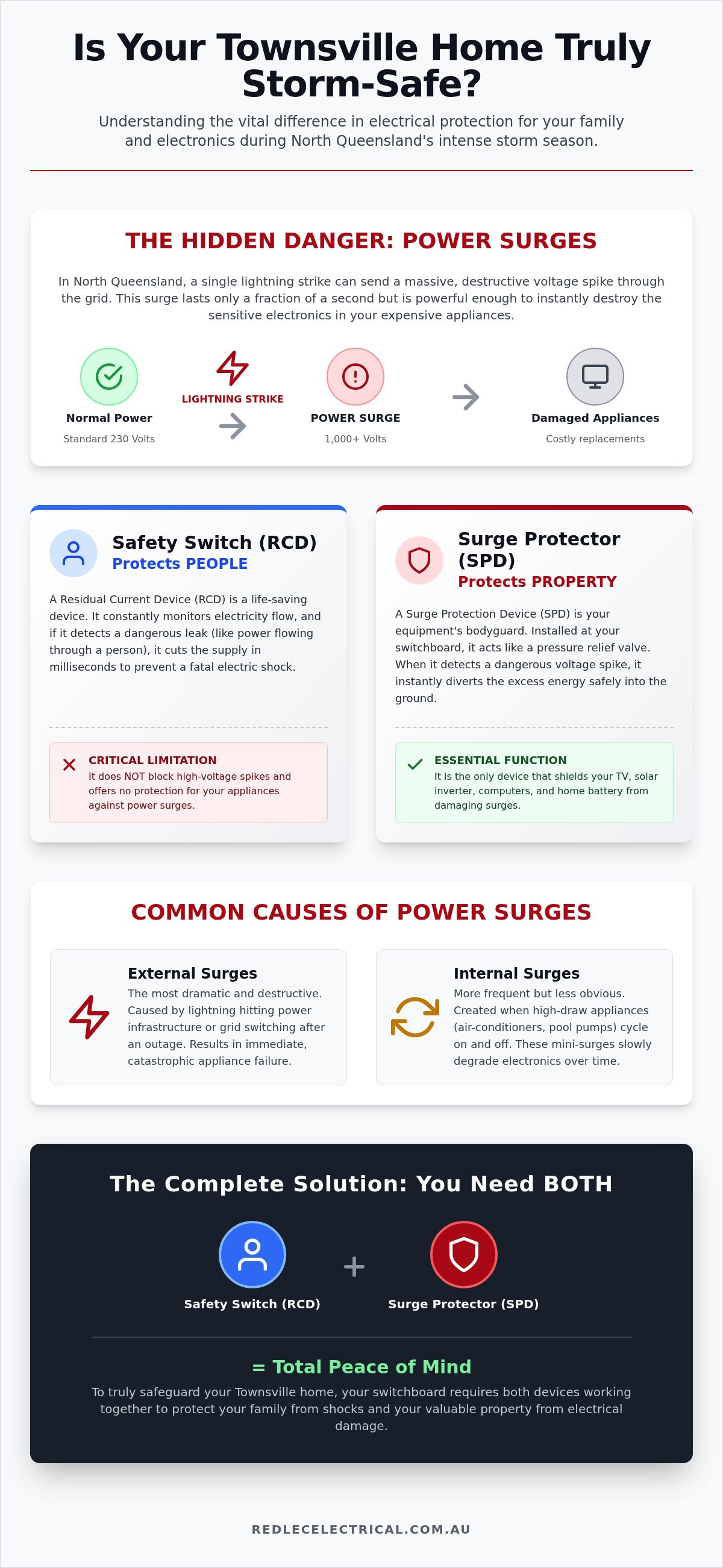
A power surge is essentially a transient overvoltage. This means the electrical pressure in your home’s wiring suddenly jumps far beyond the standard 230 volts. While it only lasts for a fraction of a second, that spike is often enough to fry the delicate circuit boards in your television, computer, or microwave. To better understand the technical mechanics of how these devices manage that energy, you can read more about what is a surge protector and how it acts as a gatekeeper for your electronics.
In North Queensland, we live in a high-risk zone for electrical volatility. Our unique combination of tropical heat and intense humidity during the storm season creates a playground for lightning. Installing robust surge protection for homes in Townsville isn’t just a recommendation; it’s a practical necessity. Our local grid faces environmental pressures that southern capital cities simply don’t experience, making your sensitive gear more vulnerable to damage.
The Reality of North Queensland Storms
Townsville is a genuine lightning hotspot. During “The Build-up,” the atmosphere becomes heavily charged, leading to some of the most spectacular but dangerous electrical displays in Australia. A single lightning strike hitting the summit of Castle Hill or a nearby Ergon Energy substation can send a massive surge rippling through the local network. Because electricity seeks the path of least resistance, that strike can affect switchboards kilometres away from the initial impact. Our local humidity also plays a role, as moisture in the air can lower the insulation resistance of older wiring, making it easier for a surge to jump between circuits.
Common Sources of Power Surges in Your Home
While we often blame the weather, surges come from several different directions. External surges are the most dramatic and destructive. These occur when lightning hits Ergon Energy infrastructure or when power is restored after a tropical cyclone. That sudden rush of electricity during grid switching is a common cause of immediate appliance failure.
Internal surges are actually more frequent, though less obvious. These happen right inside your house when high-draw appliances cycle on and off. Think about your split-system air conditioners or your pool pump. Every time those heavy motors kick in, they create a small “kickback” of electricity. Over time, these repeated mini-surges degrade the sensitive components in your solar inverter or home battery system. Without proper surge protection for homes in Townsville, your expensive technology is slowly being worn down from the inside out.
Surge Protectors vs. Safety Switches: The Critical Difference
One of the biggest myths we encounter as local sparkies is the idea that a safety switch offers protection for your TV or fridge. It’s a common and potentially costly misunderstanding that can lead to thousands of dollars in damage after a single tropical storm. To keep your property truly secure, you need to understand that safety switches and surge protectors perform two completely different, but equally essential, jobs.
A safety switch, or Residual Current Device (RCD), is designed specifically to protect human life. It constantly monitors the balance of electricity flowing through a circuit. If it detects even a tiny leak, such as power flowing through a person, it cuts the supply in milliseconds to prevent a fatal shock. While these often trip during a heavy North Queensland downpour due to moisture or nearby lightning, they don’t actually block high-voltage spikes from entering your appliances. For broader home security, knowing how to test smoke alarm units is another vital part of being a responsible homeowner.
Nuisance tripping is frequent in Townsville because our high humidity can cause minor current leakages that trigger an RCD. This is often a sign the device is doing its job, but it shouldn’t be confused with surge suppression. Without an SPD, that same storm could be sending high-voltage noise through your home’s wiring, slowly degrading the power supply units in your LED lights and smart home devices. Modern Queensland homes require both devices to meet current safety standards and protect both people and property.
Professional surge protection for homes in Townsville involves installing a Surge Protection Device (SPD) directly at your main switchboard. While the RCD looks after you, the SPD looks after your things. It acts as a pressure relief valve for electricity. When it detects a spike from a lightning strike or a grid fault, it instantly diverts that excess energy safely into the ground before it reaches your sensitive electronics. Think of it as a sacrificial gatekeeper; it takes the hit so your expensive appliances don’t have to.
Following official Queensland Government electrical safety advice is the best way to ensure your family stays safe during our volatile storm season. A whole-house protector is far more effective than those cheap power boards you buy at the supermarket. While those boards are a decent second line of defence for a single computer, they simply can’t handle the massive energy of a tropical strike. If you haven’t checked your board lately, an expert switchboard assessment can ensure you have both layers of safety in place before the next storm rolls in.
Modern Type 2 surge protectors are built to handle multiple small surges over several years, but they will sacrifice themselves during a major direct hit to save your home’s circuitry. Most have a visual indicator, usually a small green window that turns red, to let you know they’ve done their job and need replacing. It’s a small price to pay to avoid a total electrical meltdown during the summer months.
Protecting Your Solar and Battery Investment
Many Townsville locals have made the switch to solar to beat rising energy costs. It’s a smart move, but it introduces a new vulnerability to your property. Your solar inverter is essentially a high-powered computer mounted on your wall. It’s packed with sensitive motherboards and microprocessors that are incredibly susceptible to voltage spikes. This is why surge protection for homes in Townsville has become a standard requirement for any modern solar installation.
If a surge hits an unprotected system, the results are often catastrophic. Most manufacturer warranties explicitly exclude damage caused by lightning or grid surges, categorising them as “acts of God.” This means you could be looking at the full cost of solar repairs or even a total inverter replacement just because of one bad storm. Prevention is a tiny fraction of that replacement price and ensures your system keeps generating power when you need it most.
Inverters and Electronics in the Tropics
Replacing a fried inverter in North Queensland isn’t just about the hardware cost; it’s the downtime and lost energy savings while you wait for parts to arrive. For those who have invested in battery storage systems, the stakes are even higher. Modern lithium-ion batteries require “clean” power to maintain their internal health and chemical stability. A surge protector acts as a vital filter, ensuring the electricity entering your battery bank stays within safe limits, which helps you get the full lifespan out of your technology.
Air Conditioning and Pool Pumps
Living in the tropics means we rely heavily on our split systems and pool pumps to stay comfortable. These devices use powerful motors that create their own “internal” surges every time they kick in. These mini-spikes don’t just stay in the pump circuit; they ripple back through your home’s wiring. Over time, this constant electrical noise can degrade your smart home hubs and cause expensive LED lighting to fail well before its time.
Installing dedicated surge protection for homes in Townsville provides a comprehensive shield for these high-value assets. It’s the final piece of the puzzle for any homeowner who wants to protect their modern lifestyle from the volatile North Queensland grid. Keeping your gear safe means you can enjoy the cool air and solar savings without worrying about the next thunderclap over Castle Hill.
Choosing the Right Surge Protection for Your Home
Choosing the right hardware is just as important as the installation itself. For most residential properties, we install a Type 2 Surge Protective Device (SPD) in the main switchboard. While Type 1 devices are designed for heavy-duty lightning protection at the service entrance, a Type 2 unit is the standard for surge protection for homes in Townsville. It provides the necessary defence against both grid switching spikes and the indirect effects of nearby lightning strikes.
When selecting a device, we look at two main technical specs: clamping voltage and the joule rating. Clamping voltage is the threshold where the device starts diverting energy; the lower this number, the better the protection for your gear. The joule rating tells us how much total energy the device can absorb before it’s “spent.” In our tropical climate, we always recommend higher-rated units that can handle the repeated stress of our summer storms without failing prematurely.
Switchboard Upgrades and Modern Standards
Many older homes in suburbs like Mundingburra or Hermit Park still have original switchboards with ceramic fuses. These older systems were never designed to house modern safety gear or handle the sophisticated needs of solar power. Integrating surge protection is a key part of modern switchboard upgrades. It ensures your home meets the latest Australian Standard AS/NZS 3000, which now places a much heavier emphasis on protection against overvoltage to keep up with our increasing reliance on smart technology.
Maintenance and After-Storm Checks
It’s a common mistake to think that once an SPD is installed, you never have to look at it again. Most quality units feature a small status indicator window. If that window is green, you’re protected. If it has turned red, the device has sacrificed itself to save your home and needs immediate replacement. It has done its job, but your home is now vulnerable once more.
After a particularly nasty tropical cell or a direct strike nearby, it’s worth doing a quick visual check of your board. If you notice a burnt smell or the indicator has flipped, you should call an emergency electrician to assess the damage and swap out the module. We recommend a quick professional check every few years to ensure your surge protection for homes in Townsville is still active and ready for the next wet season. Don’t leave your safety to chance; book a switchboard health check with our local team today.
Secure Your Home with Redlec Energy Solutions
At Redlec Energy Solutions, we’ve seen firsthand what a single North Queensland storm can do to an unprotected switchboard. Matt and the team are dedicated to providing more than just a quick fix; we’re here to build long term relationships based on reliability and trust. When you choose us for surge protection for homes in Townsville, you’re getting the expertise of a local sparky who knows exactly how the Ergon Energy grid behaves during a tropical downpour.
Our approach is built around comprehensive electrical health checks. We don’t just swap out a part and leave. We look at the big picture of your home’s energy needs. This includes ensuring your LED lighting, split system air conditioning, and solar repairs are all integrated into a single, secure network. It’s about providing that steady hand and peace of mind so you can relax when the clouds start gathering over the Coral Sea.
The Trusted Neighbour Advantage
We aren’t a massive corporation with a clinical feel. There are no interstate call centres or automated queues here. When you call Redlec, you’re speaking to local experts who live and work in the same community as you. We understand that your home is your biggest investment, and we treat it with the respect it deserves. Our prompt service is designed to get you storm ready well before the humidity of the build up turns into a full scale tropical cell.
Tailored solutions are at the heart of what we do. Every property in Townsville has different requirements, from older highset Queenslanders to modern builds in North Shore. We assess the specific risks to your equipment and provide expert support to ensure your installation is robust enough for our unique weather. This local knowledge is what allows us to deliver results that last, keeping your environment running smoothly regardless of what happens outside.
Booking Your Safety Audit
A surge protection consultation with us is a straightforward, no pressure process. We perform a detailed safety audit of your entire electrical system to identify any weak points. During this assessment, we carefully inspect your main switchboard, any existing battery storage, and your solar inverter to ensure everything is compliant with the latest Australian Standards. We’ll explain exactly what’s needed to keep your gear safe, using clear language instead of technical jargon.
Our goal is to deliver trusted results that ensure the smooth operations of your home throughout the year. It’s time to stop worrying about the next lightning strike and start enjoying the security of a professionally protected home. Contact Redlec today for a professional surge protection assessment and let us help you maintain a safe environment for your family.
Stay Storm-Ready with Expert Home Protection
Protecting your property from the unpredictable North Queensland climate is about more than just checking your safety switches. We’ve explored how a dedicated surge protector acts as a sacrificial gatekeeper for your high-value solar inverters, home batteries, and air conditioning units. By upgrading your switchboard and understanding the technical difference between RCDs and SPDs, you’re taking a proactive step toward long-term home safety. Investing in professional surge protection for homes in Townsville is the final piece of the puzzle for any resident who values their modern technology and their daily peace of mind.
Locally owned and operated by Matt, Redlec Energy Solutions provides rapid response for Townsville electrical emergencies and specialises in tropical solar and battery protection. We pride ourselves on being the steady hand you need when the weather turns volatile. Don’t wait for the next lightning crack over Castle Hill to find out if your gear is vulnerable. You can get a surge protection quote from Townsville locals at Redlec today to ensure your home is fully prepared for the next big wet. Let’s work together to keep your tropical lifestyle running smoothly and securely.
Frequently Asked Questions
Does a safety switch protect against lightning strikes?
No, a safety switch is designed to prevent electric shocks by detecting current leakage, not to stop high-voltage surges. While an RCD protects people, it won’t stop a lightning strike from frying your television or solar inverter. You need a dedicated Surge Protection Device (SPD) to divert that excess energy safely to the ground. In Townsville’s volatile storm season, having both is the only way to ensure total protection for both your family and your electronics.
How much does it cost to install surge protection in Townsville?
The total investment for installing surge protection for homes in Townsville depends on the complexity of your switchboard and the type of device required. While we don’t provide flat rates without an inspection, the cost of prevention is significantly lower than replacing a fried solar inverter or a modern split-system air conditioner. A professional assessment will determine if your board needs an upgrade or if a simple module installation is sufficient to keep your property storm-ready.
Do surge protectors wear out over time?
Yes, surge protectors are sacrificial components that degrade every time they divert a voltage spike. Most high-quality units are designed to last between three and five years, but a single direct lightning strike can exhaust them instantly. You should regularly check the status indicator on your switchboard; a green light means you’re protected, while a red light indicates the device has done its job and needs immediate replacement by a professional electrician to maintain your home’s safety.
Can I install surge protection myself or do I need a sparky?
You must always use a licensed electrician for any work involving your home’s main switchboard. In Australia, it’s illegal and dangerous for an unlicensed person to install an SPD. A professional sparky ensures the installation complies with Australian Standard AS/NZS 3000 and that the device is correctly earthed. This not only keeps your family safe but also ensures your home insurance remains valid in the event of an electrical fire or major surge damage.
Is surge protection mandatory for new homes in Queensland?
Under the latest Australian Wiring Rules, surge protection is increasingly required for new residential builds and major switchboard upgrades. While it might not be mandatory for every existing older home, it is a standard recommendation for any property with a solar system or sensitive modern electronics. Staying compliant with current safety regulations is a smart move that adds value to your property and provides essential peace of mind during our intense North Queensland tropical storms.
Will surge protection save my solar inverter during a cyclone?
A surge protector is designed to handle electrical transients, such as lightning spikes or grid switching, but it can’t protect against physical cyclone damage. If a tree falls on your lines or water enters your system, the SPD won’t help. However, it is vital for protecting your solar inverter from the massive voltage spikes that often occur when Ergon Energy restores power to the grid after a major tropical storm or cyclone event has passed.
What is the difference between a surge power board and switchboard protection?
A surge power board only protects the specific devices plugged into it, whereas switchboard protection shields your entire home. While power boards are a useful second line of defence for a computer or gaming console, they can’t protect your hard-wired assets like air conditioners, pool pumps, or LED lighting. A whole-house protector installed at the main board catches the surge at the entry point before it can travel through any of your home’s internal wiring.
How do I know if my home already has surge protection installed?
You can check your main switchboard for a module that looks different from your standard circuit breakers. It will usually have a small window with a green or red status indicator and may be labelled SPD or Surge Arrester. If you’re unsure, it’s best to have a local expert perform a safety audit. We can quickly identify if you have surge protection for homes in Townsville and verify if the device is still active or has already expired.