Why would you take advice on solar from someone sitting in a climate-controlled office in Melbourne or Sydney? They don’t understand that here in North Queensland, our air conditioners aren’t a luxury; they’re a survival tool. When you’re trying to figure out what size solar system for my home Townsville requires, the standard approach used down south just won’t cut it. You’re dealing with high humidity, intense tropical sun, and a 6.006 cent feed-in tariff that makes exporting power less profitable than it used to be.
It’s frustrating to watch your Ergon bills climb every summer while you worry if your panels will even stay on the roof during storm season. We know you want a system that provides genuine energy independence without the fear of failure. This 2026 guide breaks down exactly how to match your panel array to your specific cooling load. We’ll look at why a 6.6kW system is often the starting point, how to prepare for battery storage, and why Region C cyclone ratings are the only way to get true peace of mind. You’ll learn how to organise a setup that works for your family, not the grid.
Key Takeaways
- Learn why Townsville’s unique humidity means you need a specific sizing strategy to keep air conditioners running efficiently without relying on the grid.
- Discover how to use your Ergon bill to determine exactly what size solar system for my home Townsville requires to offset expensive peak cooling periods.
- Understand the strict mounting requirements for Wind Region C to ensure your panels stay secure during intense North Queensland storm seasons.
- See how sizing up your solar array now can prepare your home for battery storage, helping you maximise your daily self-consumption ratio.
- Find out why partnering with a local owner-operator provides better quality control and long-term support compared to interstate sales companies.
Why Townsville Homes Require a Unique Solar Sizing Strategy
Solar sizing isn’t just about how many panels we can fit onto your roof. It’s the technical process of balancing your system’s generating capacity with your household’s actual energy consumption. When you start looking at what size solar system for my home Townsville requires, you’ll quickly realise that our tropical environment demands a different strategy than what works in Brisbane or Sydney. While Solar power in Australia has reached record adoption levels, the North Queensland “Cooling Load” is a beast of its own.
In suburbs like Pallarenda or Bushland Beach, we also have to account for the salt air and high humidity. These factors don’t just affect how much power you make; they dictate which components will actually last. Cheap panels might look good on paper, but they often struggle with the corrosive coastal air and the relentless humidity that can lead to internal component failure if they aren’t built for the tropics.
Sunlight vs. Heat: The North Queensland Paradox
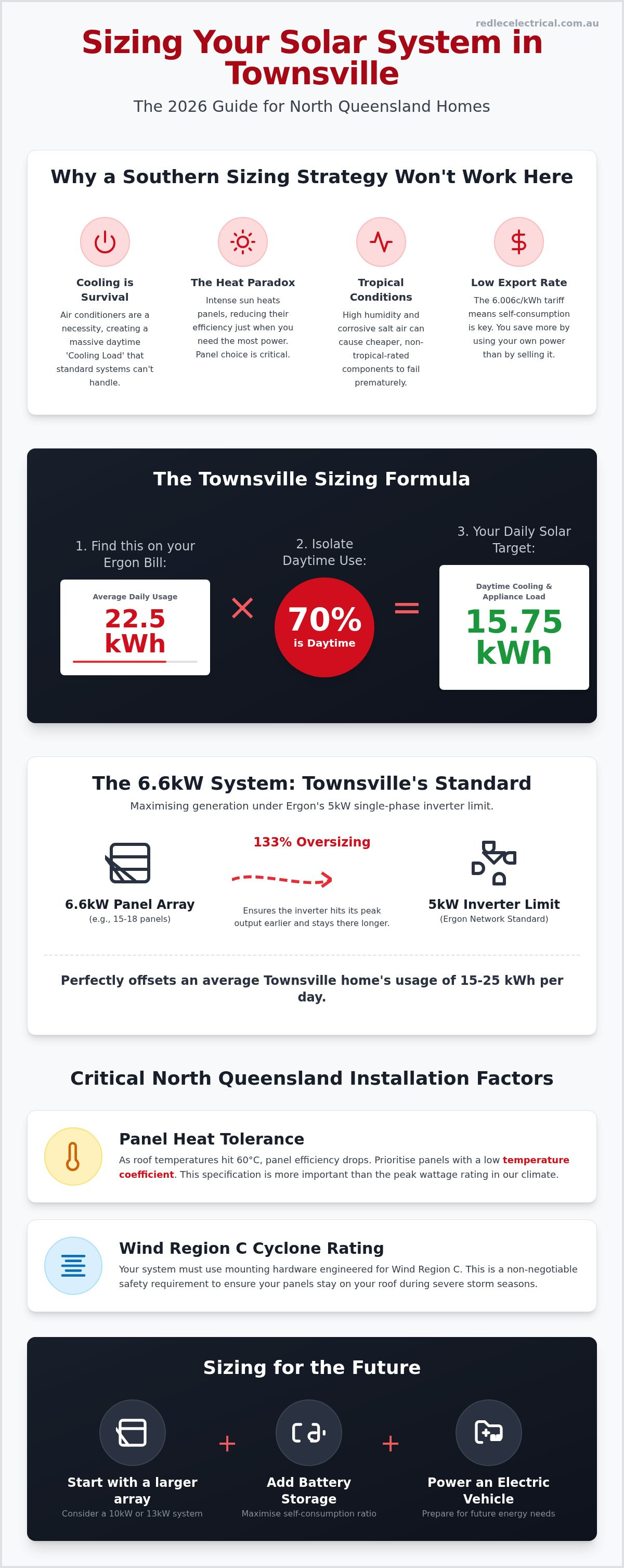
Most people assume that more sun always equals more power. However, solar panels are actually like most electronics; they perform best when they’re cool. As the temperature on your roof climbs toward 60 degrees during a typical January afternoon, panel efficiency begins to drop. This is why a 6.6kW system in Townsville performs differently than the same system in a cooler climate like Hobart. To combat this, we focus on panels with a low temperature coefficient. This technical spec tells us how well a panel maintains its output as it gets hotter. In Townsville, choosing a panel that handles heat well is often more important than the raw wattage rating on the box.
The Ergon Energy Factor
Your sizing strategy is also shaped by the Ergon Energy network rules. For most single-phase residential connections, there’s a 5kW limit on the inverter size you can install. This is why the 6.6kW solar array has become the local standard. It allows you to “oversize” the panels by 133% compared to your 5kW inverter, ensuring you hit that peak 5kW output earlier in the morning and maintain it later into the afternoon.
With the 2026 feed-in tariff sitting at 6.006 cents per kWh, the goal has shifted from “selling power back” to “using it ourselves.” For larger homes with massive air conditioning needs, we often look at export limiting. This allows us to install a larger inverter and more panels to cover your internal “Cooling Load” while ensuring we don’t push more than the allowed limit back into the Ergon grid. It’s a smarter way to gain energy independence without hitting network roadblocks.
Calculating Your Ideal System Size: The Townsville Formula
Determining what size solar system for my home Townsville requires isn’t a guessing game. It’s a calculation based on your specific energy habits. To get it right, you need to look at how much power you use when the sun is actually shining. Generic online calculators often miss the mark because they don’t account for the unique way we use electricity in the Tropics.
Reading Your Ergon Bill Like a Pro
Grab your latest bill and look for the “Average Daily Usage” section. In Townsville, this number usually spikes in summer when the air conditioning is running 24/7. You’ll see a graph showing your usage over the last year; pay close attention to the summer peaks. To estimate your daytime-only usage, take your total daily kWh and subtract about 30 per cent for overnight appliances like fridges and standby lights. The remaining 70 per cent is the target your solar panels need to hit during daylight hours.
Matching Panels to Your Lifestyle
Your daily routine dictates where your panels should face. If you’re a retiree home during the day, North-facing panels are excellent for maximum midday generation. However, for families who get home at 5 PM and immediately crank the split-systems to cool the house down, West-facing panels are often a better choice. They catch the late afternoon sun right when your “Cooling Load” is at its highest. This helps you avoid paying peak Ergon rates when the sun starts to dip.
We often recommend the “6.6kW Sweet Spot” as a starting point. This configuration usually involves 15 to 18 panels, which perfectly offsets the average Townsville household usage of 15 to 25 kWh per day. It provides enough “grunt” to run a pool pump and a couple of air conditioners without drawing heavily from the grid. If you’re planning for an electric vehicle or a future battery, sizing up to 10kW or 13kW might be the smarter long-term play. When finding a Clean Energy Council Approved Solar Retailer, ensure they actually look at your roof’s orientation rather than just giving you a “one size fits all” quote.
The Ergon network has strict rules about how much power you can export back to the grid. If you’re installing a larger array, you need to ensure your household can actually consume that power during the day. If you’re unsure about your current switchboard’s capacity for a larger array, you can always ask a local sparky to check your setup before you commit to a specific system size.
The North Queensland Factor: Heat, Humidity, and Cyclones
Townsville isn’t like the rest of Australia. While our 300 days of sunshine are a solar goldmine, our climate is also one of the most demanding on the planet. When you’re deciding what size solar system for my home Townsville requires, you have to look beyond the panels and consider the hardware that holds them down. Between the relentless humidity, the salt spray from the Coral Sea, and the threat of tropical cyclones, your system needs to be built like a fortress. Understanding what size solar system for my home Townsville needs means knowing that durability is just as important as capacity.
Cyclone-Proofing Your Investment
Townsville is classified as Wind Region C under Australian Standard AS/NZS 1170.2. This isn’t just a technical label; it’s a legal requirement that dictates how your solar array is built. In a Category 5 cyclone, the wind doesn’t just push on your panels; it tries to lift them off your roof like a wing. Standard mounting hardware used in Brisbane or Sydney will simply fail here.
We use specialised Region C mounting kits that feature thicker rails and more robust clamps. A critical part of our process is ensuring every rail is secured directly into the roof rafters, not just the thin metal battens. Because of our location, every installation requires a building permit and structural certification from a registered engineer. This might seem like extra paperwork, but it’s the only way to ensure your investment doesn’t end up in your neighbour’s yard after a storm.
Managing Heat Degradation
One factor often ignored by interstate sales reps is “heat derating.” On a 35 degree day in January, the temperature of your roof can easily exceed 60 degrees. Most solar components lose efficiency as they get hotter. To combat this, we ensure a significant air gap between the panels and the roof cladding to allow for natural ventilation. This helps keep the cells cooler and maintains a higher energy output throughout the day.
The same logic applies to your inverter. Humidity and heat are the primary killers of sensitive electronics. We never install inverters on a North-facing wall where they’ll bake in the sun all day. Instead, we prioritise shaded spots or inside the garage to extend the lifespan of the unit. Even with the best gear, the NQ environment is tough. Regular solar repairs and maintenance checks are vital to catch small issues like perished seals or loose connections before they become safety risks. We also take extra care with roof penetrations, using high-quality dektites and sealant to ensure your roof remains completely watertight, even during our heaviest monsoon downpours.
Sizing for the Future: Batteries and Electric Vehicles
While offsetting your current Ergon bill is the immediate goal, a smart solar strategy looks five to ten years down the track. If you’re pondering what size solar system for my home Townsville requires, you must consider your “Self-Consumption” ratio. This is the percentage of solar power you use within your home versus what you export back to the grid. With feed-in tariffs sitting at 6.006 cents per kWh, the most valuable electricity is the power you don’t have to buy from the retailer at 32c.
Adding a battery or an electric vehicle (EV) significantly changes the math. An EV charger can add the equivalent energy load of a second, smaller house to your property. If you plan on charging a car or storing energy for the night, your panel array needs the extra grunt to fill those reservoirs while still running your air conditioners during the day. Sizing up now prevents the need for expensive system additions later.
Is a Battery Right for Your Current Size?
A common mistake is adding a large battery to a small solar array. We recommend the “1.5x Rule” for Townsville homes. This means you should ideally have 1.5kW of solar capacity for every 1kWh of usable battery storage. For example, a 10kWh battery performs best when paired with at least a 15kW solar array. This ensures that even on a partly cloudy day in the wet season, you have enough excess generation to fully charge the unit before the sun goes down.
Beyond the savings, batteries provide a critical safety net during our summer storm season. A whole-of-home backup system allows you to keep the lights, fridge, and even a small split-system running when the grid goes down. You can read more about these options in our guide on battery storage systems.
Preparing for the EV Transition
The shift to electric vehicles is happening faster than many expected. Adding 40km of driving range per day typically requires about 8kWh of energy. To cover this entirely from the sun, you’ll need roughly 2kW of dedicated solar panels. If your roof is already at capacity, we look at smart inverters that can prioritise car charging from excess solar before sending any power back to the grid.
It’s also worth checking your electrical infrastructure. High-speed EV chargers draw significant current, which means switchboard upgrades are often a mandatory part of the installation process. If your board is outdated, it simply won’t handle the sustained load of a car charger and multiple air conditioners at the same time. If you’re ready to future-proof your property, contact us for a local solar assessment today.
Partnering with a Local Townsville Sparky for Your Installation
Many homeowners get caught in the trap of buying solar from a slick interstate sales office. These companies often use high-pressure tactics and generic templates that don’t account for what size solar system for my home Townsville actually needs. At Redlec Energy Solutions, we do things differently. As a local owner-operator, Matt and the team provide a level of personal accountability that large corporations simply can’t match. When you’re investing thousands into your property, you want a “trusted neighbour” who takes personal pride in the final result.
One of the biggest risks in the North Queensland solar market is the use of transient subcontractors. These “subbies” are often paid per panel installed, which encourages speed over precision. In a Region C cyclone zone, precision is everything. A single missed rafter or a loose clamp can compromise the entire array. By keeping everything in-house, we maintain total quality control. We ensure that every component is installed to survive our specific climate, providing you with long-term peace of mind that interstate firms just don’t guarantee.
Why Local Knowledge Trumps Interstate Sales
A sales rep sitting in a high-rise in Brisbane doesn’t understand the relentless humidity in Mount Louisa or the salt-laden winds at Bushland Beach. They’re selling a product; we’re providing a solution. Local knowledge allows us to anticipate how the afternoon sea breeze or the morning dew will affect your system’s performance and longevity. You’ll have direct communication with the electrician who actually performs the work, ensuring nothing gets lost in translation between the sales pitch and the installation. We value long-term relationships, meaning we’ll still be here to support you long after the panels are on the roof.
Your Next Steps to Energy Independence
Getting started is straightforward. The first step is always a physical site inspection. While satellite imagery is a helpful tool, it cannot confirm the structural integrity of your roof or the current state of your switchboard. We need to physically check your rafters and battens to ensure they meet the strict standards for Region C hardware. We’ll also look at your roof access and orientation to ensure our proposed design is efficient and safe.
To make the most of your consultation, have your last four Ergon bills ready. This allows us to see your seasonal usage patterns and calculate exactly what size solar system for my home Townsville requires for your specific family needs. Once we have the data and have inspected your property, we’ll provide a custom sizing quote that is built for performance, not just a generic template. Contact Redlec today for a custom Townsville solar sizing quote and take the first step toward slashing your energy bills for good.
Ready to Take Control of Your Energy Future?
Choosing the right setup isn’t just about the number of panels on the roof; it’s about building a system that stands up to the North Queensland elements. You’ve learned that sizing for the tropical heat and meeting strict Region C cyclone standards are non-negotiable for a long-term investment. By matching your array to your specific cooling habits and future-proofing for batteries, you can finally stop worrying about the next Ergon rate hike. Getting an expert assessment is the only way to be certain about what size solar system for my home Townsville requires for your unique lifestyle.
As a local Townsville owner-operator, we take pride in delivering expert Region C cyclone rated installations that are built to last. We’re part of your community, which is why we also provide 24/7 emergency electrical support as a safety net for our customers. Don’t settle for generic advice from interstate sales reps when you can have a system designed specifically for the Tropics. Get a Custom Solar Sizing Quote from a Townsville Local today. You’re just one step away from genuine energy independence and a cooler, more affordable home.
Frequently Asked Questions
Is a 6.6kW solar system enough for a 4-bedroom house in Townsville?
A 6.6kW system is the standard starting point for most 4-bedroom homes, as it typically generates enough power to cover baseline appliances and daytime air conditioning. However, if your family runs multiple split-systems simultaneously or maintains a large pool, you might find a 10kW system more effective. Determining what size solar system for my home Townsville requires involves looking closely at your peak summer usage during those humid January afternoons.
How many solar panels do I need to run a 5kW air conditioner?
To run a large 5kW air conditioner comfortably during the day, you generally need at least 15 to 20 high-quality panels. While a 5kW unit doesn’t always draw its full rated capacity once the room is cool, the initial startup surge is significant. A well-designed 6.6kW or 8kW array ensures you aren’t drawing expensive power from the Ergon grid while trying to keep your living room at a comfortable temperature.
Does Ergon Energy have a limit on solar system size?
Ergon Energy currently enforces a 5kW inverter export limit for most single-phase residential connections in Townsville. This doesn’t mean you can’t have more panels; you can install a larger 6.6kW or even a 10kW array by using an export-limited inverter. This setup prioritises powering your home’s internal loads, like your air conditioning, while ensuring you don’t exceed the network’s strict feed-in capacity during peak generation times in 2026.
What happens to my solar panels during a Townsville cyclone?
If your system is installed to Wind Region C standards, your panels are engineered to stay secure during cyclonic conditions. This involves using heavy-duty mounting rails secured directly into your roof rafters with specialised hardware. At Redlec Energy Solutions, we ensure every installation includes the necessary structural certification. While no one can predict every weather event, professional local mounting provides the highest level of security for your property and investment.
Is it better to face solar panels North or West in North Queensland?
North-facing panels provide the highest total energy generation throughout the year, but West-facing panels are often superior for Townsville’s specific needs. Because our highest electricity demand occurs in the late afternoon when air conditioners are working hardest, West-facing arrays catch the sun when you need it most. Many local families choose a split orientation to get the best of both worlds, ensuring consistent power from morning until sunset.
How much does the average solar system save a Townsville family per year?
Most Townsville families see a typical payback period of three to five years on a standard 6.6kW system. While exact savings depend on your specific Ergon tariff and how much power you use during the day, the reduction in quarterly bills is often enough to cover the system’s cost relatively quickly. Maximising your self-consumption by running heavy appliances while the sun is out is the fastest way to increase your yearly returns.
Can I add more panels to my existing Townsville solar system later?
Adding panels later is possible, but it’s often more expensive than installing a larger system from the start. You might need to upgrade your inverter or find panels that match the electrical characteristics of your existing ones, which can be difficult as technology changes. When considering what size solar system for my home Townsville needs, we always suggest sizing for your future energy goals, including potential electric vehicles or extra cooling requirements.
Do I need a battery with my solar system in Townsville?
A battery isn’t a requirement for a functional solar setup, but it’s becoming a popular choice for total energy independence. In Townsville, a battery allows you to use your solar power for night-time cooling and provides a vital backup during storm season blackouts. If you find your Ergon bills are still high due to evening air conditioning use, adding a battery storage system is the most effective way to close that gap.