What if a switch that keeps cutting your power is warning you, rather than simply getting in the way? If you’re asking, “Why does my safety switch keep tripping?”, the cause could be an appliance, wiring or moisture affecting the electrical system. Repeated trips aren’t a reason to keep resetting the switch.
It’s understandable to want your power back quickly, especially when you don’t know whether the problem is with one appliance or your home’s wiring. In Townsville, North Queensland’s humidity and wet-season conditions can make moisture exposure relevant, but only proper testing can identify the cause.
This guide explains common reasons RCD safety switches trip, what you can safely observe and when to stop and call a licensed electrician. You’ll also learn how professional fault-finding can assess the switch, connected circuits and switchboard. A clear next step can help you focus on safety instead of repeatedly restoring power without knowing why it went off.
Key Takeaways
- If you’re wondering why does my safety switch keep tripping, an appliance, wiring issue, moisture or the switch itself could be involved. Symptoms alone won’t confirm the cause.
- Notice whether a trip follows one appliance, wet weather or no clear trigger. Record what was running when the power cut out.
- If it’s safe, switch off affected appliances and note visible clues. Don’t repeatedly reset the switch or attempt electrical repairs.
- In Townsville, mention recent wet weather or possible moisture exposure when you describe the problem.
- A licensed electrician can test the RCD safety switches, connected circuits and switchboard to investigate the fault.
Why does my safety switch keep tripping, and what does it protect?
A sudden loss of power can interrupt everything from cooking to keeping your home cool. If you’re asking, “Why does my safety switch keep tripping?”, the switch is responding to a condition it has detected. Repeated trips can point to current leakage, an appliance fault, moisture or an issue with the switch itself. A trip is a reason to investigate, but it doesn’t identify the cause on its own.
What does a safety switch do when it trips?
An RCD safety switch monitors the electricity flowing through a circuit. In normal operation, the current travelling out and returning should balance. If some current takes an unintended path, such as through damaged insulation or a person, the switch detects the difference and disconnects power. This protective response is designed to reduce the risk of electric shock. You can read a general overview of how a Residual-current device (RCD) works.
A trip doesn’t prove the safety switch is faulty. It may be operating as intended because it has detected leakage somewhere on a connected circuit. Which areas lose power depends on how the switchboard is arranged. One switch may protect a particular circuit, while another arrangement may cause several circuits to lose power together. Note which lights, outlets or appliances stop working so you can describe the event accurately.
How is a safety switch different from a circuit breaker?
These devices respond to different electrical problems. An RCD safety switch detects current leakage and helps protect people from electric shock. A circuit breaker responds to faults such as an overloaded circuit or a short circuit, where current becomes excessive. Both protective roles matter, and one device doesn’t simply replace the other.
Some switchboard devices combine these functions, so their appearance may not tell you exactly what protection they provide. Labels and visible controls can offer clues, but they aren’t a diagnosis. If you’re unsure which device has tripped, use the labels to identify the affected area without removing the switchboard cover or touching wiring. If the labels aren’t clear, leave the switchboard closed and describe what you can see to a licensed electrician.
Repeated tripping means the protective device is detecting a condition that needs attention, or there may be a problem with the device itself. Knowing the difference between a safety switch and a circuit breaker can help you understand what may have happened, but it can’t confirm the source. Stick to visible controls and observations. Identifying the underlying fault requires proper electrical testing.
Common reasons an RCD safety switch keeps tripping in Townsville
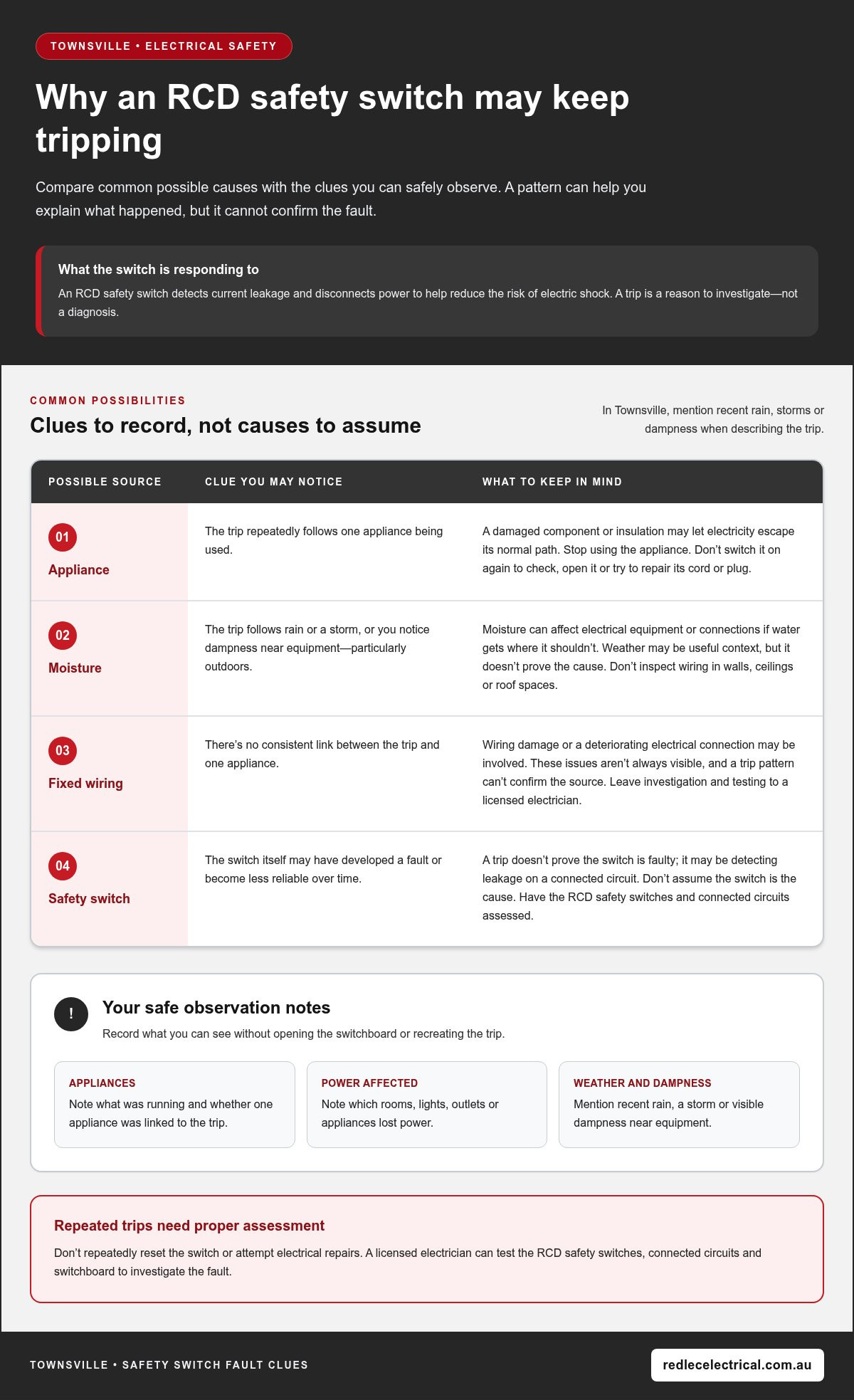
If you’re asking why does my safety switch keep tripping, don’t assume there’s only one possible cause. A fault may involve a plug-in appliance, fixed wiring, moisture-affected equipment or the safety switch itself. The pattern can give an electrician useful context, but it can’t confirm what needs repair. In Townsville, recent rain or humidity may be worth mentioning, but it doesn’t prove that weather caused the trip.
Could an appliance be causing the safety switch to trip?
An appliance can develop an internal fault even when its casing looks intact. A damaged component or insulation may allow electricity to escape its normal path, causing the safety switch to trip while the item is in use. If you notice a repeated link to one appliance, stop using it rather than switching it on again to check. Don’t open the appliance or try to repair its cord or plug.
A trip that repeatedly follows one appliance may point towards an appliance fault, while a trip with no consistent appliance connection may also involve fixed wiring. Neither pattern proves the source, so don’t treat timing as a diagnosis. An electrician can assess the appliance and relevant circuit safely.
Can moisture or an electrical fault cause repeated trips?
Moisture can affect electrical equipment or connections if water gets where it shouldn’t. In North Queensland, note whether a trip followed rain, a storm or visible dampness near equipment, particularly outdoors. This context can help an electrician decide what to assess, but it doesn’t establish that the weather caused the problem. Don’t inspect wiring in walls, ceilings or roof spaces, and don’t open the switchboard.
Other possibilities include wiring damage, a deteriorating electrical connection, or a safety switch that has developed a fault or become less reliable over time. These issues aren’t always visible, and similar trip patterns can have different causes. If a switch trips more than once, have it assessed rather than assuming it’s faulty or simply resetting it.
Your observations can help an electrician narrow down where to look, but they can’t reliably distinguish an appliance fault from a wiring or switchboard issue. Without recreating the trip, note whether one appliance was in use, whether several items were running and whether rain or dampness was present. Leave testing and repairs to a licensed electrician, who can assess the RCD safety switches and connected circuits. If the cause is unclear, electrical fault-finding in Townsville can help identify the issue through a professional assessment.
What the timing and pattern of a safety switch trip can tell you
The timing of a trip can help you give a clearer account of what happened, but it can’t identify the fault by itself. If you’re asking, “Why does my safety switch keep tripping?”, note what was running, which rooms lost power and whether anything unusual happened beforehand. Treat these details as clues for an electrician, not as a reason to test appliances or wiring yourself.
What if it trips when you use one particular appliance?
If a trip follows use of the same appliance, record its name and what it was doing just before the power cut out. Note whether it was starting, heating, washing or had been running for a while. This pattern may help an electrician decide whether the appliance or its circuit needs inspection, but it doesn’t prove which is at fault. Don’t reconnect it repeatedly to reproduce the trip.
| When the trip happens | What to record |
|---|---|
| After using one appliance | Appliance, task it was performing and approximate timing. |
| While several appliances are in use | What was operating and which rooms or outlets lost power. |
| After rain or a storm | When the weather occurred and any dampness you can see safely. |
| With no obvious trigger | Time, affected areas, what was running and whether the trip has happened before. |
Several appliances running at once is useful context, not proof of an overload or another particular fault. Likewise, a trip after one appliance starts doesn’t confirm that the appliance caused it. Note the sequence and let electrical testing establish what’s happening.
What if it trips after rain or with no clear pattern?
In Townsville, add recent heavy rain or storm exposure to your notes, along with any visible dampness near electrical equipment. Don’t assume the weather caused the trip, and don’t inspect walls, roof spaces or switchboard interiors. If there’s no clear pattern, record the affected rooms, any recent electrical work and what was in use. Intermittent faults can have several possible causes.
If trips affect different areas or keep returning without an obvious trigger, an electrician can assess the RCD safety switches, connected circuits and switchboard. The switchboard’s condition is one part of that assessment, not something trip timing can determine. If you’re concerned about its age or condition, Townsville switchboard upgrades may be relevant. Keep your notes handy for the electrician’s fault-finding.
What to do safely when your safety switch keeps tripping
When power cuts out, focus first on people’s safety, not on restoring every circuit straight away. Follow this sequence:
- Pause and assess from a safe position. Keep children and pets away from the switchboard and any electrical equipment that may be affected.
- Leave the switchboard closed. Use only its normal visible controls if there are no warning signs. Don’t remove covers, force a switch or attempt repairs.
- Stop if anything looks or smells unsafe. Don’t approach electrical equipment if you notice smoke, sparks, a burning smell, unusual heat, exposed wiring or water nearby.
- Arrange professional help. If the switch won’t stay on or keeps tripping, leave it alone and have a licensed electrician investigate.
If the power is out in a dark area, use a torch rather than a candle. Don’t touch equipment that may be affected by water, and don’t try to move or unplug anything if doing so would bring you close to a hazard. Keeping a safe distance is safer than trying to find the fault yourself.
What can you check without opening the switchboard?
Limit checks to what you can see from a safe position. Look for visible smoke, sparks or damage, and whether the switchboard’s exterior appears affected. Don’t touch a hot surface, exposed wiring or electrical equipment near water. If you’re unsure whether it’s safe to approach, step away and wait for professional help.
When should you stop using the circuit and get help?
Stop and seek urgent assistance if you see smoke or sparks, smell burning, notice unusual heat or find water near electrical equipment. Keep others away too. Don’t try to restore power or handle the affected equipment. For warning signs and safe next steps, read the Townsville electrical emergency guide.
If there are no immediate danger signs but the switch continues to trip, arrange electrical fault-finding rather than trying to manage the problem through the switchboard. Redlec Energy Solutions provides electrical services in Townsville to investigate recurring faults. Contact Redlec Energy Solutions for electrical assistance to discuss the issue.
When a Townsville electrician should investigate repeated safety switch trips
Arrange an electrician’s assessment if trips keep recurring, the switch won’t stay on or you can’t identify a clear trigger. The aim is to investigate the cause rather than keep restoring power without knowing what’s happening. You don’t need to diagnose it first. Notes about the pattern, affected areas and what was running can help the electrician decide where to begin.
What can professional electrical fault-finding involve?
A licensed electrician can assess the RCD safety switches, relevant circuits and connected equipment. Depending on the findings, the assessment may also involve checking the switchboard. The checks depend on the situation, so there isn’t one fixed process for every trip.
Electrical safety testing can help investigate a fault by assessing relevant parts of the electrical installation. This is different from trying to reproduce the trip at home: leave testing and repairs to the electrician. The findings can guide what needs attention next, rather than assuming the switch, appliance or wiring is at fault before assessment.
How Redlec can help with a recurring electrical fault
For a recurring fault in Townsville, Redlec can professionally assess the affected circuits, RCD safety switches and switchboard. A switchboard upgrade should only enter the discussion if an inspection identifies a relevant issue. A repeated trip on its own isn’t enough to determine that an upgrade is needed. If the assessment raises a switchboard concern, the Townsville switchboard upgrade guide provides further context.
Before the electrician attends, share the trip pattern and any relevant observations, such as which appliances were operating or whether the problem followed rain. In Townsville, mention possible moisture exposure as context without assuming it caused the fault. Keep switchboard covers closed and leave electrical testing to the professional.
Redlec provides electrical services in Townsville to help investigate recurring faults. An assessment can establish what should happen next.
Take the next step towards dependable power
Repeated interruptions can make it tempting to treat each trip as a temporary inconvenience. Instead, use the disruption as a prompt to have the fault assessed. If you’re still asking, “Why does my safety switch keep tripping?”, you don’t need to pinpoint the cause before seeking help. A clear account of what happened is a useful starting point.
For Townsville households, an assessment can help move you from uncertainty towards a practical next step. Redlec provides electrical safety testing, electrical services, switchboard upgrades and emergency electrical repairs. The right support depends on what the electrician finds, so don’t assume a particular repair or upgrade is needed before the system is assessed.
If the trips continue, don’t let repeated resets become your routine. Contact Redlec for help with a recurring electrical fault and arrange a professional assessment.
Frequently Asked Questions
Why does my safety switch trip when it rains?
Rain may be relevant if moisture reaches outdoor electrical equipment or connections, but a trip after rain doesn’t prove water caused it. In Townsville, note when the rain occurred and whether the trip followed soon after or happened later. If you can see dampness from a safe distance, record its location. Don’t touch wet equipment or investigate wiring. Share your observations with a licensed electrician.
Can one faulty appliance keep tripping a safety switch?
Yes, a fault inside one appliance can cause a safety switch to trip, sometimes only while the appliance is operating. A damaged cord or unusual appliance behaviour is useful information to report, but a normal appearance doesn’t rule out an internal issue. Stop using the appliance if you suspect a fault. Don’t repeatedly switch it on to see whether it triggers another trip.
Is it safe to keep resetting a tripping safety switch?
No. Repeated trips are a reason to stop resetting the switch and have the cause investigated. Don’t hold the switch on or bypass its protection. If it trips again after a reset, leave it alone and arrange help from a licensed electrician. If you notice smoke, sparks, a burning smell, unusual heat or water near electrical equipment, keep clear and treat the situation as urgent.
What is the difference between a safety switch and a circuit breaker?
A safety switch responds to current leaking from its intended path, while a circuit breaker responds to other circuit faults, such as excessive current. Some switchboard devices combine both functions, so labels may not tell the full story. Use visible labels and controls only. Don’t remove the switchboard cover to identify a device. An electrician can check which protection is installed and what has operated.
Can a safety switch become faulty or wear out?
Yes, a safety switch can develop a fault or become less reliable over time. However, a trip alone doesn’t show that the switch has failed. An appliance or circuit fault can also prompt it to operate. A licensed electrician can assess the switch and related circuits rather than replacing parts based on guesswork. Don’t open the switchboard or try to test the device by handling its wiring.
What should I do if my safety switch will not stay on?
Don’t force it or keep trying to reset it. Leave the control alone and arrange for a licensed electrician to investigate why it won’t stay on. You can note which rooms have lost power and what was operating before the trip, provided you can do so safely. If there’s smoke, heat, sparks, a burning smell or nearby water, keep clear and seek urgent assistance.
Does a tripping safety switch mean I need a switchboard upgrade?
No, a trip by itself doesn’t mean a switchboard upgrade is needed. The cause may be elsewhere, and an electrician needs to assess the installation before recommending work. If an inspection identifies a switchboard issue, an upgrade may be considered as a next step. In Townsville, describe the recurring trips clearly so the electrician can assess the relevant equipment and switchboard instead of assuming the remedy.