You’ve just opened your latest electricity bill, expecting the usual credit from the North Queensland sun, but the total is hundreds of dollars higher than it should be. You head out to the side of the house and find your inverter staring back at you with a blinking red light and a cryptic error code that looks like a foreign language. It’s incredibly frustrating when the technology you bought to save money starts costing you instead. We know that between the relentless Townsville humidity and the salt air, our local systems work harder than almost anywhere else in Australia.
Finding a specialist for solar inverter repair townsville shouldn’t feel like a gamble or a hunt for a sparky who disappears the moment there’s a problem. This guide will show you exactly how to decode those system faults, decide if a repair or a full replacement is your best financial move, and how to protect your investment from our harsh tropical climate. We’ll also look at the 2026 inspection costs and how to ensure your current setup is ready for a battery upgrade to keep your bills low for the long term.
Key Takeaways
- Learn how Townsville’s humidity and salt spray impact your electronics and how to spot early signs of corrosion before they cause a total system shutdown.
- Understand how to decode those frustrating red lights and error codes to determine if you need an expert for solar inverter repair townsville.
- Master the “Rule of Threes” to decide if repairing your ageing inverter is a smart move or if upgrading to a modern 6.6kW system offers better long-term value.
- Discover why an October health check is the best way to prepare your system for the North Queensland storm season and prevent costly roof damage.
- See why CEC accreditation and local Townsville expertise are non-negotiable for keeping your warranties intact and your home safe.
Common Solar System Faults in the Townsville Climate
Living in the Tropics means our electrical gear takes a beating. While a photovoltaic system is designed to sit in the sun, the specific cocktail of high heat and relentless moisture in Townsville can lead to premature failure. If you’ve noticed your energy production dropping, it’s often due to environmental wear that standard warranties don’t always account for. This is why solar inverter repair townsville services often focus as much on environmental protection as they do on electrical fixes.
Humidity and Inverter Failure
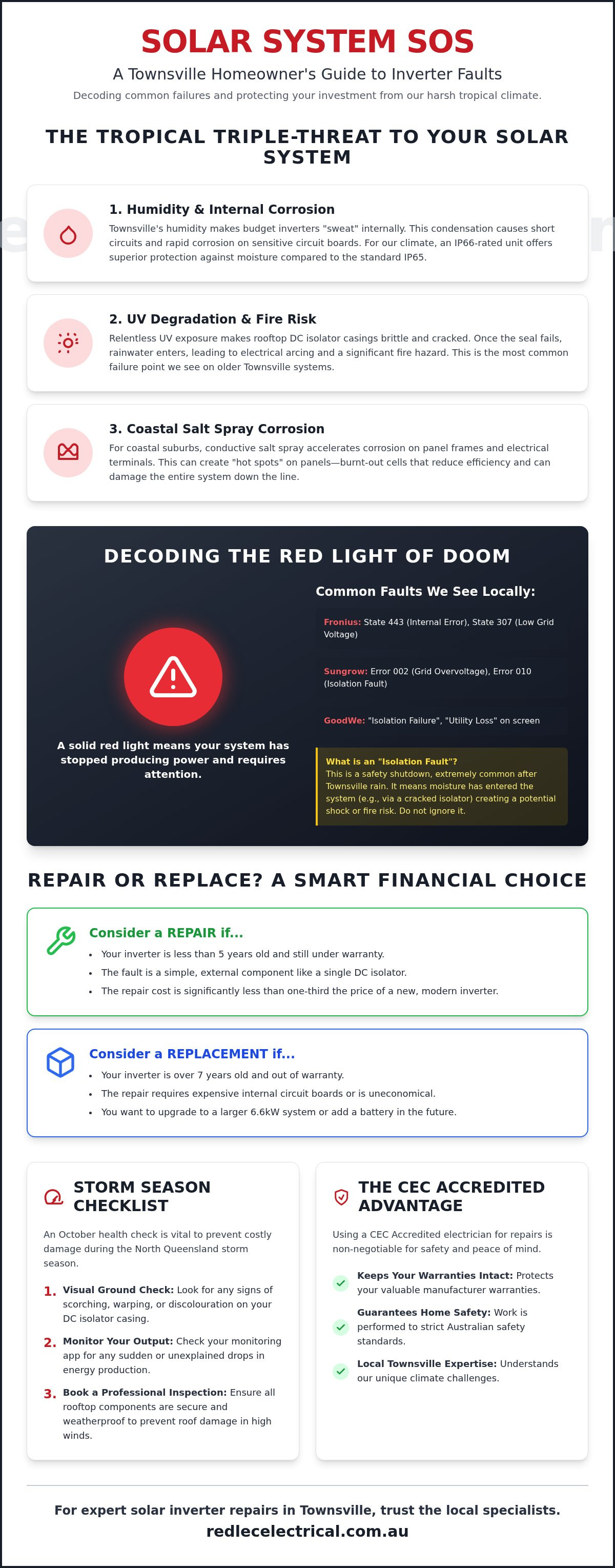
Budget inverters are notorious for “sweating” in our climate. When warm, moist air gets inside a poorly sealed housing, it condenses as the unit cools down at night. This internal moisture causes short circuits and rapid corrosion on the sensitive circuit boards. While an IP65 rating is the industry standard, we often recommend IP66 rated equipment for our local conditions to provide that extra level of protection against moisture ingress. Intense North Queensland summers create extreme thermal stress that causes internal components to expand and contract rapidly, eventually leading to microscopic fractures in the circuitry.
The Danger of Perished DC Isolators
The rooftop DC isolator is currently the most common failure point we see across Townsville. Constant UV exposure causes the plastic enclosures to become brittle and eventually crack. Once the seal is gone, rainwater gets in, leading to internal arcing and, in extreme cases, a significant fire risk. The 2026 safety standards have tightened requirements for these components, but many older systems still have “ticking time bomb” isolators on the roof. You should look for any signs of scorching, warping, or discolouration on the plastic casing during a safe visual check from the ground.
For those living in coastal suburbs like Pallarenda or Bushland Beach, salt spray adds another layer of trouble. Salt is highly conductive and corrosive; it eats through the aluminium frames of panels and corrodes the electrical terminals. This often leads to “hot spots,” where a single cell in a panel fails and begins to overheat. You can sometimes spot these as small brown burnt marks or bubbles on the surface of the panel. Catching these early prevents the fault from travelling down the line and damaging your inverter. Dealing with these issues promptly ensures your system stays efficient and safe for years to come.
Troubleshooting Your Solar Inverter: Error Codes and Red Lights
Seeing a solid red light on your inverter display is a clear signal that your energy production has ground to a halt. While it’s tempting to ignore it and hope it resets itself, a red light usually indicates a fault that requires attention to prevent long-term damage. In many cases, these errors are the system’s way of protecting itself from the unique electrical stresses we face in North Queensland. If the light stays on after a simple reboot, it is time to look into professional solar inverter repair townsville to get your bills back under control.
Different brands use different “languages” to tell you what’s wrong. Here are some common codes we see across the region:
- Fronius: Look for “State 443” (internal component error) or “State 307” (low grid voltage).
- Sungrow: Errors like “002” often point to grid overvoltage, while “010” is a classic isolation fault.
- GoodWe: You will often see “Isolation Failure” or “Utility Loss” displayed on the screen.
What an Isolation Fault Really Means
Isolation faults, or “ISO faults,” are incredibly common after a typical Townsville downpour. Your inverter constantly monitors the insulation of the wiring. If moisture enters a cracked DC isolator or a perishing cable, the system detects a “leak” to the ground and shuts down to prevent a fire or electrocution. Never attempt to bypass this error. We use specialised insulation resistance testers to pinpoint exactly where the moisture is getting in without needing to pull apart your entire roof.
When to Call a Professional Sparky
Some errors, like “Grid Overvoltage,” might be caused by Ergon’s network voltage being too high in your street. However, recurring red lights often point to internal hardware failure or dangerous arc faults. Following Best Practices for Operation and Maintenance is the best way to avoid these surprises. If you are unsure about the state of your system, a quick safety check from a local electrician can provide peace of mind.
The startup sequence is the process where your inverter checks the health of the grid and the solar panels before engaging. Once you turn the system on, the unit typically waits for sixty seconds to ensure the voltage is stable. You will see a blinking green light or a ‘testing’ message on the screen during this vital safety period.
If you want to try a safe “hard reset” at home, follow these steps exactly:
- Turn off the “Solar Supply Main Switch” located in your main switchboard.
- Turn off the “PV Array DC Isolator” usually found next to or underneath your inverter.
- Leave the system completely off for at least 60 seconds.
- Turn the “PV Array DC Isolator” back to the ON position.
- Turn the “Solar Supply Main Switch” back to the ON position.
Solar Repair vs. Replacement: Calculating Your ROI in 2026
Deciding whether to patch up an old system or start fresh is the most common dilemma we see. When you’re faced with a fault, the immediate goal is usually to stop those high electricity bills from returning. However, finding the right path for solar inverter repair townsville often involves weighing up the age of your hardware against the falling cost of new technology. We use a simple “Rule of Threes” to help our customers make a logical, stress-free choice. You should look at the age of the system, the total cost of the repair, and the status of your remaining warranty.
If your inverter is over eight years old, it’s likely approaching the end of its reliable life. While a minor fix might get it humming again today, you could find yourself paying for another service call in six months. Modern 2026 inverters are up to 15% more efficient than models from a decade ago, meaning they squeeze more power out of every sunrise. When Choosing and using a photovoltaic system for your home, the decision often comes down to long-term value rather than the cheapest immediate fix. Upgrading an old 3kW system to a modern 6.6kW setup is frequently the better financial move because it maximizes your available roof space and dramatically shortens your payback period.
When a Repair Makes Financial Sense
Repairing your system is usually the best move if your hardware is less than five years old and still covered by a manufacturer’s warranty. In these cases, the fault is often something simple like a blown fuse, a perished cable, or a loose connection caused by local wildlife. These are quick, affordable fixes that restore your system to full health without the need for a total overhaul. Before you decide, it’s a good idea to run through our Solar Power Systems Checklist to see if your current setup is still up to standard for 2026.
The Case for a Full System Upgrade
Technology has moved fast. If your Townsville block has since grown some shady trees, moving from a traditional string inverter to micro-inverters can significantly boost your daily output. An upgrade also allows you to add solar battery storage to protect your home from rising grid prices and keep power flowing during North Queensland outages, which is the ultimate way to beat rising grid prices. New systems also come with Tier 1 panels that feature 25-year product warranties, giving you decades of peace of mind. We always recommend using original equipment manufacturer (OEM) parts for any repairs, as “cheap” non-genuine alternatives often fail under the intense North Queensland heat, leading to even more expensive issues down the road.
Preparing Your Solar for the North Queensland Storm Season
Townsville locals know that October isn’t just about the heat; it’s the final window to secure your home before the storm season kicks in. While many people focus on clearing the yard, your rooftop power station needs equal attention. A proactive health check ensures that your mounting hardware hasn’t loosened over the dry season and that your electrical components are ready for the inevitable lightning strikes. If you wait until a cyclone is on the horizon, finding a specialist for solar inverter repair townsville becomes much harder as demand spikes.
Structural integrity is the backbone of a safe system. We often find that years of vibrating in the wind can loosen the mid-clamps and end-clamps that hold your panels in place. If these fail during a high-wind event, your panels can become dangerous projectiles. Equally important are the roof penetrations; if the sealant has perished, a heavy downpour will find its way into your ceiling space. During the NQ summer, dry leaves and bird nests trapped under your panels become a serious fire hazard. The heat trapped in that small gap can reach extreme temperatures, making debris management a critical safety task.
Your switchboard plays a vital role in protecting your inverter from atmospheric surges. If a surge does take out your electronics, a prompt solar inverter repair townsville service can often salvage the unit if the damage is confined to the input protection stage. Modern systems should include:
- Type 2 Surge Protection Devices (SPDs) to divert high-voltage spikes from the grid.
- Correctly labelled solar supply main switches for fast emergency isolation.
- Weatherproof enclosures that haven’t been degraded by the sun or humidity.
Cyclone Resilience and Structural Checks
Townsville is classified as Wind Region C, which requires specific installation standards to withstand cyclonic force. Your mounting system must be rated for these pressures to remain insurance-compliant. If you hear a “panel rattle” during a stiff breeze, it is a red flag that your mounting hardware needs tightening immediately. If your system does suffer damage from hail or flying debris, do not attempt to touch the panels yourself. Damaged panels can still produce high-voltage electricity and pose a severe shock risk even if the glass is shattered.
Post-Storm Inspection Checklist
Once the weather clears, a quick visual check from the ground is your first line of defence. Look for shifted panels or cracked glass that might lead to water ingress. Checking your monitoring app immediately after a blackout is vital; if the grid is back but your system stays offline, there may be a surge-related fault. While you can see major damage, professional testing is required to identify micro-cracks. These tiny fractures in the silicon cells are invisible to the eye but can cause hot spots and eventual system failure if left unaddressed.
Don’t leave your safety to chance this summer. You can book a comprehensive storm-readiness inspection today to ensure your system is bolted down and electrically sound before the first big blow arrives.
Why Choose a CEC Accredited Townsville Electrician for Repairs?
Choosing the right person to work on your rooftop power station is just as important as the hardware itself. When you need a solar inverter repair townsville, you aren’t just looking for someone to flick a switch; you need a professional who understands the specific electrical demands of North Queensland. Clean Energy Council (CEC) accreditation is the gold standard for a reason. It ensures your electrician has undergone rigorous training specifically for solar systems and holds an unrestricted electrical licence. Without this accreditation, your manufacturer warranties could be voided, and you might lose eligibility for government rebates if components need replacing.
Local knowledge is our greatest asset. We’ve seen too many Townsville homeowners left stranded by “fly-in-fly-out” installers who offer cheap deals but vanish when the humidity starts causing inverter faults. These national companies often lack the context of our local grid requirements and the aggressive nature of salt air in suburbs like Bushland Beach. A comprehensive solar service should be far more than just a quick wipe down of the panels. It involves testing the insulation resistance of your cables, checking the thermal health of your DC isolators, and ensuring your mounting rails are still cyclone-ready as per the 2026 standards. We focus on these technical details to ensure your solar inverter repair townsville provides a long-term solution rather than a temporary patch.
The Redlec Difference: Local Accountability
Matt and the team at Redlec Energy Solutions take personal pride in every job. We focus on a “right first time” approach because we live and work in this community too. We prioritise your home’s safety and system efficiency over making a quick sale on new parts you might not need. Our process includes detailed documentation of all repairs, which is essential if you ever need to make an insurance claim after a storm or a warranty claim with a manufacturer. We make sure your system isn’t just working; it’s optimised for the long term and meets all current Australian safety regulations.
Booking Your Solar Health Check
Getting your system back to peak performance is straightforward. When you call, try to have the age of your system, the inverter brand, and your latest Ergon bill handy. This information helps us diagnose potential issues before we even arrive at your door. Once the job is done, we provide a certified electrical safety certificate, giving you the peace of mind that your investment is secure and your household is protected. Don’t let your solar investment go to waste. Contact Redlec for a professional solar repair today and ensure your home stays powered by the sun safely and efficiently.
Protect Your Home and Maximise Your Solar Savings
You’ve invested in solar to take control of your household energy costs, and keeping that system in peak condition is the best way to ensure those savings continue. We’ve looked at how our unique tropical humidity can impact sensitive electronics and why understanding those cryptic error codes is the first step toward a resolution. Whether you’re facing a simple fix or deciding if it’s time for a full system upgrade, making an informed choice now prevents the “tropical tax” of premature failure caused by the North Queensland heat.
When you need a solar inverter repair townsville, you deserve a partner who understands the local climate and stands by their work. As a Townsville owned and operated business with CEC Accredited Installers, we pride ourselves on providing dependable support when you need it most. We even offer 24/7 emergency support to give you total peace of mind during our unpredictable storm seasons.
Book Your Townsville Solar Health Check with Redlec Today to restore your system’s efficiency and keep your electricity bills as low as possible. We’re here to help you get the most out of the North Queensland sun for years to come.
Frequently Asked Questions
How much do solar repairs typically cost in Townsville?
The cost of solar repairs varies significantly depending on whether you need a minor component fix or a major hardware replacement. Minor issues like replacing a perished DC isolator or a blown fuse are relatively affordable. However, replacing a full inverter is a larger investment. Because every home setup is different, it’s best to get a specific quote from a local expert who can assess your system’s age and brand.
Can I fix my own solar inverter if it shows a red light?
No, you should never attempt to open or repair a solar inverter yourself. DIY solar repairs are illegal in Australia and pose a severe risk of electrocution from high-voltage DC electricity. While you can perform a safe system reset using the shut-down procedure, any internal work must be carried out by a CEC accredited electrician to ensure your safety and keep your warranties intact.
How do I know if my solar panels are actually working?
The most effective way to monitor your panels is through your system’s dedicated smartphone app or by checking the “Power Produced” data on your inverter’s screen. If you notice a sudden, unexplained drop in your daily generation or your Ergon bill credits have disappeared, it is a clear sign of a fault. A professional solar inverter repair townsville specialist can use specialised tools to test the output of every individual string.
Does home insurance cover solar panel repairs after a storm?
Most Australian home insurance policies treat solar panels as part of the building, meaning they are typically covered for storm-related damage. This usually includes impacts from hail, lightning strikes, or flying debris during a cyclone. It’s important to check your specific policy for “fusion cover,” which protects the electrical motors and components within your inverter against power surges and internal failures caused by external events.
Why is my solar inverter making a loud buzzing noise?
A faint hum is normal during peak production, but a loud buzzing or grinding noise usually indicates a failing internal cooling fan or a loose transformer. In the intense Townsville heat, these fans work overtime to keep the electronics cool and can eventually wear out. If the noise is loud enough to be heard from inside the house, you should have it inspected before the unit overheats and fails.
Is it worth repairing a 10-year-old solar system?
It is often more cost-effective to replace rather than repair a system that has reached the ten-year mark. Most string inverters have a natural lifespan of 10 to 15 years in our harsh conditions. If a repair costs more than 40% of the price of a new unit, upgrading to a modern system is the smarter financial move. New technology offers better efficiency and comes with fresh warranties for long-term peace of mind.
What is the difference between a solar repair and a solar service?
A solar service is a proactive health check designed to prevent problems before they happen, while a repair is a reactive fix for a system that has already failed. During a service, we clean the panels, tighten mounting hardware, and test electrical seals to ensure everything is safe. A repair focuses on diagnosing a specific fault, such as a red light error, to restore your system’s energy production.
How often should I have my solar system professionally inspected in NQ?
We recommend a professional safety and performance inspection every two years for homes in North Queensland. Our extreme UV levels and humidity cause plastics and seals to degrade much faster than in cooler climates. Regular inspections allow us to catch small issues like cracked isolator covers or bird nests before they lead to an expensive solar inverter repair townsville or create a fire risk on your roof. If you are considering adding solar battery storage to maximise your energy independence in Townsville, a current inspection also ensures your existing system is compatible and ready for the upgrade.