Did you know that by the time you actually smell smoke in a traditional North Queensland high-set home, it might already be too late to reach the exit safely? It’s a sobering thought, but it’s exactly why the state government has mandated a new safety standard for every household. Most Townsville locals we speak with are feeling the pressure of the 1 January 2027 deadline. You might be worried about the potential cost of rewiring an older home or simply confused about which devices actually meet the Australian Standard AS 3786-2014.
We understand that you want a solution that protects your family without the frustration of nuisance alarms every time the humidity spikes. This guide provides the clear roadmap you need for professional smoke alarm installation. We’ll show you how to navigate the new laws, why interconnected photoelectric alarms are a non-negotiable for safety, and how to ensure your system is certified to satisfy your insurance provider. By the end of this article, you’ll know exactly how to bring your property up to code well before the deadline arrives.
Key Takeaways
- Understand why 1 January 2027 is a critical deadline for every Townsville homeowner to meet the new Queensland safety standards.
- Learn why photoelectric technology is superior for detecting slow-smouldering house fires and how it reduces nuisance alarms in our humid tropical climate.
- Discover the legal requirements for professional smoke alarm installation, including the mandatory interconnection of all devices across your property.
- Identify the exact locations where alarms must be placed on every level and in every bedroom to ensure your family is alerted instantly.
- Explore how modernising your switchboard and safety switches works alongside your alarms to provide a complete shield of electrical protection.
Understanding the Queensland Smoke Alarm Legislation: The 2027 Deadline
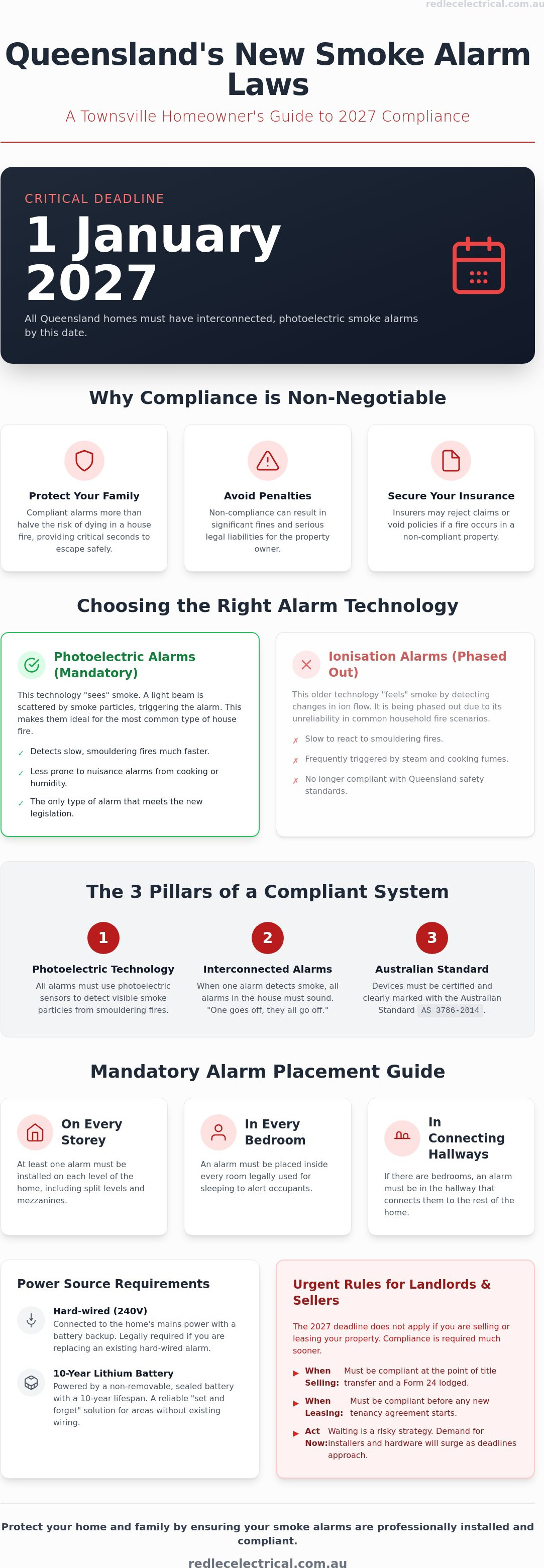
Queensland’s fire safety landscape is changing, and the 1 January 2027 deadline is closer than it appears. By this date, every domestic dwelling in the state must be equipped with interconnected photoelectric smoke alarms. This isn’t just a helpful suggestion; it’s a legal mandate designed to significantly increase your chances of a safe escape. Statistics show that the risk of dying in a house fire is more than halved when compliant alarms are present. For many locals, booking a professional smoke alarm installation is the most reliable way to ensure their home meets these strict new standards without the guesswork.
If you’re living in a classic Townsville Queenslander or a modern suburban build, the rules remain the same. However, the consequences of ignoring them are steep. Beyond the obvious danger to your family, non-compliance can lead to hefty fines and serious legal liabilities. Perhaps most concerning for homeowners is the impact on insurance. If a fire occurs and your system doesn’t meet the legislative requirements, your insurer may have grounds to reject your claim or void your policy entirely. It’s a high price to pay for a task that a local expert can certify in a single visit. For a comprehensive breakdown of every requirement and penalty, our QLD smoke alarm legislation 2027 homeowner guide covers exactly what Townsville properties must have in place before the deadline.
The Three Pillars of a Compliant System
To be legally compliant, your system must rest on three technical requirements. First, the alarms must use photoelectric technology. When comparing photoelectric vs ionisation sensors, photoelectric versions are far superior at detecting the smoky, smouldering fires common in homes. Second, the devices must be interconnected. This “one goes off, all go off” rule ensures that a fire starting in the garage will immediately alert someone sleeping at the other end of the house. Finally, every device must be marked with the Australian Standard AS 3786-2014. If your hardware lacks this specific certification, it simply isn’t compliant.
Deadlines for Landlords and Sellers
While owner-occupiers have until 2027, landlords and sellers in Townsville are already under pressure. Any property being sold or leased must meet these requirements before the new tenancy starts or at the point of title transfer. For sellers, a Form 24 must be lodged to confirm the property is up to code. Waiting until the end of 2026 to organise your smoke alarm installation is a risky strategy. As the deadline nears, the demand for licensed sparkies will surge, and hardware shortages are likely. Getting ahead of the curve now provides peace of mind and ensures your property remains a safe, legal asset.
Choosing the Right Hardware: Photoelectric vs Ionisation
Selecting the correct hardware is the first step toward a safer home. Under the Queensland Smoke Alarm Legislation, ionisation alarms are being phased out in favour of photoelectric technology. While ionisation sensors were once common, they often struggle to detect the smoky, smouldering fires that account for most household fatalities. Photoelectric sensors work by “seeing” visible particles of combustion. They use a light source and a sensor; when smoke enters the chamber, it scatters the light toward the sensor, triggering the alarm much faster than older tech. This early warning is vital for giving your family those extra seconds needed to evacuate.
The power source is another critical decision. Modern standards move away from the old 9V alkaline batteries that chirp every year. Today, you’ll choose between alarms hard-wired to your home’s 240V power supply or those powered by a non-removable 10-year lithium battery. If you currently have hard-wired units, the law requires they be replaced with new hard-wired versions. For other areas of the home, a 10-year lithium unit provides a “set and forget” solution that remains reliable for the entire lifespan of the device.
Why Quality Matters in the Tropics
Townsville’s climate presents unique challenges for smoke alarm installation. High humidity and salt air can wreak havoc on cheap, entry-level sensors, leading to those dreaded 2 AM “nuisance alarms” during the wet season. Professional-grade hardware is designed with the tropics in mind. Look for units featuring advanced bug screens and dust protection. These features prevent small insects or fine dust from entering the sensing chamber and triggering a false alert. Investing in higher-quality hardware now prevents the frustration of a system that fails or malfunctions when the North Queensland weather turns. If you’re unsure which models handle the heat best, our team can help you select the most reliable electrical services and hardware for our local conditions.
Interconnection Methods: Wired vs Wireless
Interconnection is the “brain” of your safety system. When one alarm detects smoke, every alarm in the house sounds. There are two main ways to achieve this. Hard-wired interconnection involves physically running cables between units, which is the gold standard for new builds or major renovations. However, for many of our beautiful older “Queenslanders,” running new wires through tight ceiling spaces or asbestos-containing materials can be difficult. This is where Radio Frequency (RF) wireless interconnection shines. These units “talk” to each other via a stable mesh network, providing a compliant, interconnected system without the need for extensive rewiring. In complex, multi-level homes, we often use a hybrid approach to ensure every corner of the property is covered.
Strategic Smoke Alarm Placement for Townsville Homes
Correct placement is just as vital as Choosing the Right Hardware. Even the most advanced sensor is useless if it’s tucked away in a “dead air” space where smoke cannot reach it. In a typical home, smoke rises and then spreads along the ceiling. If an alarm is placed too close to a corner or the very peak of a cathedral ceiling, it sits in a pocket of stagnant air that smoke might bypass for several critical minutes. To avoid this, we ensure sensors are installed at least 300mm away from corners and light fittings, ensuring they catch the first hint of trouble.
Legal compliance requires a smoke alarm installation on every storey of the home. This includes levels used for living, sleeping, or even storage if they are enclosed. We also have to consider the “path of travel” from the bedrooms to the exits. If your hallway is longer than a few metres, multiple alarms might be necessary to ensure the siren is loud enough to wake every occupant. Avoiding nuisance triggers is equally important. We never place sensors directly outside a bathroom door where steam can cause a false alarm, or too close to a kitchen stove where burnt toast might ruin your morning.
Placement Guide for High-Set Queenslanders
Townsville’s iconic high-set homes and Queenslanders present specific challenges. These properties often rely on louvres and large windows for cross-ventilation, which is great for our climate but can blow smoke away from a poorly positioned alarm. We focus on placing sensors in the central “hub” of the upper floor while ensuring the lower level is fully protected. If the downstairs area has been built-in for a rumpus room or guest suite, it must have its own interconnected alarms. We also verify that the interconnection signal remains strong through thick timber floorboards, so a fire downstairs triggers the alarms upstairs immediately.
The Bedroom Mandate
The most significant change in the new legislation is the requirement for an alarm in every individual bedroom. It’s no longer enough to have one in the hallway. This mandate ensures that even if someone sleeps with the door closed and the air conditioner running, they will be alerted the moment smoke is detected anywhere in the house. This interconnected network means the bedroom unit acts as a personal siren for a fire starting in the lounge or kitchen. Once your system is in place, it’s essential to know how to test smoke alarm volume levels across the house to confirm every family member can hear the alert clearly through closed doors.
Professional Installation vs DIY: What You Need to Know
While the temptation to handle home improvements yourself is strong, the law in Queensland is very clear about certain electrical tasks. Any smoke alarm installation involving 240V hard-wired units must be performed by a licensed electrician. This isn’t just a safety recommendation; it’s a legal requirement. If you attempt to wire these units yourself, you risk an electrical fire, personal injury, and the immediate voiding of your home insurance policy. Even for battery-powered units, the complexity of the new interconnection rules means that a professional touch is often the only way to guarantee your system is actually “talking” to itself correctly.
The real challenge lies in the mesh network that links your alarms. Interconnection is the core of the 2027 mandate, ensuring that a fire in the downstairs laundry triggers the alarm in your upstairs bedroom. If these units aren’t synced properly, you lose those vital seconds of early warning. A professional installer doesn’t just mount a bracket; they verify signal strength through walls and floors, ensuring the network is stable and responsive. This level of technical certainty is something a DIY approach simply can’t offer, especially in larger or multi-storey Townsville homes. If you want to understand the full scope of what the QLD smoke alarm legislation 2027 requires before booking an installer, our detailed guide walks through every rule that applies to your property type.
Why the DIY Approach Often Fails
We often see DIY attempts that fall short of the mark. A common mistake is incorrect placement that creates “dead zones” where smoke can’t reach the sensor quickly enough. Another issue is the failure to properly pair wireless RF units. Without a methodical testing process, it’s easy to leave a part of the house isolated from the rest of the system. Additionally, working in the ceiling cavities of older Townsville properties carries the risk of disturbing aged wiring or insulation, which can lead to far more expensive repairs than the initial cost of a professional smoke alarm installation.
The Redlec Installation Process
We take a systematic approach to your family’s safety to ensure nothing is left to chance. Our process is designed to be thorough and transparent:
- Step 1: We conduct a comprehensive home safety audit and placement mapping to identify the most effective sensor locations.
- Step 2: Our team performs the expert installation of high-quality, AS 3786-2014 compliant hardware tailored to your home’s layout.
- Step 3: We carry out system-wide testing to verify that every unit is interconnected and the sirens meet the required decibel levels.
- Step 4: We issue full compliance documentation for your records, providing the proof your insurer needs.
If you want the peace of mind that comes with a certified safety system, our team is ready to help with our professional electrical services and local expertise.
Beyond the Alarm: Complete Electrical Safety for Your Home
A professional smoke alarm installation is a vital step toward protecting your family, but these devices are only one part of a larger electrical ecosystem. Think of your smoke alarms as the warning sirens and your switchboard as the command centre. If your switchboard is outdated or struggling to handle the load of modern appliances, the very system meant to protect you could be at risk. Ensuring your home is truly safe means looking beyond the sensors on the ceiling and evaluating the health of your entire electrical network. Homeowners relying on old ceramic fuses should consider switchboard upgrades in Townsville as a critical companion step to smoke alarm compliance.
Safety switches, or RCDs, play a crucial role in this ecosystem. While smoke alarms alert you to a fire that has already started, a safety switch is designed to prevent a fire from occurring in the first place by instantly cutting power when an electrical fault is detected. In many older Townsville properties, the circuit protection is insufficient for today’s high-power demands. Combining a compliant smoke alarm system with modern RCD protection creates a dual-layered shield for your household.
Our local climate adds another layer of complexity. As we approach the North Queensland storm season, power surges and high humidity can put immense strain on aged components. This is also a great time to consider LED lighting upgrades. Old halogen globes can reach temperatures of over 200 degrees Celsius, posing a significant fire risk if they come into contact with ceiling insulation or dust. Switching to cool-running LEDs is a simple way to reduce fire hazards while lowering your energy bills.
Switchboard Health and Fire Prevention
Does your switchboard still use old-fashioned ceramic fuses? If so, your home is likely overdue for an upgrade. Signs of an overloaded system include frequently tripping breakers, flickering lights, or a faint burning smell near the electrical cupboard. Modern switchboard upgrades provide the stable foundation needed for all your safety devices to function correctly. By installing high-quality circuit breakers and RCDs, you ensure that your home can handle the electrical demands of air conditioning and appliances without compromising safety.
Emergency Support When You Need It
Even with the best hardware, electrical issues don’t always stick to business hours. If your interconnected system triggers in the middle of the night or a storm causes a dangerous fault, you need help fast. Our emergency electrician services provide Townsville families with 24/7 support, ensuring that a steady hand is always available when you need it most. We take pride in being a dependable local partner for everything from routine maintenance to urgent repairs.
Final Checklist: Is your home ready for 2027?
- Are your alarms photoelectric and less than 10 years old?
- Is there a functioning alarm in every bedroom and hallway?
- Are all units interconnected so they sound simultaneously?
- Has a licensed sparky certified your smoke alarm installation?
- Is your switchboard equipped with modern safety switches?
Protect Your Family and Future-Proof Your Home
The 1 January 2027 deadline is more than just a date on the calendar; it’s a vital step toward making our Townsville community safer. By choosing interconnected photoelectric technology and ensuring strategic placement in every bedroom and on every level, you’re providing your family with the earliest possible warning. We’ve seen how the right hardware and professional placement make all the difference in our unique tropical climate, especially when it comes to avoiding those frustrating nuisance alarms during the wet season.
Don’t leave your compliance to the last minute. As 2027 QLD legislation experts, our licensed Townsville electricians are here to guide you through the transition. We provide the technical expertise and rapid 24/7 emergency support you need for total peace of mind. Let’s make sure your smoke alarm installation is certified, compliant, and ready to protect what matters most.
Book Your Townsville Smoke Alarm Compliance Audit Today and take the stress out of your home’s safety requirements. It’s a simple, proactive step that ensures your property remains a secure sanctuary for years to come.
Frequently Asked Questions
Do I really need to replace my smoke alarms if they are still working?
Yes, you must replace them if they are more than 10 years old or if they are the older ionisation type. All smoke alarms have an expiry date because their sensors lose sensitivity over time. To meet the new QLD legislation, your alarms must be photoelectric and less than a decade old to ensure they function correctly when it matters most.
What is the difference between hard-wired and 10-year lithium battery alarms?
Hard-wired alarms connect directly to your home’s 240V power supply and include a battery backup, while 10-year lithium alarms run on a sealed, non-removable battery. If your home already has hard-wired units, the law requires you to replace them with new hard-wired versions. Lithium battery units are a great solution for adding required alarms to bedrooms without the need for new cabling.
How many smoke alarms do I need in a standard three-bedroom Townsville home?
You will typically need at least four alarms for a single-storey three-bedroom house. The law requires one alarm in every bedroom and at least one in the hallway that connects them. If your home has multiple levels, such as a high-set Queenslander with a built-in downstairs area, you must have at least one alarm on every storey.
Can I install interconnected wireless smoke alarms myself?
You can install 10-year battery-powered wireless units yourself, provided you aren’t replacing an existing hard-wired alarm. However, many locals choose a professional smoke alarm installation to guarantee the wireless mesh network is stable. A licensed sparky ensures that when one alarm sounds, every other unit in the house triggers instantly, regardless of the distance between them.
What happens if I don’t meet the January 2027 smoke alarm deadline?
Missing the deadline leaves you open to legal fines and makes it difficult to sell or lease your property. More importantly, non-compliance is a major safety risk for your family. If a fire occurs in a non-compliant home, you also face the very real possibility of your insurance provider rejecting your claim, leaving you with no financial support for repairs.
Why do my smoke alarms keep going off for no reason in summer?
Townsville’s high humidity and tiny insects are the usual culprits. Moisture can build up inside cheaper sensors during the wet season, while small bugs are often attracted to the warmth of the internal electronics. Both factors cause nuisance alarms. Investing in high-quality hardware with dust and bug screens is the most effective way to prevent these false alerts.
Does my insurance cover me if my smoke alarms aren’t compliant?
It is unlikely that you would be fully covered. Most home and landlord insurance policies require the property to be maintained in accordance with all state safety regulations. If an investigation finds that your smoke alarms didn’t meet the 2027 standards, the insurer may argue that you failed to provide a safe environment, potentially voiding your entire policy.
What is the specific Australian Standard for smoke alarms?
The specific standard is AS 3786-2014. When you’re buying new hardware, you must check the packaging or the unit itself for this number. This certification ensures the device has been rigorously tested to detect smoke effectively and provide a loud enough siren to wake residents in an emergency.